A letter of intent with very large numbers
Tay Ninh province has received one of the boldest digital infrastructure proposals in Vietnam this year. A consortium of Saigon Telecommunications and Technologies Corporation, known as SAIGONTEL, World Harmony Co. Ltd, known as WVU, and SAIF Eagle II Investment Co. submitted a letter of intent to the province at its investment promotion conference on 28 August 2026.
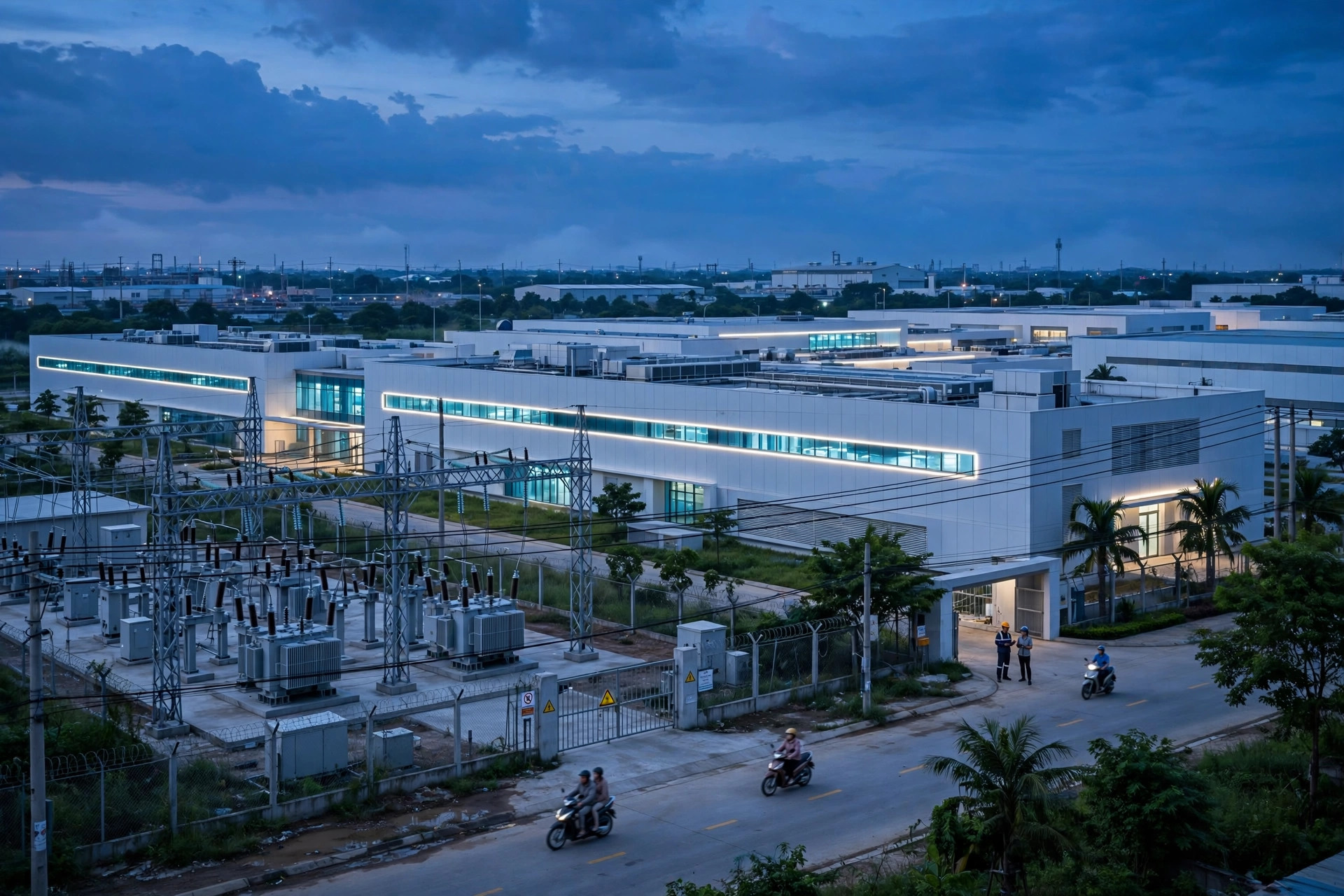
The proposed AI data centre complex covers about 20 hectares at Nam Tan Tap Industrial Park in Tan Tap commune. The design target is a total IT load of 200 MW at full build. Phase one alone would provide 100 MW, with investment of about USD 3.5 billion. Those are not incremental figures. A load of 100 MW belongs in conversations with power planners as much as with technology executives, and 200 MW would place the site among the most power hungry facilities in the country. Artificial intelligence has changed what a data centre is. An AI facility trains and runs models that consume large amounts of electricity, produce intense heat and depend on networks that move data quickly across borders. The Tay Ninh proposal is therefore two projects in one, a computing project and an energy project, and the second may decide the fate of the first.
Built for AI heat and AI density
The consortium is targeting Tier IV standard, which targets 99.999 percent uptime. In plain terms, the design goal is a facility with enough redundancy that maintenance and faults should not bring services down. Customers paying for AI computing at scale expect that resilience, because an interruption can halt training runs and damage confidence.

Cooling is equally central. The design is intended for AI workloads and includes direct liquid cooling and immersion cooling, enabling densities up to 150 kW per rack. Traditional air cooling struggles at such densities. Bringing liquid closer to the chips, or immersing components in a cooling fluid, allows far more computing power in a given space, but it also raises demands on building design, energy management, maintenance skills and safety procedures.
Connectivity forms the third leg. The project targets international latency below 18 milliseconds to Singapore, a regional hub for finance, cloud services and submarine cable connections. A site in Tay Ninh that can reach Singapore that quickly can present itself as part of a regional network, not an isolated facility serving only the domestic market.
The real negotiation is about power
Servers can be ordered and racks can be shipped. Electricity at the scale of 100 MW for phase one, rising to 200 MW at full build, is different. It must be planned, allocated and delivered reliably, hour after hour, through peak demand periods and maintenance cycles in the wider grid.
Groundbreaking is targeted for the fourth quarter of 2026 and commercial operations in 2027, subject to investment procedures and finalising the power supply plan with the province and the power sector. That qualification is the most important phrase in the proposal. Without a credible power plan, a groundbreaking date is a ceremony. With one, it becomes a construction programme that suppliers, customers and financiers can plan around.
Power planning involves more than total capacity. A data centre needs firm supply, suitable connection points, backup arrangements and a route to cleaner electricity if customers demand it. Many global buyers now ask detailed questions about the carbon intensity of the power behind their computing. Tay Ninh and the consortium will need to show where the electricity comes from, how reliability will be protected, and how expansion to 200 MW can be served without weakening supply for other users in the province. A predictable and creditworthy load can also support investment in transmission, substations and renewable generation if contracts are structured well. The negotiation is therefore not an obstacle to the project. It is the project, in its most strategic form.
The partners behind the consortium
SAIGONTEL brings a Vietnamese base in telecommunications and industrial infrastructure, a combination that fits a project located in an industrial park and dependent on connectivity. Its local presence matters when a proposal must move through provincial procedures, land arrangements and coordination with national sectors.
WVU adds international data centre experience. It is a member of World Vista United and is developing a 32 MW hyperscale data centre in Taipei. That project is smaller than the Tay Ninh ambition, but it gives the group direct exposure to the design and delivery standards expected by large customers in the region. SAIF Eagle II Investment Co. connects the consortium to the SAIF Group, whose financial arm manages nearly USD 10 billion in assets across more than 500 portfolio companies. A project with phase one investment of about USD 3.5 billion needs capital partners who understand long payback periods, phased construction and the risk that demand or power timelines can shift. Their presence does not remove those risks, but it changes the seriousness with which the proposal will be examined.
Tay Ninh in a crowded regional race
The province is not entering an empty field. Saigon Hi-Tech Park drew more than USD 1.2 billion across four high tech projects in early 2026, including two hyperscale data centres. Separately, the Starmason complex, a joint venture involving Sembcorp Development, carries registered investment of USD 480 million for 60 MW of initial capacity, expandable to 90 MW. Investors already see southern Vietnam as a credible location for large digital facilities.
Tay Ninh must therefore sell a distinct case. Land of about 20 hectares at Nam Tan Tap Industrial Park is part of it, and proximity to the Ho Chi Minh City economic region is another part. The decisive part will be execution, above all aligning investment approval, construction and power supply on a timeline customers believe. Meeting the target of groundbreaking in the fourth quarter of 2026 and operations in 2027 would send a strong signal across ASEAN.
For Vietnam, the prize goes beyond one province. AI data centres bring construction work, skilled operations jobs and a stronger claim to a place in regional digital supply chains. If the power plan is finalised well, Tay Ninh could become a model for pairing digital growth with disciplined infrastructure planning. If it is not, the site will remain a reminder that in the AI era, the scarcest resource is not computing ambition. It is dependable electricity, delivered at exactly the scale the computers require.
Related reading
- Sembcorp’s USD 480 Million Wager on Saigon Hi-Tech Park
- Data Centres Are Power Projects Now
- ASEAN’s Data Centre Map in 2026
Sources
VOV English, August 2026, reporting on the consortium letter of intent presented to Tay Ninh province on 28 August 2026. Vietnam Investment Review, August 2026, and Economic Times CIO, September 2026, reporting on the proposed AI data centre complex, its design targets and timeline.