Ho Chi Minh City ● Vietnam

Green tech, read from Vietnam  EN Edition

Est. 2026 · Independent · English Language

Vietnam's green tech & EV voice in English

Category: Tech & AI

Technology and AI in service of the green transition: data centres, semiconductors, AI on the grid and in factories, and smart cities.

  • Vietnam Is Cleaning Its National Land Database with Satellites, Drones and GeoAI

    Vietnam Is Cleaning Its National Land Database with Satellites, Drones and GeoAI

    A land parcel can look perfect on paper and still be wrong on the map. Its record may list the right owner, the right area and the right land use, yet its boundary quietly overlaps the neighbouring plot or sits several metres away from where it should be. Vietnam is now hunting down exactly those hidden errors at national scale, using satellite imagery, drones and GeoAI.

    Few datasets matter more to daily life. Land records underpin ownership certificates, compensation when the state recovers land, urban planning, infrastructure projects and a large share of civil disputes. When the underlying database is inconsistent, every one of those processes slows down or goes wrong. Cleaning it is therefore not a back office exercise but a foundation for how the country manages its most contested resource.

    A national clean up with two government plans

    The push is structured by two joint plans. Plan 515/KH-BCA-BNN&MT, issued on 31 August 2025 by the Ministry of Public Security together with the Ministry of Agriculture and Environment, opened a 90 day high point campaign to enrich and clean the national land database, with data synchronised centrally and connected to the national population database.

    Plan 2959/KH-BNNMT-BCA, dated 29 March 2026, goes further, pushing surveying, cadastral mapping, land registration and cadastral record keeping so the national land database can be completed. The stated criteria are demanding: land data must be correct, complete, clean and live, as well as unified and shared across agencies.

    Complete on the form, wrong on the map

    The hardest problems are spatial, not textual. Data can be complete in every attribute field and still hide overlapping parcels, shifted positions or missing links between a plot and its legal file. Cleaning therefore has to cross check three layers at once: the attributes, the legal records and the geometry of each parcel.

    Two workstreams run in parallel. The first cleans and completes data accumulated over many historical periods. The second builds data from scratch for parcels that have never entered the system. Reviewing millions of parcels by hand, one file at a time, cannot keep pace with either task, which is why the review itself had to be automated.

    Three layers of observation

    The technology chain starts from orbit. Satellite imagery watches wide areas and tracks how land use changes over time, revealing where the current state on the ground no longer matches the stored record. Satellite positioning supports precise survey coordinates, while UAVs add fine detail in priority areas where satellite resolution is not enough to draw conclusions.

    A survey drone flying over green rice fields and a river in Vietnam
    Drones add fine detail in priority areas where satellite imagery is not detailed enough. Illustration

    Combining the view from above with field surveys lets agencies identify change accurately and choose the right areas to verify, instead of spreading scarce survey teams everywhere at once.

    Inside VNPT iLIS

    The platform tying the workflow together is VNPT iLIS, a land information system developed by Vietnam Posts and Telecommunications Group. It manages cadastral data, change registration, certificate issuance and file circulation, and integrates GIS mapping tools for displaying, searching and editing parcel boundaries, with interconnection to other systems.

    VNPT iLIS has been deployed in provinces and cities including Quang Ninh, Gia Lai, Dien Bien, Lai Chau, Lam Dong, Can Tho and Phu Tho. In this model it acts as the environment that receives, exploits and maintains the data, while a full process construction page manages each job from data intake and checking through to completion and handover of standards compliant data into the system.

    Surveyors using a GNSS receiver and tablet to verify land parcels in the field in Vietnam
    Officers verify every flagged case in the field against the cadastral records before any boundary is edited. Illustration

    GeoAI flags the anomalies, officials decide

    GeoAI sits in the spatial review step. It automatically analyses imagery and maps and flags three kinds of anomaly for officers: parcel boundaries that cross each other, groups of parcels shifted from their true position, and boundaries overlapping transport works.

    Every flagged case is then verified by cadastral officers against the legal records. Boundaries are edited according to the verification result, and the system stores the full processing history for each case, including the responsible person, the status and the legal basis added along the way.

    VNPT is explicit about the limits of the technology. Information drawn from imagery only supports the review; the legal status of a parcel, and any violation, must still be appraised and verified strictly in accordance with the law. The technology works as a smart assistant that helps officers detect anomalies early and focus on the right cases, not as a replacement for the professional process.

    Finally, periodic satellite image updates keep the database living after the campaign ends, so the cleaned data does not quietly decay. If the programme holds, Vietnam ends up with something it has never had before: one correct, complete, clean and continuously updated land dataset, shared by every agency that needs it.

    Sources: VNPT, vnpt.com.vn; Vietnam Law Library, thuvienphapluat.vn
  • Sembcorp’s USD 480 Million Wager on Saigon Hi-Tech Park

    Sembcorp’s USD 480 Million Wager on Saigon Hi-Tech Park

    A lease that turns a plan into a site

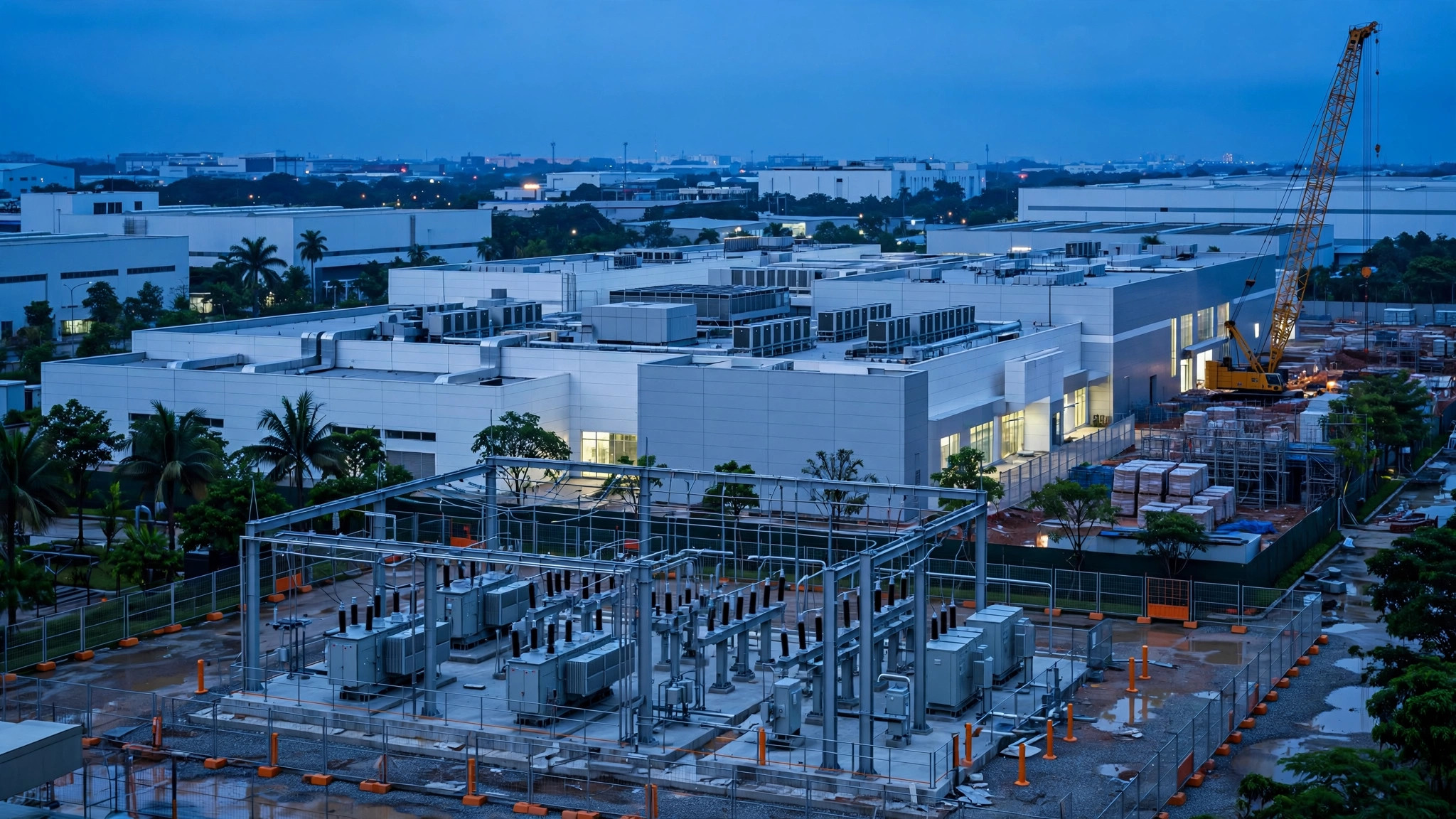
    Data centre announcements are cheap. Land leases are not. In September 2026, Ho Chi Minh City approved the lease of 4.5 hectares in Saigon Hi-Tech Park to Starmason, the joint venture between Singapore’s Sembcorp Development and Vietnamese partner BB Holding, on a term running to 2076. The plot, lot T9 in the park’s Tang Nhon Phu area, is where Starmason will build a hyperscale data centre complex with registered investment of USD 480 million. The project’s investment registration certificate was issued on 24 March 2026. With land secured, the wager Sembcorp announced in the spring is now a construction obligation with a fifty year horizon, and the first data centre project backed by the Singapore group in Vietnam.

    What is being built

    The Starmason complex is designed for an initial 60 MW of IT load, expandable to 90 MW. Its workload targets are the standard hyperscale mix: artificial intelligence, cloud computing, big data processing and high performance computing. The design can meet the Uptime Institute’s Tier III standard, with an ambition to reach Tier IV, the highest resilience tier. Starmason was established in November 2025, initially with registered capital of VND 50 billion, and Sembcorp Development, a wholly owned subsidiary of Sembcorp Industries, acquired a 49 percent stake in December 2025, with BB Holding holding the balance. The structure is deliberate. The Singapore partner brings the operating brand and hyperscale customer relationships. The Vietnamese partner brings local execution. The land lease decision adds the incentives typical for strategic projects in the park, including eligibility for land rent exemption where conditions are met, and it binds the developer to use the land for the approved purpose, fund the project on schedule and meet construction, environmental and fire safety rules, or lose the exemptions and face penalties.

    Sembcorp's USD 480 Million Wager on Saigon Hi-Tech Park

    Why Sembcorp, why now

    Sembcorp Development’s chief executive Lee Ark Boon said in March 2026 that Vietnam’s digital economy was accelerating on the back of cloud adoption and AI demand, and the group has said Starmason will look to expand its data centre pipeline in Vietnam beyond this first site. Read the wager in regional terms. Singapore itself is land and power constrained for new data centres, and its capital has spent years building digital infrastructure in larger neighbouring markets. Southern Vietnam offers what Singapore cannot: hectares inside an established high tech park, a metropolitan economy of more than ten million people generating data demand, and a government actively courting hyperscale investment. Sembcorp is not a speculative entrant. It operates industrial parks and energy businesses across Asia, including long standing Vietnam Singapore industrial parks. A data centre is a natural extension: the group increasingly sells integrated sites where power, land and digital capacity come together.

    A park filling with rivals

    Starmason does not arrive alone. In April 2026 the city granted investment certificates to four high tech projects in Saigon Hi-Tech Park worth a combined USD 1.23 billion. Alongside Starmason sat the Evolution DC VN project, backed by a Singapore consortium of Hathor, Frontier and Evolution, at more than USD 508 million for 52 MW of IT load, with a commitment to use more than 30 percent renewable energy and a net zero goal for 2045. Two further projects covered biomedical technology and smart electronics. City reporting counts three large data centre projects in the park with combined registered capital near USD 1.15 billion. For the park, the cluster effect is the prize: shared grid investment, a supplier ecosystem, and a claim to be southern Vietnam’s digital infrastructure address. For Starmason, the neighbours are both validation and competition for the same grid capacity and the same anchor tenants.

    The power question underneath

    Every figure in this story is a proxy for one variable: electricity. Sixty megawatts of IT load, ninety at expansion, means a facility drawing power on the scale of a small city district, continuously, with no tolerance for interruption. The project’s Tier ambitions, its fifty year lease and its Singaporean operator all reduce commercial risk. None of them generates a single megawatt. The decisive negotiations are with the grid: connection capacity, dual feeds, substation works and the renewable share that global cloud and AI customers increasingly require in their contracts. Evolution’s public commitment to more than 30 percent renewable energy shows the direction tenants are pushing. Starmason’s filings are quieter on power sourcing, which makes its eventual supply arrangements the detail to watch.

    What the wager says about Vietnam

    Step back and the Starmason lease marks a shift in the kind of foreign investment Vietnam is landing. A decade ago, a USD 480 million Singapore project in an industrial park would have meant a factory and export containers. This one means servers, cooling and uptime guarantees, employing fewer people per dollar but anchoring Vietnam inside regional cloud and AI networks that factories increasingly depend on. Sembcorp has bet that Ho Chi Minh City can deliver land, permits and power at hyperscale speed. The lease to 2076 says the city has bet the same. Construction progress and the power plan will settle who read the grid correctly.

    Related reading

    Sources

    TNGlobal, 11 September 2026, on Ho Chi Minh City leasing 4.5 hectares to Starmason, the USD 480 million registered investment, 60 MW expandable to 90 MW, and the Sembcorp Development stake. Vietnam Investment Review, September 2026, on the land lease decision to March 2076, investment incentives and the project’s Tier III design with a Tier IV aim. Vietstock, September 2026, on the investment registration certificate of 24 March 2026, Starmason’s establishment in November 2025 and the park’s three data centre projects totalling near USD 1.15 billion. VietnamPlus, April 2026, on the four Saigon Hi-Tech Park projects worth more than USD 1.23 billion, including the Evolution DC project at more than USD 508 million.

  • Who Buys the First Vietnamese Made Chips?

    Who Buys the First Vietnamese Made Chips?

    Why is the first customer the hardest problem in chips?

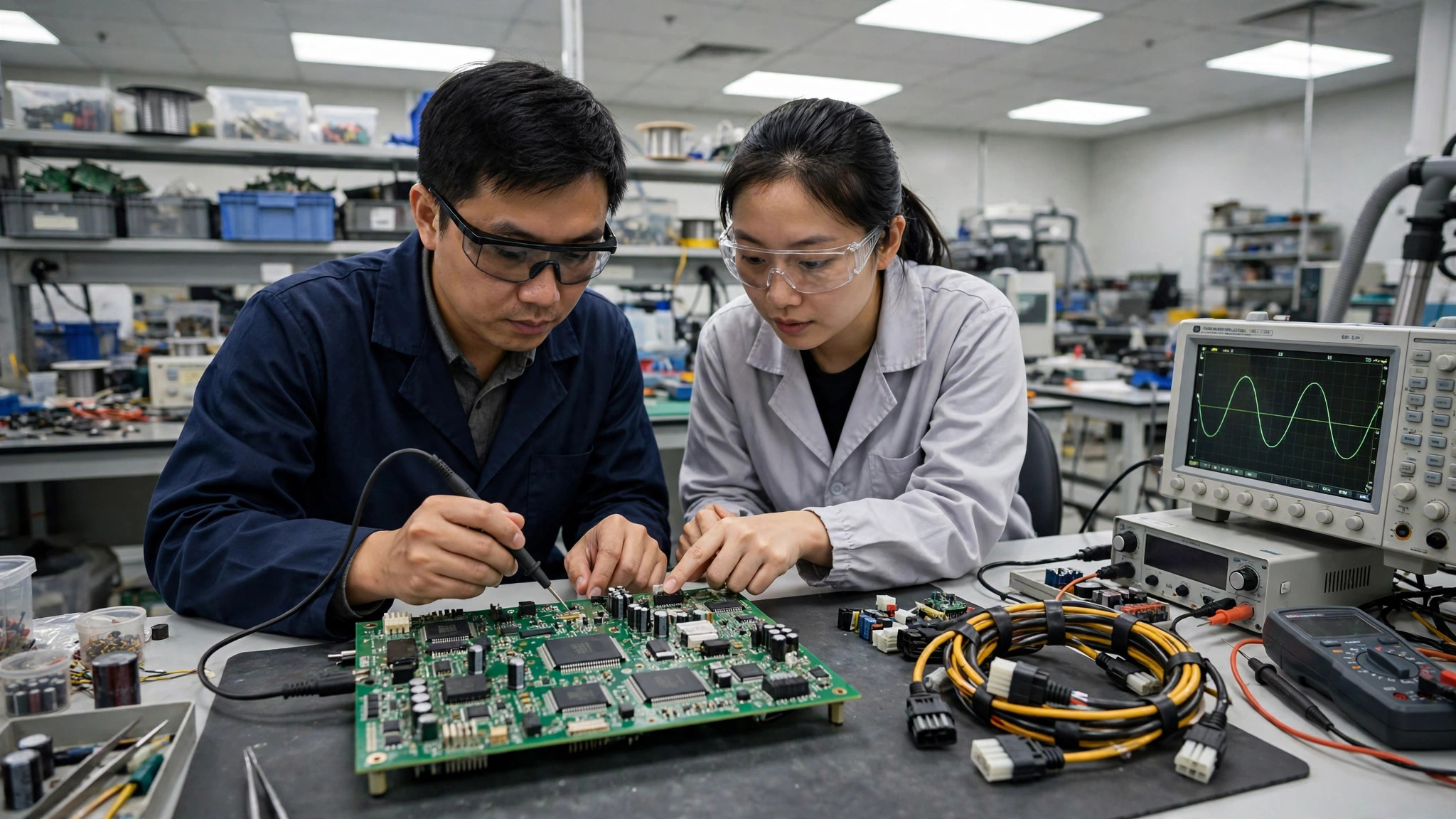
    A chip factory is usually discussed as a construction story: land, cleanrooms, equipment, timelines. The harder story starts the day the line works. A new producer has no track record, no reliability data from years in the field, and no proof that its chips survive heat, vibration and time inside a real product. Buyers of components, whose own products fail if a chip fails, are rationally conservative. They wait for proof. But proof requires a first buyer willing to install an unproven chip, run it, and report back. Vietnam’s semiconductor planners name this openly as the first customer problem, and the country’s 2026 chip push is interesting precisely because three different actors are offering three different answers to it.

    What is actually being built, and when?

    Two factories frame the question. Viettel, the military run telecoms and technology group, broke ground in early 2026 on Vietnam’s first high tech chip plant, on 27 hectares at Hoa Lac Hi Tech Park near Hanoi. The plan is to finish construction and technology transfer by the end of 2027 and begin trial production in 2028, using 32 nanometre technology aimed at specialised chips rather than leading edge processors. The second project is private. Geleximco Group is advancing investment procedures for a chip plant in Hung Yen province, with construction expected to begin in November 2026 and the first commercial products targeted for early 2028. Neither plant will sell a chip this year. Both need their first customers identified well before the first wafers come off the line, because product design, testing and certification take years, not months.

    Who Buys the First Vietnamese Made Chips?

    What has Geleximco promised to do differently?

    Geleximco’s answer is to be the first customer itself. The group’s deputy general director, Ngo Anh Tri, has pledged that it will prioritise testing and integrating control circuits, sensors and power chips designed by Vietnamese engineers into the group’s own electric vehicle lines and wider industrial ecosystem. The logic deserves attention. A diversified group that builds vehicles and industrial products owns something a standalone chip startup never has: internal demand. If its own products adopt Vietnamese designed chips, those chips gain field hours, failure data and a reference customer that outside buyers can call. The argument, aired in Vietnam’s chip industry discussions in September 2026, is that the market must come first in planning, not as an afterthought once the factory exists. The caveat is scale. One group’s internal demand can prove a chip. It cannot, by itself, fill a fab.

    Can the state act as the anchor buyer?

    The second answer is public procurement. Vietnam’s semiconductor strategy, set by Decision 1018 in 2024, puts specialised chips at its centre: chips designed for a defined job in cameras, grid equipment, charging stations, robots, drones, telecommunications, healthcare and digital identity. The Ministry of Science and Technology is finalising a list of specialised chip groups, reported at 20 groups, drawn from the stated needs of ministries, agencies, businesses and research institutes. The 2026 action plan of the national semiconductor steering committee calls for at least three strategic chip lines to enter product development programmes. The mechanism matters more than the list. Public investment projects, digital transformation programmes and national infrastructure builds would order Vietnamese chips through procurement, generating exactly what private buyers demand before committing: a market signal, operating history and certification data. Officials are explicit that the aim is to bring quality products into use, not to build a protected market with lowered standards.

    What about the space between a design and a product?

    Between a promising design and a buyable chip sits expensive, unglamorous work: trial production runs, packaging, testing, software refinement, reliability assessment and certification. Small orders often cannot access packaging and testing services at sensible prices, which is why Vietnam has created a national support centre for semiconductor chip prototyping. Its role is to provide shared infrastructure and laboratories, connect design firms with factories and packaging units, support measurement after prototyping, and, crucially, connect chip designers with product companies from the requirements stage rather than after the chip is finished. Qualcomm’s expanding research presence in Vietnam, training engineers across the full design cycle, adds an external layer of design capability that local product firms can draw on. None of this sells a chip by itself. All of it shortens the distance between the first design and the first purchase order.

    So who buys the first Vietnamese made chips?

    On the evidence of 2026, the honest answer is a sequence, not a single name. First, the producers’ own ecosystems: Geleximco’s vehicles and industrial products, and the equipment world around Viettel. Second, the state, ordering specialised chips into public infrastructure and digital programmes from a defined list, with standards and testing attached. Third, and only with operating proof in hand, the commercial market: the electronics, electric vehicle, energy and automation firms that already manufacture in Vietnam at enormous scale. The first customer problem is real, but Vietnam is unusual in attacking it from three sides at once. The factories will be judged in 2028 and after, not by their opening ceremonies, but by whose products are running on their chips.

    Related reading

    Sources

    Vietnam.vn reporting from Vietnam News Agency, September 2026, on specialised chips: the Geleximco Hung Yen plant timetable, its first customer pledge for control circuits, sensors and power chips, the Viettel Hoa Lac plant and the 20 specialised chip groups list. VietnamPlus, September 2026, on state procurement mechanisms for Vietnamese specialised chips and the support programme from research to testing. VietnamNet, September 2026, on using public investment and national programmes as the first customer for Vietnamese chips.

  • Data Is the New Oil, Context Is the New Refinery: Inside Dell’s AI Data Platform

    Data Is the New Oil, Context Is the New Refinery: Inside Dell’s AI Data Platform

    Why clean data still leaves AI confused

    Companies have spent years collecting data. They hold tables of customers, products, machines, payments, shipments and service calls, stored across systems that were rarely designed to work together. The old saying calls data the new oil. The harder truth in enterprise artificial intelligence is that raw data on its own does not make an AI agent useful. The agent needs context, the business meaning that tells it what a field represents, how one record relates to another, which definition is current, and what action is allowed.

    Dell Technologies is building its latest platform update around that problem. In a release carried by Business Wire on 6 October 2026, the company announced additions to the Dell AI Data Platform, described as the core of its Dell AI Factory. The additions are a Unified Semantic Layer, an Enterprise Knowledge Graph and a Knowledge Agent, all designed to run on premises, with release planned for the first half of 2027. Arthur Lewis, President of Dell’s Infrastructure Solutions Group, makes the underlying point in paraphrased form in the announcement. In his argument, data stripped of context is close to noise for an AI agent, because the agent cannot reliably tell what matters or how facts connect.

    What a semantic layer actually does

    Imagine a bank where the word customer appears in five systems. In one it means a person with a current account. In another it includes a business that once applied for a loan. An AI agent reading the raw tables sees similar labels and may treat them as the same thing, producing a confident answer built on the wrong definition.

    Data Is the New Oil, Context Is the New Refinery: Inside Dell's AI Data Platform

    A semantic layer sits between the raw data and the user or agent. It defines business terms once, in a shared way, and maps those definitions back to the tables and fields in each source system. Revenue, active customer, overdue payment and machine downtime become governed concepts rather than local habits. When an agent asks for overdue payments by region, the layer helps translate that question into the correct data, using the correct definition. A unified layer will not fix poor source data by magic. It can make definitions visible, reusable and testable, so errors are easier to find and correct.

    What a knowledge graph adds

    If a semantic layer is a dictionary of business meaning, a knowledge graph is a map of relationships. It connects entities such as people, companies, products, machines, locations, contracts and events, and records how they relate. A factory might connect a specific motor to a production line, a supplier, a warranty period, a maintenance history, a spare part in stock and the orders that would be affected if that line stopped.

    An AI agent works better with that map because many real questions are relationship questions. Which customers use the product that contains a faulty component. Which supplier delays affect the orders due next week. Which engineer has worked on this machine before, and what fixed the problem last time. A search across separate tables can miss those links. The Enterprise Knowledge Graph in Dell’s announcement is intended to make those relationships available to agents in a structured form, and the Knowledge Agent then uses that structure to help answer questions and reason over enterprise knowledge. The shift is from retrieval alone to retrieval with context.

    Speed, storage and the platform around it

    Context is the headline, but Dell also announced performance and storage changes. Its data processing engine, built with the NVIDIA cuDF library and offered with the RTX PRO 4500 Blackwell GPU, processes data about four times faster than CPU only processing, and up to 20 times faster for batch workloads. Those are vendor figures from the announcement, so buyers should test them against their own data and workloads. Preparing and querying large data sets for AI is heavy work, and graphics processors are becoming part of the standard enterprise data toolkit.

    On storage, PowerScale will support up to 500 tenants per cluster from November 2026. A tenant is a separated user group, business unit or service environment sharing a platform while keeping its data and access apart. A Storage Performance Tool is already available, giving operators a way to examine how storage behaves before the larger platform release arrives in the first half of 2027.

    Why on premises matters

    Dell emphasises that the new capabilities are designed to run on premises. That phrase carries weight for banks, manufacturers, hospitals, energy companies and public bodies. Some data cannot move freely to a public cloud because of regulation, contracts, security policy or the cost and risk of moving very large volumes.

    On premises deployment also changes governance. Data owners can point to where the data sits, who can access it, how agents are approved and how logs are kept. A semantic layer and a knowledge graph can themselves become sensitive assets, because together they describe how a business understands itself. They need ownership and access rules like any other critical system, applied inside an environment the organisation already governs.

    What it means for buyers in Vietnam

    Vietnamese banks and manufacturers face the same data sprawl as larger markets, often with systems adopted at different stages of rapid growth. A branch network, a core banking platform, a customer app, a factory system and a collection of spreadsheets may each hold part of the truth. An AI agent placed on top of that landscape without a semantic foundation will reproduce the confusion faster and at larger scale.

    The practical buying lesson is to ask about meaning before asking about model size. Which business terms will be defined first, and who owns those definitions. How will the knowledge graph be kept current as products, machines and suppliers change. Which workloads will test the claim of four times faster processing, and which batch jobs could approach the higher vendor figure. How will up to 500 tenants per cluster be separated and audited. Those questions decide whether a pilot becomes a dependable service.

    Dell is placing its bet on a refinery model for enterprise AI. Raw data remains valuable, but value grows when it is defined, connected and delivered with context that an agent can use. The releases planned for the first half of 2027 will show how well that bet works in real data centres. Do not only buy computing power for AI. Build the layer of meaning that tells that computing power what your business actually means.

    Related reading

    Sources

    Dell Technologies release via Business Wire, 6 October 2026, announcing additions to the Dell AI Data Platform, including the Unified Semantic Layer, Enterprise Knowledge Graph and Knowledge Agent. VoltViet desk reporting from kynguyenso.com.vn, October 2026, on enterprise AI adoption and data infrastructure in Vietnam.

  • A USD 3.5 Billion AI Data Centre Bet Lands in Tay Ninh

    A USD 3.5 Billion AI Data Centre Bet Lands in Tay Ninh

    A letter of intent with very large numbers

    Tay Ninh province has received one of the boldest digital infrastructure proposals in Vietnam this year. A consortium of Saigon Telecommunications and Technologies Corporation, known as SAIGONTEL, World Harmony Co. Ltd, known as WVU, and SAIF Eagle II Investment Co. submitted a letter of intent to the province at its investment promotion conference on 28 August 2026.

    The proposed AI data centre complex covers about 20 hectares at Nam Tan Tap Industrial Park in Tan Tap commune. The design target is a total IT load of 200 MW at full build. Phase one alone would provide 100 MW, with investment of about USD 3.5 billion. Those are not incremental figures. A load of 100 MW belongs in conversations with power planners as much as with technology executives, and 200 MW would place the site among the most power hungry facilities in the country. Artificial intelligence has changed what a data centre is. An AI facility trains and runs models that consume large amounts of electricity, produce intense heat and depend on networks that move data quickly across borders. The Tay Ninh proposal is therefore two projects in one, a computing project and an energy project, and the second may decide the fate of the first.

    Built for AI heat and AI density

    The consortium is targeting Tier IV standard, which targets 99.999 percent uptime. In plain terms, the design goal is a facility with enough redundancy that maintenance and faults should not bring services down. Customers paying for AI computing at scale expect that resilience, because an interruption can halt training runs and damage confidence.

    A USD 3.5 Billion AI Data Centre Bet Lands in Tay Ninh

    Cooling is equally central. The design is intended for AI workloads and includes direct liquid cooling and immersion cooling, enabling densities up to 150 kW per rack. Traditional air cooling struggles at such densities. Bringing liquid closer to the chips, or immersing components in a cooling fluid, allows far more computing power in a given space, but it also raises demands on building design, energy management, maintenance skills and safety procedures.

    Connectivity forms the third leg. The project targets international latency below 18 milliseconds to Singapore, a regional hub for finance, cloud services and submarine cable connections. A site in Tay Ninh that can reach Singapore that quickly can present itself as part of a regional network, not an isolated facility serving only the domestic market.

    The real negotiation is about power

    Servers can be ordered and racks can be shipped. Electricity at the scale of 100 MW for phase one, rising to 200 MW at full build, is different. It must be planned, allocated and delivered reliably, hour after hour, through peak demand periods and maintenance cycles in the wider grid.

    Groundbreaking is targeted for the fourth quarter of 2026 and commercial operations in 2027, subject to investment procedures and finalising the power supply plan with the province and the power sector. That qualification is the most important phrase in the proposal. Without a credible power plan, a groundbreaking date is a ceremony. With one, it becomes a construction programme that suppliers, customers and financiers can plan around.

    Power planning involves more than total capacity. A data centre needs firm supply, suitable connection points, backup arrangements and a route to cleaner electricity if customers demand it. Many global buyers now ask detailed questions about the carbon intensity of the power behind their computing. Tay Ninh and the consortium will need to show where the electricity comes from, how reliability will be protected, and how expansion to 200 MW can be served without weakening supply for other users in the province. A predictable and creditworthy load can also support investment in transmission, substations and renewable generation if contracts are structured well. The negotiation is therefore not an obstacle to the project. It is the project, in its most strategic form.

    The partners behind the consortium

    SAIGONTEL brings a Vietnamese base in telecommunications and industrial infrastructure, a combination that fits a project located in an industrial park and dependent on connectivity. Its local presence matters when a proposal must move through provincial procedures, land arrangements and coordination with national sectors.

    WVU adds international data centre experience. It is a member of World Vista United and is developing a 32 MW hyperscale data centre in Taipei. That project is smaller than the Tay Ninh ambition, but it gives the group direct exposure to the design and delivery standards expected by large customers in the region. SAIF Eagle II Investment Co. connects the consortium to the SAIF Group, whose financial arm manages nearly USD 10 billion in assets across more than 500 portfolio companies. A project with phase one investment of about USD 3.5 billion needs capital partners who understand long payback periods, phased construction and the risk that demand or power timelines can shift. Their presence does not remove those risks, but it changes the seriousness with which the proposal will be examined.

    Tay Ninh in a crowded regional race

    The province is not entering an empty field. Saigon Hi-Tech Park drew more than USD 1.2 billion across four high tech projects in early 2026, including two hyperscale data centres. Separately, the Starmason complex, a joint venture involving Sembcorp Development, carries registered investment of USD 480 million for 60 MW of initial capacity, expandable to 90 MW. Investors already see southern Vietnam as a credible location for large digital facilities.

    Tay Ninh must therefore sell a distinct case. Land of about 20 hectares at Nam Tan Tap Industrial Park is part of it, and proximity to the Ho Chi Minh City economic region is another part. The decisive part will be execution, above all aligning investment approval, construction and power supply on a timeline customers believe. Meeting the target of groundbreaking in the fourth quarter of 2026 and operations in 2027 would send a strong signal across ASEAN.

    For Vietnam, the prize goes beyond one province. AI data centres bring construction work, skilled operations jobs and a stronger claim to a place in regional digital supply chains. If the power plan is finalised well, Tay Ninh could become a model for pairing digital growth with disciplined infrastructure planning. If it is not, the site will remain a reminder that in the AI era, the scarcest resource is not computing ambition. It is dependable electricity, delivered at exactly the scale the computers require.

    Related reading

    Sources

    VOV English, August 2026, reporting on the consortium letter of intent presented to Tay Ninh province on 28 August 2026. Vietnam Investment Review, August 2026, and Economic Times CIO, September 2026, reporting on the proposed AI data centre complex, its design targets and timeline.

VoltViet.

Vietnam’s green tech & EV voice in English. Green economy and clean technology from Vietnam, for a global audience.

© 2026 VoltViet · Ho Chi Minh City, Vietnam

Made in Vietnam · Read everywhere