
Why is the first customer the hardest problem in chips?
A chip factory is usually discussed as a construction story: land, cleanrooms, equipment, timelines. The harder story starts the day the line works. A new producer has no track record, no reliability data from years in the field, and no proof that its chips survive heat, vibration and time inside a real product. Buyers of components, whose own products fail if a chip fails, are rationally conservative. They wait for proof. But proof requires a first buyer willing to install an unproven chip, run it, and report back. Vietnam’s semiconductor planners name this openly as the first customer problem, and the country’s 2026 chip push is interesting precisely because three different actors are offering three different answers to it.
What is actually being built, and when?
Two factories frame the question. Viettel, the military run telecoms and technology group, broke ground in early 2026 on Vietnam’s first high tech chip plant, on 27 hectares at Hoa Lac Hi Tech Park near Hanoi. The plan is to finish construction and technology transfer by the end of 2027 and begin trial production in 2028, using 32 nanometre technology aimed at specialised chips rather than leading edge processors. The second project is private. Geleximco Group is advancing investment procedures for a chip plant in Hung Yen province, with construction expected to begin in November 2026 and the first commercial products targeted for early 2028. Neither plant will sell a chip this year. Both need their first customers identified well before the first wafers come off the line, because product design, testing and certification take years, not months.
What has Geleximco promised to do differently?
Geleximco’s answer is to be the first customer itself. The group’s deputy general director, Ngo Anh Tri, has pledged that it will prioritise testing and integrating control circuits, sensors and power chips designed by Vietnamese engineers into the group’s own electric vehicle lines and wider industrial ecosystem. The logic deserves attention. A diversified group that builds vehicles and industrial products owns something a standalone chip startup never has: internal demand. If its own products adopt Vietnamese designed chips, those chips gain field hours, failure data and a reference customer that outside buyers can call. The argument, aired in Vietnam’s chip industry discussions in September 2026, is that the market must come first in planning, not as an afterthought once the factory exists. The caveat is scale. One group’s internal demand can prove a chip. It cannot, by itself, fill a fab.
Can the state act as the anchor buyer?
The second answer is public procurement. Vietnam’s semiconductor strategy, set by Decision 1018 in 2024, puts specialised chips at its centre: chips designed for a defined job in cameras, grid equipment, charging stations, robots, drones, telecommunications, healthcare and digital identity. The Ministry of Science and Technology is finalising a list of specialised chip groups, reported at 20 groups, drawn from the stated needs of ministries, agencies, businesses and research institutes. The 2026 action plan of the national semiconductor steering committee calls for at least three strategic chip lines to enter product development programmes. The mechanism matters more than the list. Public investment projects, digital transformation programmes and national infrastructure builds would order Vietnamese chips through procurement, generating exactly what private buyers demand before committing: a market signal, operating history and certification data. Officials are explicit that the aim is to bring quality products into use, not to build a protected market with lowered standards.
What about the space between a design and a product?
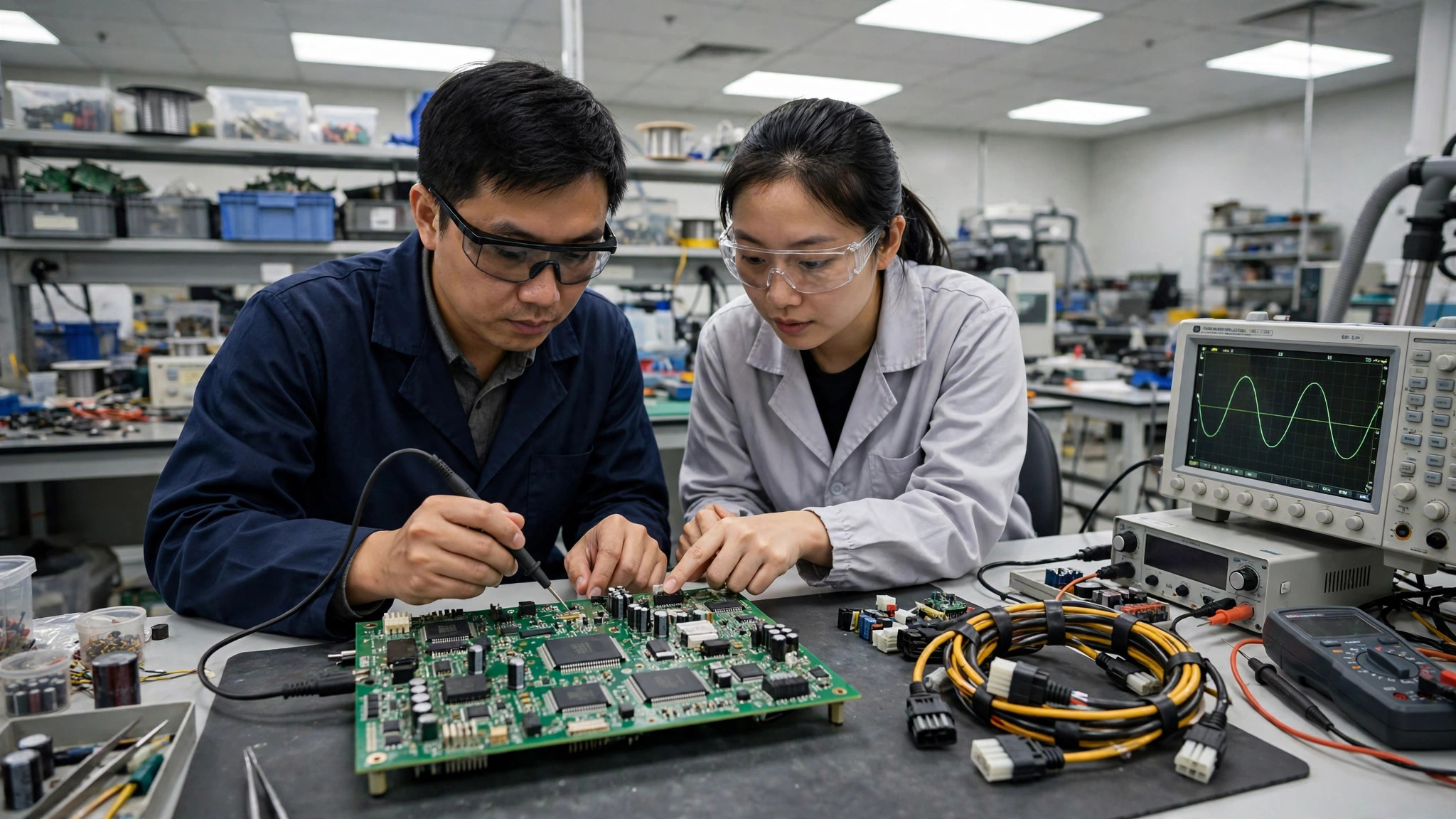
Between a promising design and a buyable chip sits expensive, unglamorous work: trial production runs, packaging, testing, software refinement, reliability assessment and certification. Small orders often cannot access packaging and testing services at sensible prices, which is why Vietnam has created a national support centre for semiconductor chip prototyping. Its role is to provide shared infrastructure and laboratories, connect design firms with factories and packaging units, support measurement after prototyping, and, crucially, connect chip designers with product companies from the requirements stage rather than after the chip is finished. Qualcomm’s expanding research presence in Vietnam, training engineers across the full design cycle, adds an external layer of design capability that local product firms can draw on. None of this sells a chip by itself. All of it shortens the distance between the first design and the first purchase order.
So who buys the first Vietnamese made chips?
On the evidence of 2026, the honest answer is a sequence, not a single name. First, the producers’ own ecosystems: Geleximco’s vehicles and industrial products, and the equipment world around Viettel. Second, the state, ordering specialised chips into public infrastructure and digital programmes from a defined list, with standards and testing attached. Third, and only with operating proof in hand, the commercial market: the electronics, electric vehicle, energy and automation firms that already manufacture in Vietnam at enormous scale. The first customer problem is real, but Vietnam is unusual in attacking it from three sides at once. The factories will be judged in 2028 and after, not by their opening ceremonies, but by whose products are running on their chips.
Related reading
- Vietnam’s First Chip Fab: What a 32nm Line Can and Cannot Do
- A Prototyping Centre Tries to Cut the Cost of a First Chip
- The Talent Equation: 50,000 Engineers Do Not Appear by Decree
Sources
Vietnam.vn reporting from Vietnam News Agency, September 2026, on specialised chips: the Geleximco Hung Yen plant timetable, its first customer pledge for control circuits, sensors and power chips, the Viettel Hoa Lac plant and the 20 specialised chip groups list. VietnamPlus, September 2026, on state procurement mechanisms for Vietnamese specialised chips and the support programme from research to testing. VietnamNet, September 2026, on using public investment and national programmes as the first customer for Vietnamese chips.