Why clean data still leaves AI confused
Companies have spent years collecting data. They hold tables of customers, products, machines, payments, shipments and service calls, stored across systems that were rarely designed to work together. The old saying calls data the new oil. The harder truth in enterprise artificial intelligence is that raw data on its own does not make an AI agent useful. The agent needs context, the business meaning that tells it what a field represents, how one record relates to another, which definition is current, and what action is allowed.
Dell Technologies is building its latest platform update around that problem. In a release carried by Business Wire on 6 October 2026, the company announced additions to the Dell AI Data Platform, described as the core of its Dell AI Factory. The additions are a Unified Semantic Layer, an Enterprise Knowledge Graph and a Knowledge Agent, all designed to run on premises, with release planned for the first half of 2027. Arthur Lewis, President of Dell’s Infrastructure Solutions Group, makes the underlying point in paraphrased form in the announcement. In his argument, data stripped of context is close to noise for an AI agent, because the agent cannot reliably tell what matters or how facts connect.
What a semantic layer actually does
Imagine a bank where the word customer appears in five systems. In one it means a person with a current account. In another it includes a business that once applied for a loan. An AI agent reading the raw tables sees similar labels and may treat them as the same thing, producing a confident answer built on the wrong definition.
A semantic layer sits between the raw data and the user or agent. It defines business terms once, in a shared way, and maps those definitions back to the tables and fields in each source system. Revenue, active customer, overdue payment and machine downtime become governed concepts rather than local habits. When an agent asks for overdue payments by region, the layer helps translate that question into the correct data, using the correct definition. A unified layer will not fix poor source data by magic. It can make definitions visible, reusable and testable, so errors are easier to find and correct.
What a knowledge graph adds
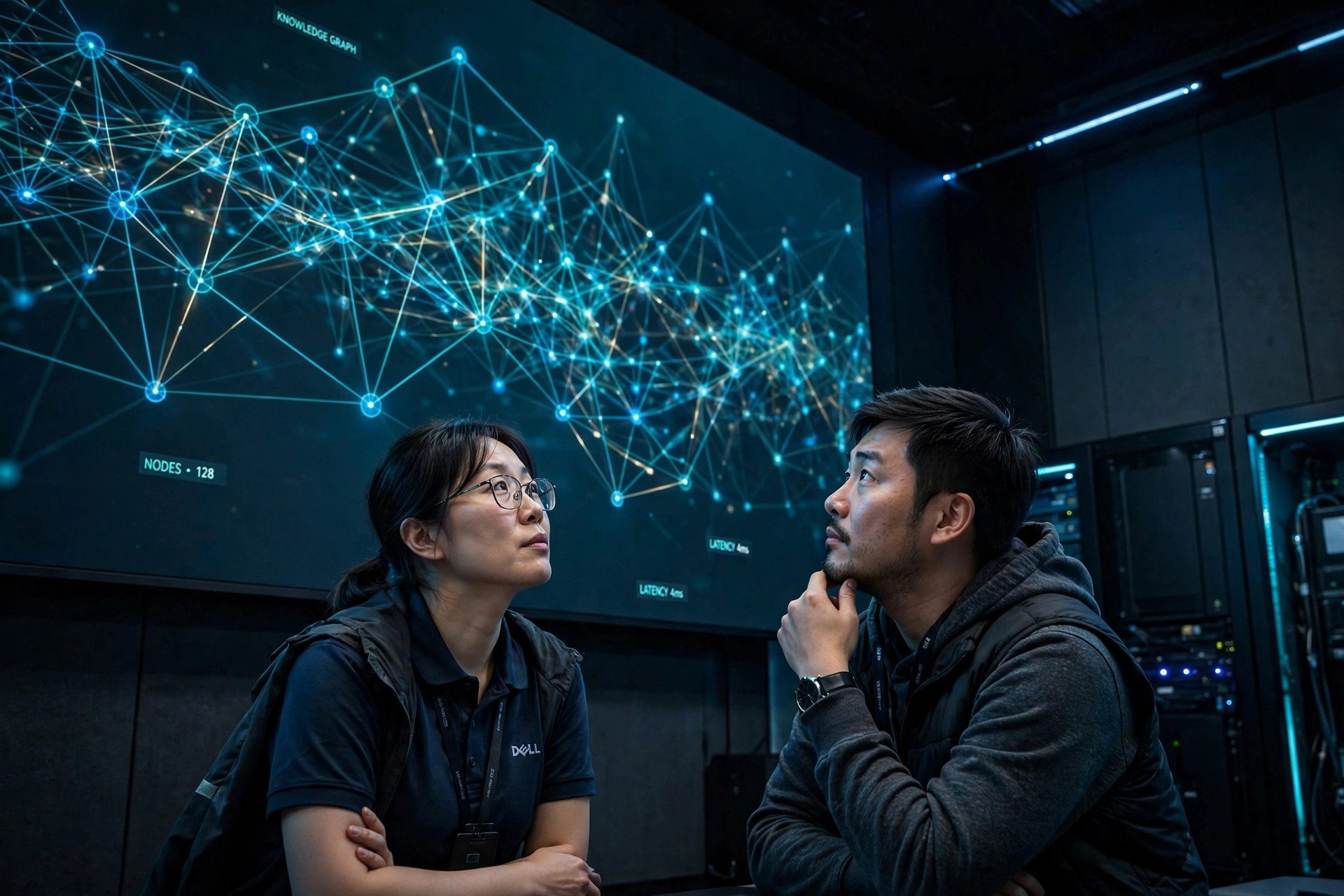
If a semantic layer is a dictionary of business meaning, a knowledge graph is a map of relationships. It connects entities such as people, companies, products, machines, locations, contracts and events, and records how they relate. A factory might connect a specific motor to a production line, a supplier, a warranty period, a maintenance history, a spare part in stock and the orders that would be affected if that line stopped.
An AI agent works better with that map because many real questions are relationship questions. Which customers use the product that contains a faulty component. Which supplier delays affect the orders due next week. Which engineer has worked on this machine before, and what fixed the problem last time. A search across separate tables can miss those links. The Enterprise Knowledge Graph in Dell’s announcement is intended to make those relationships available to agents in a structured form, and the Knowledge Agent then uses that structure to help answer questions and reason over enterprise knowledge. The shift is from retrieval alone to retrieval with context.
Speed, storage and the platform around it
Context is the headline, but Dell also announced performance and storage changes. Its data processing engine, built with the NVIDIA cuDF library and offered with the RTX PRO 4500 Blackwell GPU, processes data about four times faster than CPU only processing, and up to 20 times faster for batch workloads. Those are vendor figures from the announcement, so buyers should test them against their own data and workloads. Preparing and querying large data sets for AI is heavy work, and graphics processors are becoming part of the standard enterprise data toolkit.
On storage, PowerScale will support up to 500 tenants per cluster from November 2026. A tenant is a separated user group, business unit or service environment sharing a platform while keeping its data and access apart. A Storage Performance Tool is already available, giving operators a way to examine how storage behaves before the larger platform release arrives in the first half of 2027.
Why on premises matters
Dell emphasises that the new capabilities are designed to run on premises. That phrase carries weight for banks, manufacturers, hospitals, energy companies and public bodies. Some data cannot move freely to a public cloud because of regulation, contracts, security policy or the cost and risk of moving very large volumes.
On premises deployment also changes governance. Data owners can point to where the data sits, who can access it, how agents are approved and how logs are kept. A semantic layer and a knowledge graph can themselves become sensitive assets, because together they describe how a business understands itself. They need ownership and access rules like any other critical system, applied inside an environment the organisation already governs.
What it means for buyers in Vietnam
Vietnamese banks and manufacturers face the same data sprawl as larger markets, often with systems adopted at different stages of rapid growth. A branch network, a core banking platform, a customer app, a factory system and a collection of spreadsheets may each hold part of the truth. An AI agent placed on top of that landscape without a semantic foundation will reproduce the confusion faster and at larger scale.
The practical buying lesson is to ask about meaning before asking about model size. Which business terms will be defined first, and who owns those definitions. How will the knowledge graph be kept current as products, machines and suppliers change. Which workloads will test the claim of four times faster processing, and which batch jobs could approach the higher vendor figure. How will up to 500 tenants per cluster be separated and audited. Those questions decide whether a pilot becomes a dependable service.
Dell is placing its bet on a refinery model for enterprise AI. Raw data remains valuable, but value grows when it is defined, connected and delivered with context that an agent can use. The releases planned for the first half of 2027 will show how well that bet works in real data centres. Do not only buy computing power for AI. Build the layer of meaning that tells that computing power what your business actually means.
Related reading
- A USD 3.5 Billion AI Data Centre Bet Lands in Tay Ninh
- Smart Factories, Lower Bills: AI in Industrial Energy Management
- The Kill Switch Conversation: Governing Frontier AI in Production
Sources
Dell Technologies release via Business Wire, 6 October 2026, announcing additions to the Dell AI Data Platform, including the Unified Semantic Layer, Enterprise Knowledge Graph and Knowledge Agent. VoltViet desk reporting from kynguyenso.com.vn, October 2026, on enterprise AI adoption and data infrastructure in Vietnam.