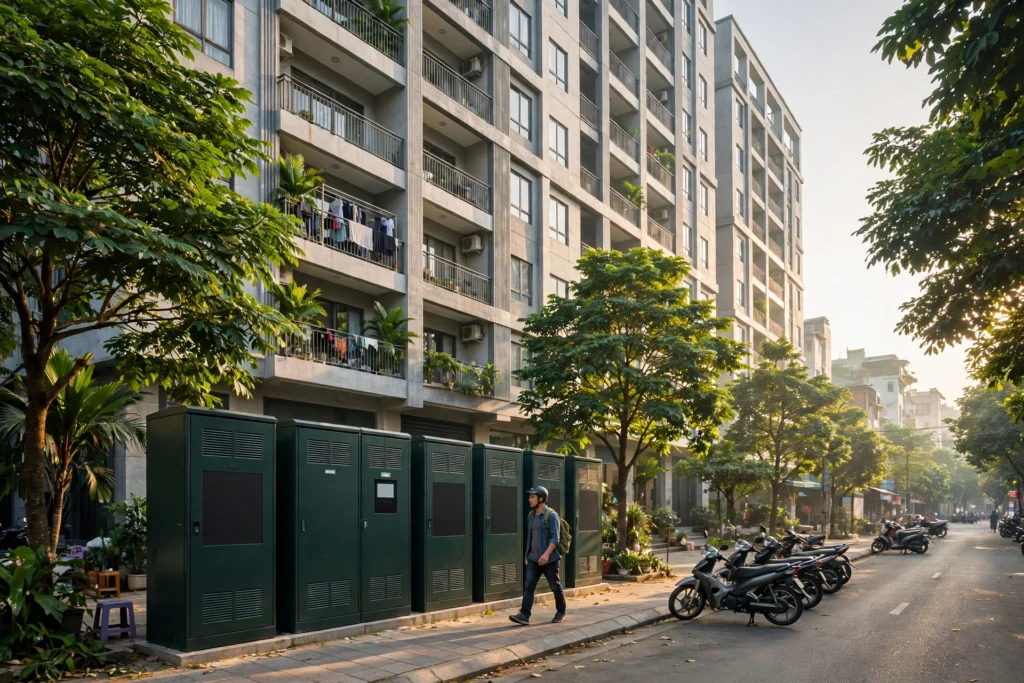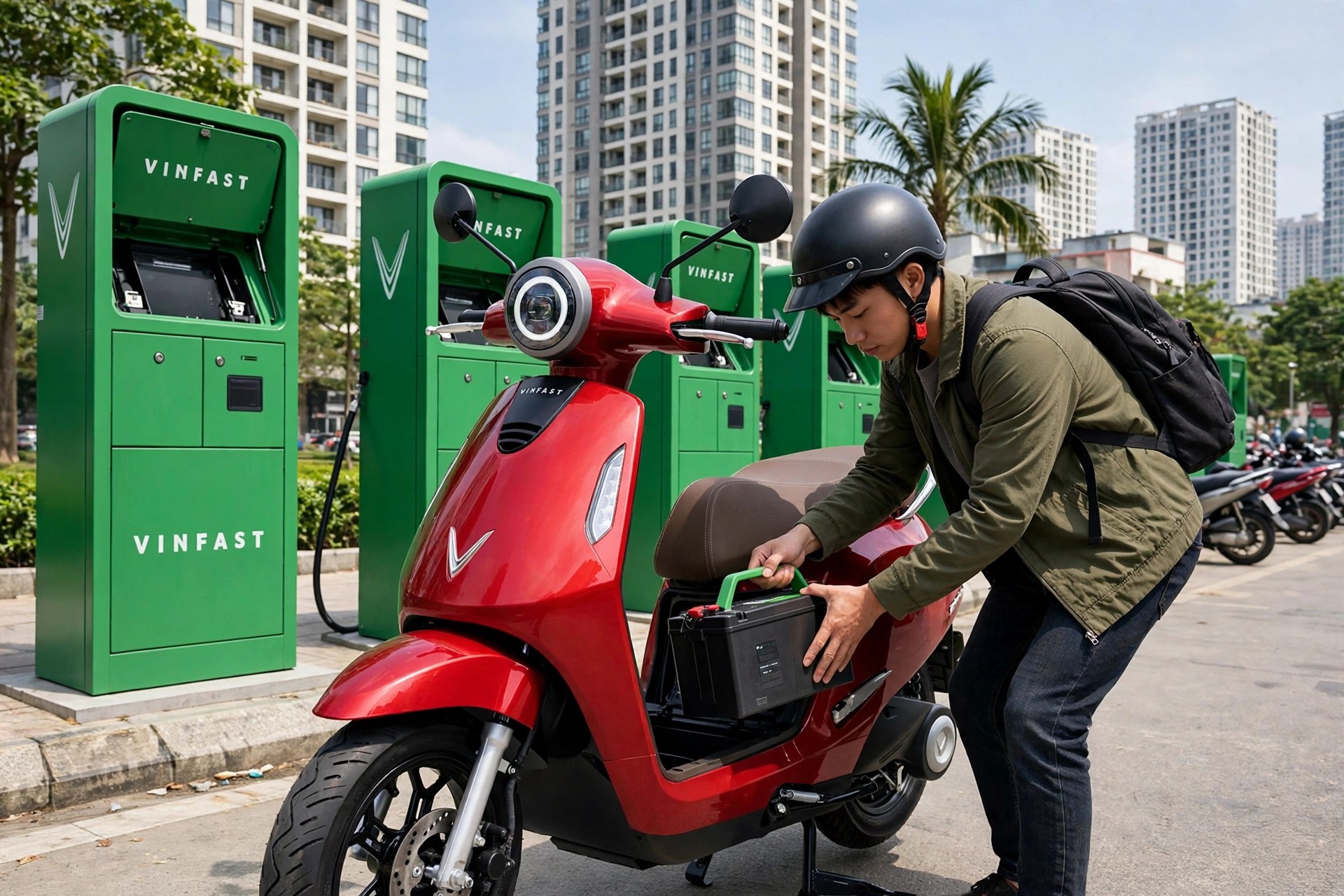
For millions of people living in apartments in Hanoi and Ho Chi Minh City, the hardest part of switching to an electric motorbike has never been the motorbike itself. It has been the question of where to charge it. Basement parking in older buildings often has no dedicated outlet, no charging zone that meets safety standards, and no clear plan for when one will appear. Battery swapping answers a different question: what if riders never needed to charge at home at all?
A new rule, an old building problem
On 15 June 2026, the Ministry of Construction issued Circular 31/2026/TT-BXD, amending the national technical regulation on apartment buildings, QCVN 04:2021/BXD. The circular takes effect on 15 December 2026 and sets requirements for electric vehicle parking areas, charging areas and battery swapping areas in apartment buildings. For existing buildings, owners or their authorised organisations and individuals must complete a review of those areas within six months of the circular taking effect, by 15 June 2027 at the latest. Where a building does not meet the regulation, it must be repaired and renovated in line with construction law.
The technical requirements are demanding. Electric vehicle parking must be separated from petrol and diesel vehicle parking, with at least two metres between parking zones or a separation made of non-combustible material at least two metres high. Electric parking areas must have surveillance cameras, automatic fire alarm systems and warning devices for carbon monoxide and hydrofluoric acid gas. For older buildings with tight basements and ageing electrical systems, meeting all of this quickly is a genuine engineering and management challenge.
The one-minute workaround
Battery swapping takes the energy problem out of the building entirely. When the battery runs low, the rider stops at a public swapping cabinet, hands in the used battery and takes a fully charged one. The whole process takes about one minute. There is no need to leave the bike plugged in for hours, no need to find a socket in the basement, and no need to plan the day around charging time.
Swapping also removes the time pressure that shapes how electric two-wheelers are used. A bike charged at home usually needs to be plugged in overnight or for several hours. A swapped bike refuels almost as fast as a petrol bike, without a visit to a petrol station. That matters most for three groups: apartment residents and renters who have no private outlet where they park; ride-hailing drivers, for whom charging time is lost income; and families who use one bike for everything from commuting to school runs and shopping.
A network growing fast
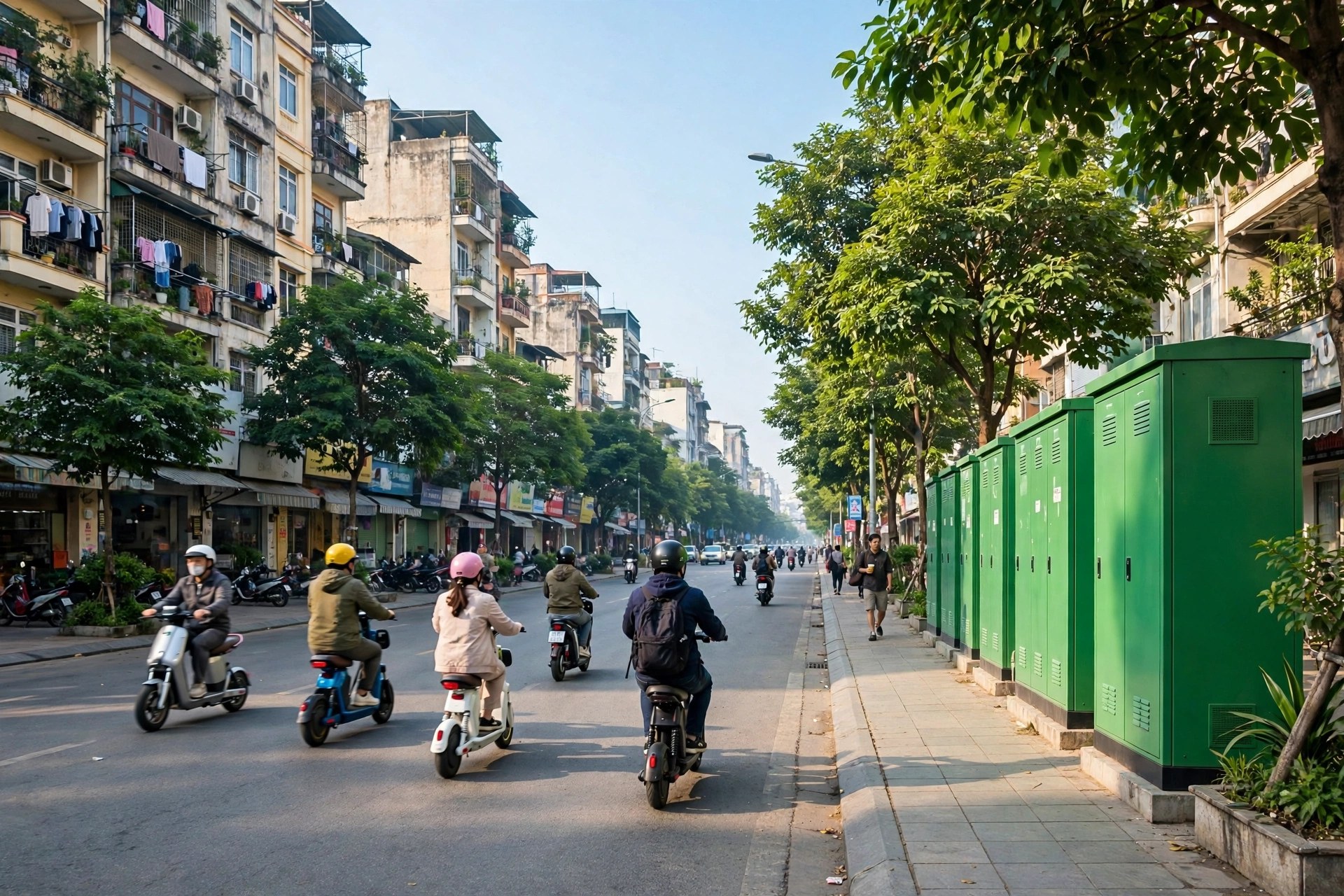
Swapping only works if the cabinets are close to where people live and work. According to the company, the V-Green swapping network has reached 80,000 cabinets nationwide, with a plan for 150,000 cabinets by the end of 2026. Cabinets are placed in residential areas, workplaces, parking lots and shopping malls, so riders can top up on routes they already travel instead of going out of their way. Riders who prefer it can also charge directly at V-Green public charging stations.
What it costs
Cost is where swapping currently has its clearest advantage. According to the company, VinFast offers 20 free battery swaps per month until 30 June 2028 for customers using its battery-swapping electric motorbikes, equivalent to a minimum distance of about 800 kilometres per month. VinFast owners also get free charging at the V-Green public network until 31 May 2027. For someone riding 20 to 30 kilometres a day, 20 free swaps a month covers regular commuting with almost no energy cost at all.
The purchase price is supported too. Until 19 December 2026, the second phase of the For a Green Future programme offers support of up to 6 million VND for customers who own a car, a petrol motorbike or a lead-acid battery electric motorbike of any brand, or a VinFast car or electric motorbike, and switch to a VinFast electric motorbike. For the longer term, VinFast electric motorbikes using LFP batteries carry a six-year vehicle warranty and an eight-year battery warranty, both with unlimited mileage.
Who gains most
The clearest winners are residents of older apartment buildings and renters, who cannot decide on their own when their building upgrades its electrical infrastructure. The second group is ride-hailing drivers and people who ride all day, whose working day can be longer than a single full charge and who cannot afford to wait for a battery to fill. The third group is families using one bike for commuting and daily life, because a one-minute swap slots into a packed schedule without demanding a big change in habits.
The limits
Swapping is a bridge, not a replacement for safe building infrastructure. Apartment buildings must still review and upgrade their electric parking, charging and swapping areas under Circular 31/2026/TT-BXD, because those are long-term safety requirements for every resident, whether or not they ride electric. Cabinet locations also need careful planning so cabinets sit near where people live and work. Riders need clear guidance on using and handling batteries and on what to do if something goes wrong, since the battery determines both the range and the safety of the bike.
Seen in full, the swapping story shows that urban electrification is not only about a vehicle or a regulation. It is about coordination between government rules, company infrastructure and everyday habits. The new regulation sets a clear safety standard and a timetable for apartment buildings. The swapping network gives riders a way to switch immediately while buildings catch up. Building infrastructure will take time to complete, but riders do not need to wait for it before going electric.
Read more
Battery Swapping Helps Hanoi’s Apartment Riders Go Electric
VinFast Eyes Philippine EV Incentives for Its Batangas Plant