Battery Swapping Helps Hanoi’s Apartment Riders Go Electric
Hanoi’s apartment residents want to go electric, but their buildings will not let them charge. At a seminar in Hanoi on October 23, 2026, representatives of several apartment buildings described the same obstacles: limited basement space, a building design that never planned for chargers, and electrical systems that cannot support them. While the buildings work out a fix, residents are finding a workaround that needs no plug at all: battery-swap electric motorbikes, exchanged at a public cabinet in about one minute.
The seminar, titled “Green Vehicle Transition: Untangling Infrastructure Bottlenecks for Hanoi Apartment Buildings,” put the problem in plain terms. Adding charging infrastructure to an existing apartment block is not a matter of installing a few sockets. It means finding floor space in a crowded basement, reworking a building that was never designed for vehicle charging, and upgrading electrical systems that are already stretched. The pressure is real: Hanoi’s low-emission zone, which began in July 2026, is driving a commuting shift for about 450,000 motorbikes in the city’s Ring Road 1 area. For a resident inside that area, the question is not whether to go electric eventually, but how to charge an electric motorbike tonight.
What the seminar found
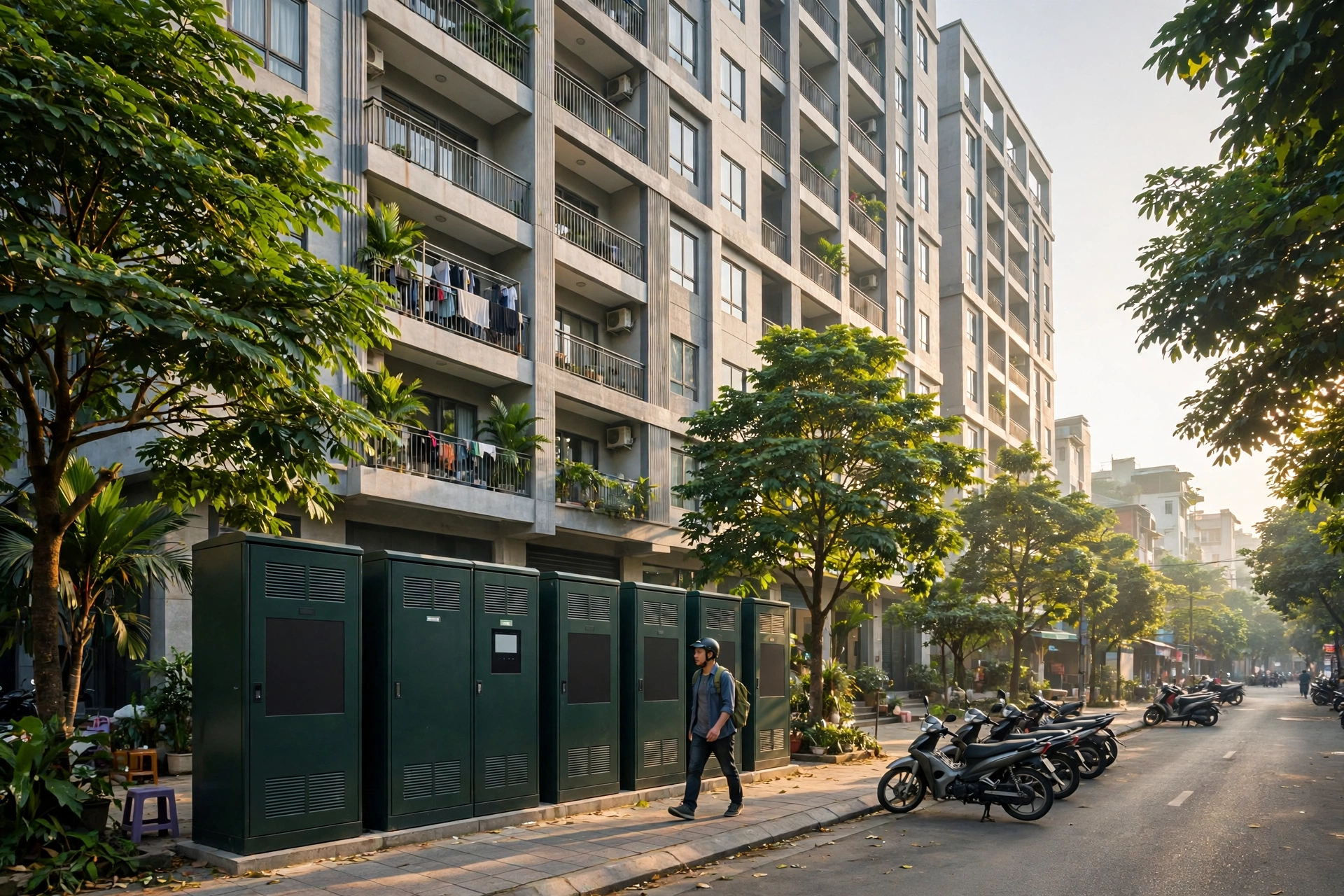
The difficulty is practical before it is technical. Many of Hanoi’s apartment blocks were built when no one expected residents to charge a vehicle at home. Their basements are parking areas, not energy infrastructure, and the wiring was sized for lifts, lighting, and household loads. A charging point needs space, capacity, and a safety sign-off the building’s management may not know how to obtain.
That is why the seminar’s main recommendation was institutional rather than technical. The experts called for the relevant authorities to intervene, guiding apartment buildings through the requirements and the upgrades, rather than leaving each building to solve the problem alone. Until that guidance arrives, residents who want to switch need another way to charge, and the swap cabinet is the way most of them are choosing.
The one-minute workaround
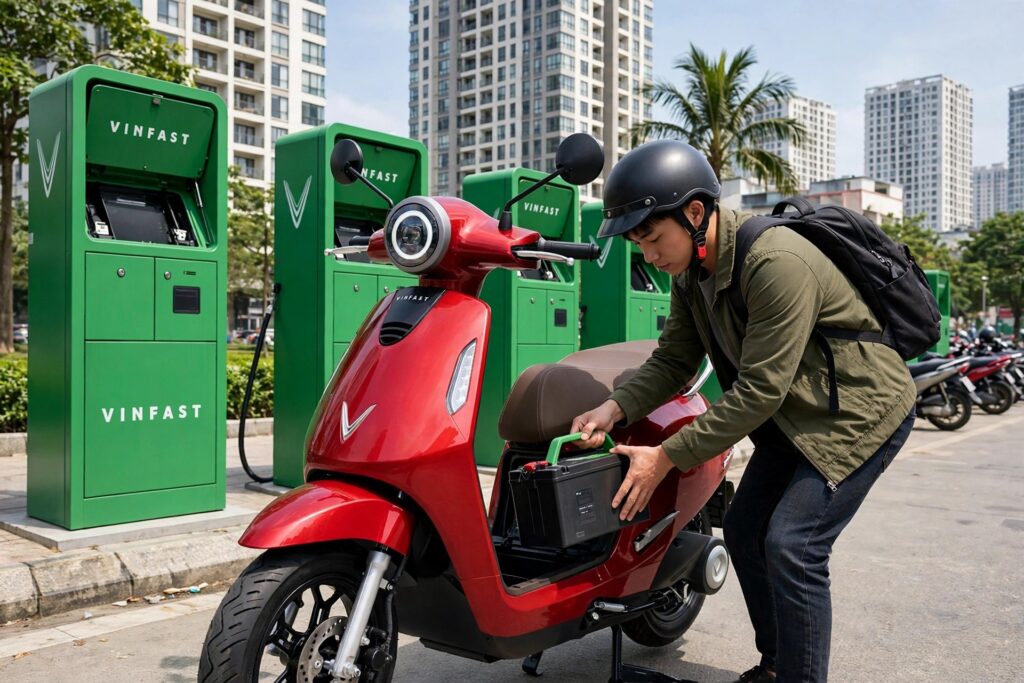
The workaround is simple. A rider on a battery-swap electric motorbike stops at a public swap cabinet, hands over the used battery, and takes a fully charged one. The exchange takes about one minute, with no waiting at a plug and no need for a power outlet in the building.
Bao Ngoc, an office worker in Hanoi, is one of the residents who made the switch. Her apartment parking area has no charging infrastructure, and her long working hours mean she needs a fast way to add range. She chose a VinFast Evo, and now swaps batteries at cabinets near her home and workplace. “After work, I still have to pick up my child, go to the market, and then go home. If I see the battery is running low, I stop to exchange it on the way, and then continue on my way,” she said.
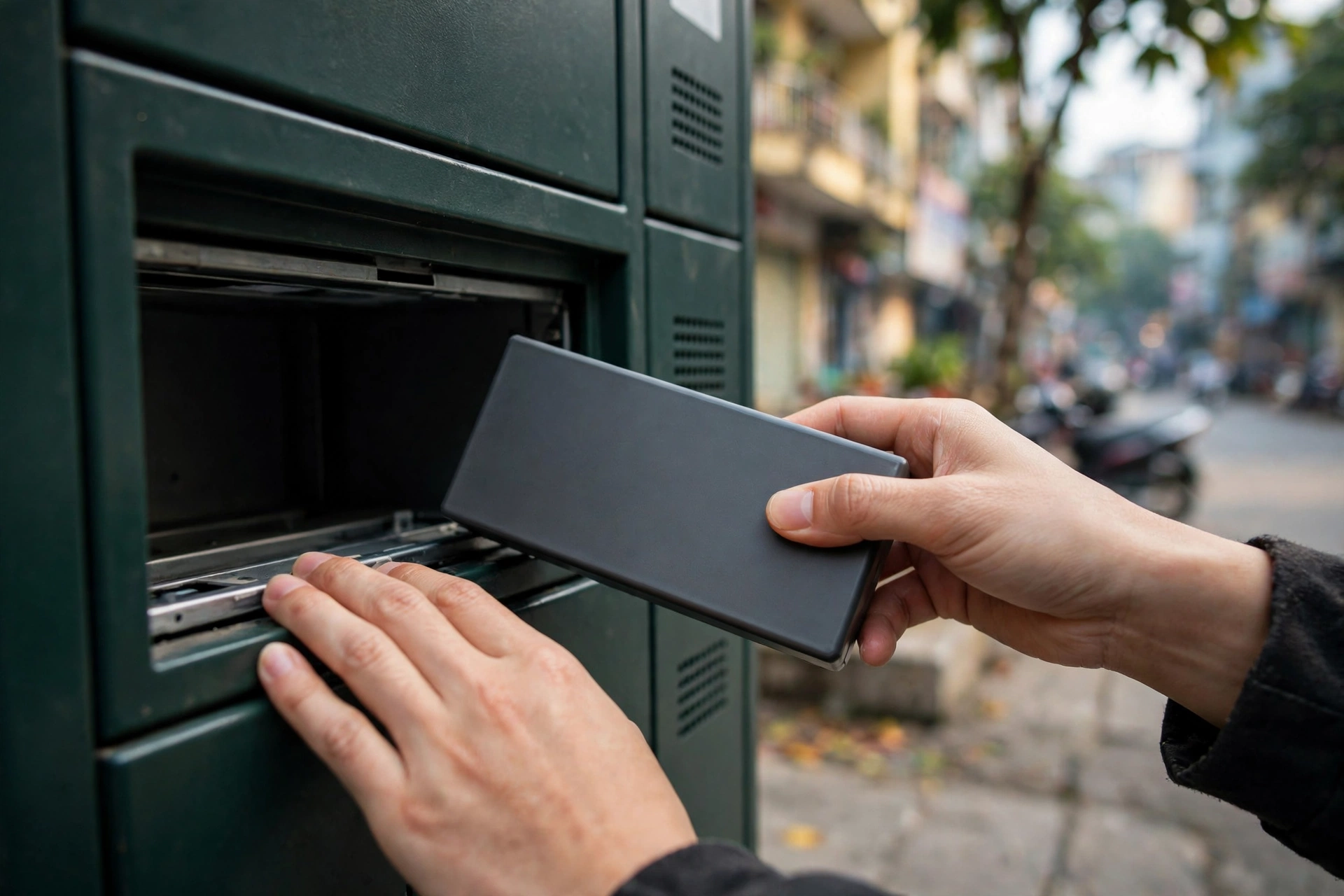
The network behind that convenience is growing fast. V-Green, the charging operator, says its battery-swap network has reached about 80,000 cabinets nationwide, with a plan for 150,000 by the end of 2026, VnExpress reported on October 24, 2026. The cabinets sit in residential areas, offices, parking lots, and shopping malls, so a rider can fit a swap into an ordinary trip.
The economics help too. VinFast is offering 20 free battery swaps a month until June 30, 2028, for riders using its battery-swap models. The bikes use LFP batteries, with a six-year vehicle warranty and an eight-year battery warranty, both with no mileage limit. Buyers who switch to a VinFast electric motorbike can receive up to VND 6 million in support under the second Green Future program, which runs to December 19, 2026.
Why apartments are the hard case
Apartment residents are the hardest riders to serve with plugs, and not only in Hanoi. Renters cannot rewire a building they do not own. Residents of older buildings often have no private parking outlet. Swapping removes the building from the equation: the energy is stored in a cabinet on the street, and the rider carries the charged battery home in the bike.
Ho Chi Minh City has taken the same logic further, betting on 20,000 sidewalk battery-swap cabinets to serve 400,000 service riders. The comparison that matters for a rider is not only swap against plug-in charging, but swap against home charging and leasing, which VoltViet examined in its comparison of the three ownership models. For a rider doing long daily distances, swapping trades a higher running cost for virtually no waiting time, and for an apartment resident that trade is often the only one available.
Swapping helps the grid too. The cabinets can charge their batteries outside peak hours, spreading the load that home plugs would concentrate in the evening.
The limits of the workaround
Swapping is a workaround, not a complete answer. It works only for bikes built for it, and only where the cabinets are. A rider on a plug-in model still needs a plug, and a rider far from the cabinet network still faces the same problem the seminar described.
Competition may widen the choice. Honda, the dominant maker of gasoline motorbikes in Vietnam, is now pushing into electric models, but its electric motorbikes offer ranges under 120 km per charge, while VinFast and Dat Bike offer up to 160 to 200 km, vnauto.net reported on October 25, 2026.
The public charging network also still needs the standards that make it trustworthy. From July 1, 2027, every public charger in Vietnam must meet five groups of national requirements under QCVN 32:2026, covering safety, interoperability, and payment. Apartment buildings will need their own version of that clarity: who pays for the wiring, who certifies it, and who is liable if it fails.
What to watch
Three checkable milestones will show whether the bottleneck is clearing. The first is guidance from the authorities the seminar called for: a clear procedure for apartment buildings to add charging infrastructure, with safety rules building managers can follow. The second is V-Green’s cabinet count, which should reach 150,000 by the end of 2026 if the plan holds. The third is the Green Future deadline of December 19, 2026, after which the VND 6 million switching support ends.
Until the buildings catch up, the swap cabinet is doing the work the basement cannot. It is a partial solution, dependent on one operator’s network, but for a rider like Bao Ngoc it is the difference between waiting for infrastructure and riding electric today.
Sources
vietnam.vn, October 24, 2026: Apartment buildings still lack charging space; VinFast’s battery-swap electric motorbikes pave the way for residents to “go green.”: https://www.vietnam.vn/en/chung-cu-con-vuong-cho-sac-xe-may-dien-doi-pin-vinfast-mo-loi-len-xanh-cho-nguoi-dan
VnExpress, October 24, 2026: Battery-swap electric motorbikes, a solution for apartment residents: https://vnexpress.net/xe-may-dien-doi-pin-giai-phap-cho-cu-dan-chung-cu-5136439.html
Tien Phong, October 24, 2026: Green vehicle transition: untangling infrastructure bottlenecks for Hanoi apartment buildings: https://tienphong.vn/chuyen-doi-phuong-tien-xanh-go-nut-that-ha-tang-cho-chung-cu-ha-noi-post1888214.tpo
vnauto.net, October 25, 2026: Honda Vietnam aims to dominate Vietnam’s electric motorcycle market: https://vnauto.net/2026/10/25/honda-vietnam-aims-to-dominate-vietnams-electric-motorcycle-market/