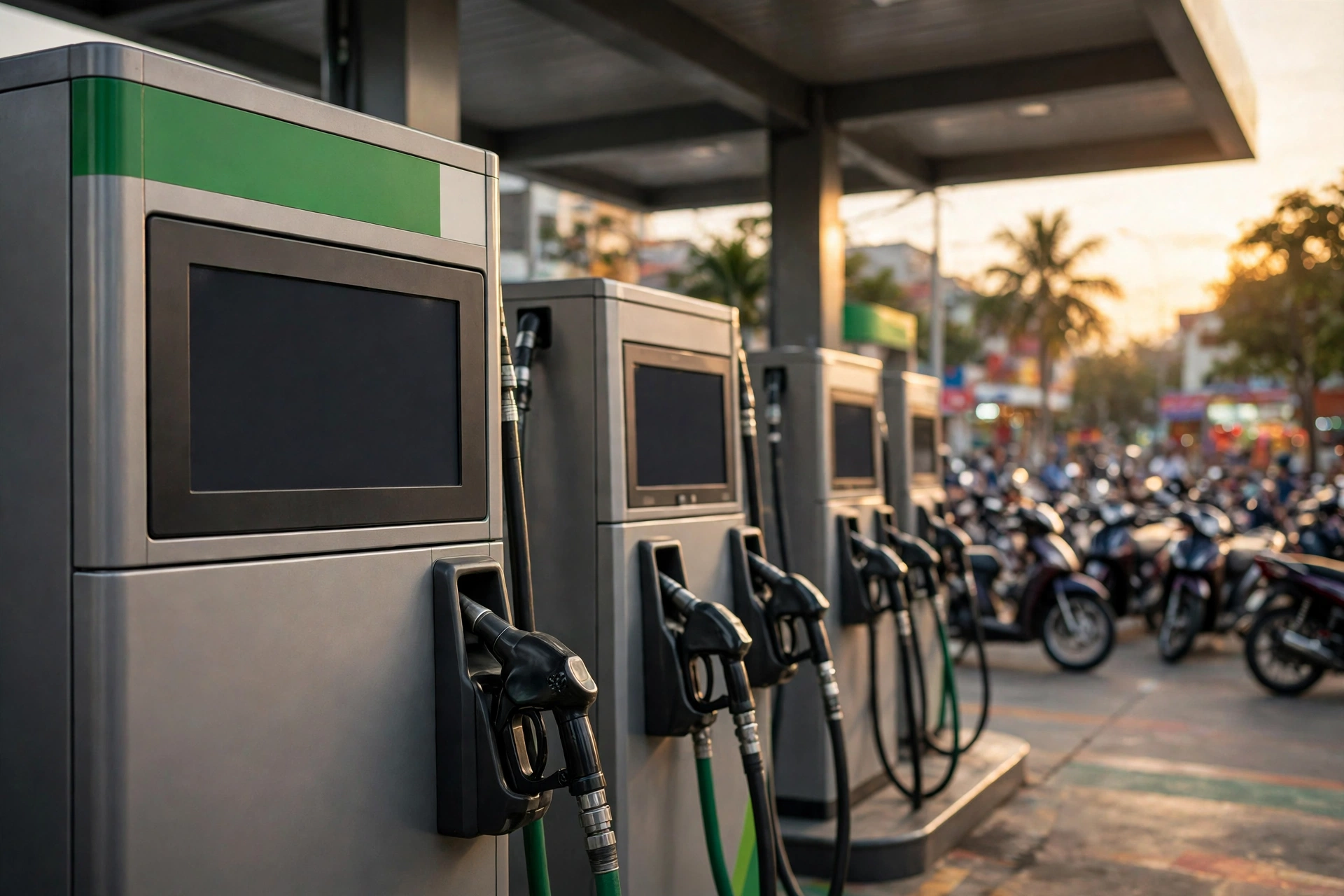
From 15:00 on October 29, 2026, filling a tank with biofuel E10 RON95-III costs less than filling it with standard E5 RON92 at pumps across Vietnam. In the latest fuel price adjustment, the Ministry of Industry and Trade (MOIT) set the ceiling price of E10 at VND 25,734 per liter against VND 26,027 per liter for E5, a gap of VND 293. The Ministry of Finance did not tap the petrol price stabilization fund in this round, MOIT reports.
The new price table
The adjustment affected every major grade. E5 RON92 rose VND 666 to a maximum of VND 26,027 per liter. E10 RON95-III rose VND 521 to a maximum of VND 25,734 per liter. Diesel 0.05S rose VND 696 to VND 30,246 per liter, and mazut 180CST 3.5S rose VND 223 to VND 23,596 per kilogram. All figures are the national ceiling prices published in MOIT’s official notice for the October 29, 2026, adjustment, effective at 15:00 Vietnam time.
The headline change is the crossover. E10, which blends 10 percent ethanol into a RON95 base, now sits below E5, which blends 5 percent ethanol into a RON92 base. Until this adjustment, the higher-octane biofuel had carried the higher retail price.
Why the cheaper fuel uses the costlier blend stock
The price flip does not come from crude. MOIT’s own comparison shows the world price of RON95 blending stock actually rose more than the price of RON92 blending stock in this cycle, by 0.564 USD per barrel, or about VND 91 per liter. Based on blending cost alone, E10 should have been the pricier fuel.
The flip comes from tax. Vietnam’s special consumption tax (SCT) applies at different rates by grade: 10 percent for mineral petrol, 8 percent for E5 and 7 percent for E10. The tax base price for E10 is also slightly lower, at VND 22,501 per liter against about VND 22,551 for E5. The result, according to the official breakdown, is an SCT cost of VND 1,575 per liter for E10 against VND 1,804 per liter for E5, a gap of VND 229 per liter.
That VND 229 tax gap accounts for most of the VND 293 retail gap. In other words, a deliberate one-percentage-point tax preference for the higher ethanol blend is doing more to set pump prices today than the world price of the fuel itself. That is policy working as designed: the tax code rewards the blend with more renewable content.
A zero-tax proposal is pending
A larger change is on the table but has not been decided. At the fuel price management meeting on October 27, 2026, Deputy Prime Minister Nguyen Van Thang ordered the Ministry of Finance to urgently review the legal basis, the authority to decide, and the impact of cutting special consumption tax on all petrol grades to zero percent. The proposed application window runs from November 1, 2026, through March 31, 2027.
This is a proposal under review, not a rule in force. The pump prices in effect today reflect the existing SCT rates of 7, 8 and 10 percent. If the proposal were adopted, analysis in Tien Phong suggests about VND 1,575 to VND 1,804 per liter of tax cost could be removed from retail prices, depending on the grade.
One caution comes from inside the industry. Do Hoang Ha of Petrolimex notes that the ethanol portion of the blend is already exempt from special consumption tax, so removing the tax entirely would affect each grade differently. The E10 that benefits from the current one-point gap would not necessarily gain the most from a zero rate.
What it means for the biofuel push
Vietnam’s move toward higher ethanol blends has historically depended on the pump-price signal, and today’s adjustment delivers it. The cleaner blend is now visibly the cheaper one. Whether the gap survives the next adjustment depends on world prices and on whether the tax preference stays in place, so today’s crossover is a data point, not a permanent ranking.
The international comparison also favors the current setup. MOIT puts Vietnam’s E10 at VND 25,734 per liter against about VND 32,550 in Thailand, VND 32,010 in Cambodia, VND 35,017 in China and VND 48,276 in Laos, among the lowest in the region.
The broader fiscal backdrop is unchanged for now. Government Resolution 43/2026/NQ-CP, dated September 30, 2026, extended import tax, environmental protection tax and value added tax relief for petrol through December 31, 2026, and the environmental protection tax on petrol remains at VND 0 per liter. Those reliefs, together with today’s tax-driven price gap, shape what drivers actually pay.
The biofuel story fits within a wider fuel transition. Hanoi’s plan to phase petrol motorbikes out of its low-emission zones is the demand-side push, while electric two-wheelers have reached a 27.6 percent share of new motorbike sales. E10’s new price advantage adds a supply-side nudge for the vehicles that still burn fuel.
Sources
MOIT official notice, October 29, 2026: https://moit.gov.vn/tin-tuc/thong-tin-ve-viec-dieu-hanh-gia-xang-dau-ngay-29-10-2026.html
tienphong.vn, October 29, 2026: https://tienphong.vn/neu-thue-tieu-thu-dac-biet-ve-0-gia-xang-co-the-giam-bao-nhieu-post1889686.tpo
moneyf.vn, October 29, 2026: https://moneyf.vn/tu-15-gio-ngay-2910-gia-ban-le-xang-dau-o-muc-nao-8agxtrhz