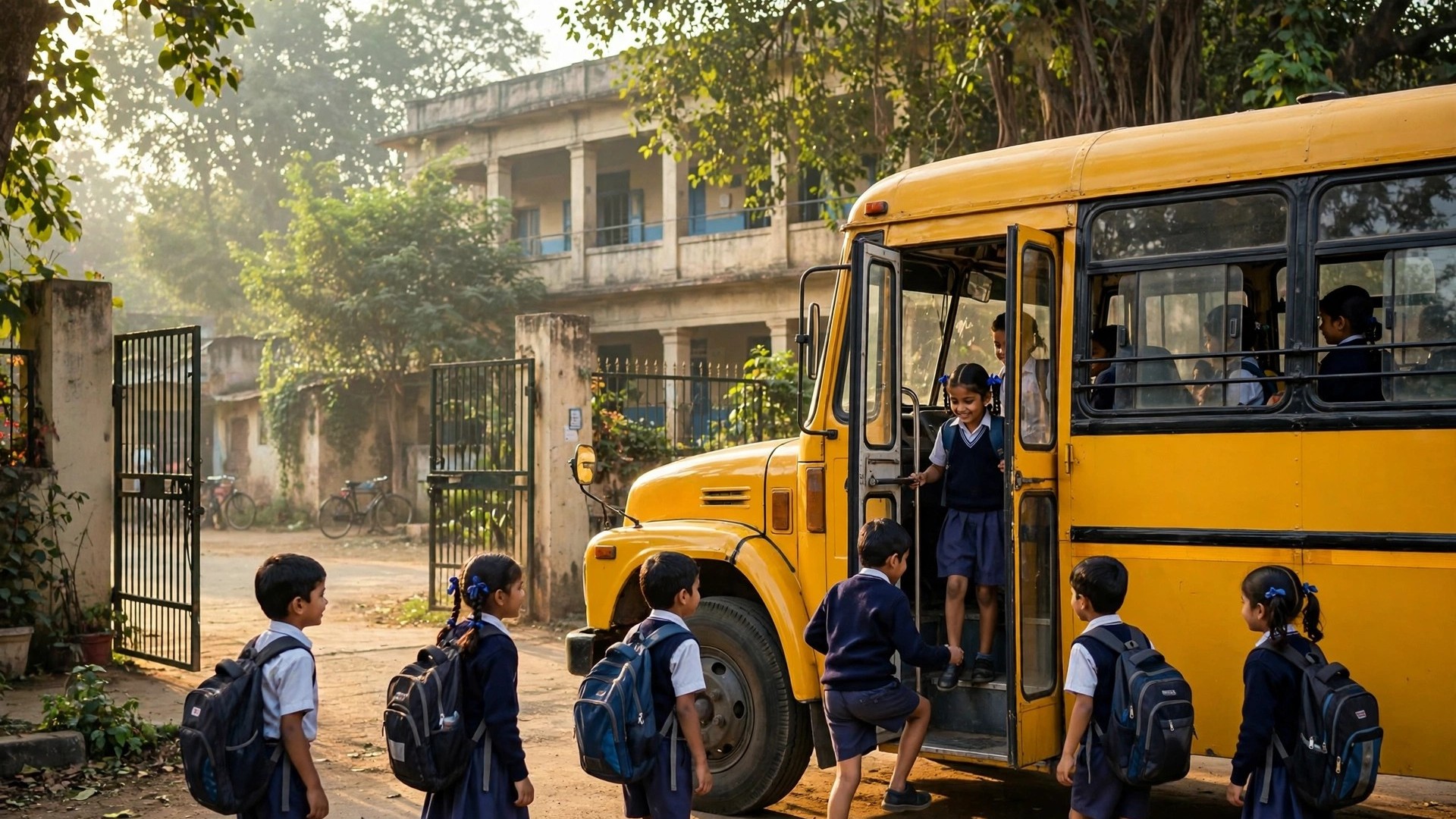
India’s electric bus rollout has so far been driven by city transport agencies. A senior World Bank specialist now points to a different candidate. He argues the first major private segment to electrify could be the yellow school bus, a vehicle that operates short daily routes and remains idle for most of the day.
The argument was presented at a panel on school bus electrification during the India Clean Transportation Summit 2026 in New Delhi, in a session titled Generation E: Electrifying India’s School Bus Fleet. Dr. Laghu Parashar, a senior transport specialist at the World Bank, estimated that between 30 and 35 percent of India’s 1.6 million privately operated buses are used for school transport, as reported by the trade publication Electrive. That share amounts to roughly 480,000 to 560,000 buses, a fleet larger than the entire public bus systems of many countries.
The case for school bus electrification
The case rests on how school buses are used. They typically run just 50 to 60 kilometers a day, Parashar said, a distance that falls well within the range of a current electric bus battery. They operate in two fixed shifts, morning and afternoon. Long idle periods fill the hours in between, and the buses park overnight. Slow alternating current charging, the cheapest way to charge, is enough to refill the battery in those windows.
Land is the third advantage. Schools often control space on their own grounds, where buses park and chargers can be installed on site. Many small private bus operators in India have no depot at all. They park on streets or under flyovers, which makes organized charging significantly harder.
“School transportation will be the first mover in the private sector,” Parashar said, according to Electrive.
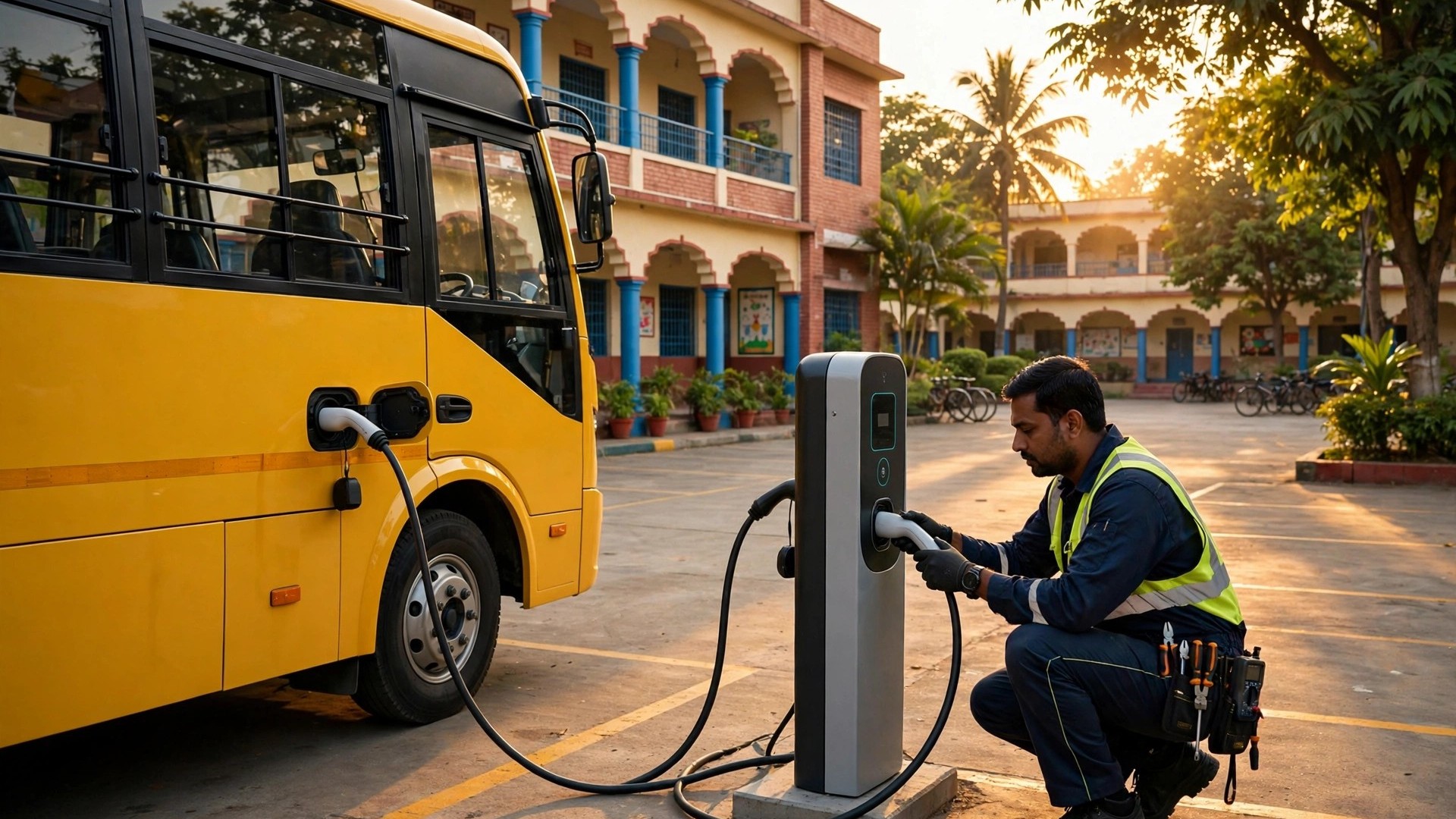
Delhi mandates school bus electrification
India’s capital is already implementing the model through binding regulations. The Delhi EV Policy 2026 to 2030 was formally issued on June 30, 2026. It requires school transport fleets to convert at least 10 percent of their vehicles to electric models within two years. The share rises to 20 percent within three years and reaches 30 percent by March 31, 2030. The requirement covers buses that schools own, lease, or hire. The city’s Education Department is responsible for compliance, according to an analysis of the policy by the International Council on Clean Transportation, published by ET Edge Insights. Under that timeline, the first 10 percent deadline is set for mid-2028.
A predictable mandate gives manufacturers and charging investors something the private bus market has lacked: a time-bound, measurable source of demand. Parashar proposed that the Delhi approach be scaled up across India.
Public programs supporting electrification
Public fleets still account for most of India’s electric bus momentum. Under the PM E-DRIVE program, the central government allocated 4,391 crore rupees, about US$490 million, to support 14,028 electric buses, according to the Press Information Bureau. The program works through state and city transport agencies on operating-cost contracts. Across successive central programs, support has now covered more than 31,000 electric buses.
The private side may not stay untouched for long. The Ministry of Heavy Industries is considering a new support scheme for heavy-duty electric vehicles that could reach private bus operators, Electrive reported. No such scheme has been formally announced, and its design will decide whether school fleets qualify.
Price and shared charging are the hard parts
The economics are not yet easy. An electric school bus currently costs nearly twice as much as a comparable diesel bus, Vinoth Kumar R of Switch Mobility said at the same panel. Many schools are not ready to pay that premium, according to C. K. Goyal of PMI Electro Mobility.
Charging economics also break down at small scale. A school running only five to ten buses cannot spread the cost of its own charging station thin enough. One answer discussed at the summit is shared infrastructure. School buses could charge at the public depots of the Delhi Transport Corporation for a small fee, with subsidized electricity, topping up after the morning run before returning to school in time for the afternoon shift.
There is also a passenger argument that rarely appears in fleet spreadsheets. School buses load and unload children at the curb, often in dense morning traffic. Removing diesel exhaust at exactly the places where children gather each day is a public health gain that cities can measure at the school gate.
None of this settles the timeline. The estimate behind the opportunity comes from one specialist’s reading of the fleet, and India’s private bus data is patchy. But the operating profile is hard to dispute. Short routes, fixed schedules, and long idle hours are exactly what early electric fleets need. If financing and shared charging follow the Delhi mandate, the vehicles that carry India’s children to school each morning could end up carrying its private bus transition as well.
Sources: Electrive, Schools could lead India’s private bus transition; Hindustan Times, Electric school buses gain traction; ET Edge Insights, What Delhi’s school bus mandate means; Press Information Bureau, PM E-DRIVE