A field that breathes
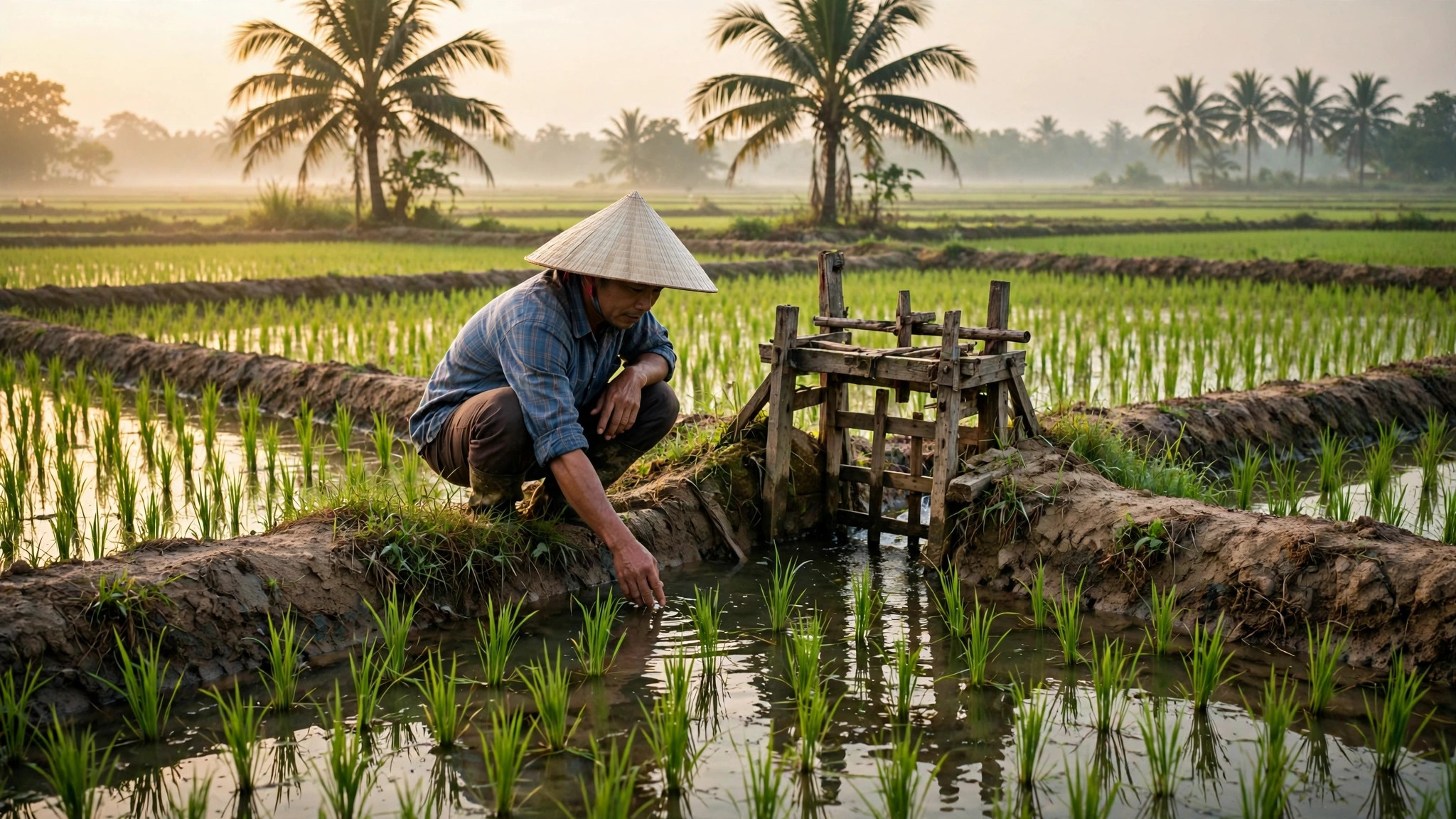
For generations, a healthy rice field in the Mekong Delta was a flooded field. Water stood on the paddies from transplanting to harvest, and the standing water did quiet chemical work in the soil: without oxygen, microbes produced methane, one of the most potent greenhouse gases. The new harvest being tested across the Delta asks farmers to do something that feels wrong the first time. Drain the field. Let the soil breathe. Then flood it again.
The technique is called alternate wetting and drying, and it sits at the heart of Vietnam’s programme for one million hectares of high quality, low emission rice in the Mekong Delta. In the model fields reported from Dong Thap province in September 2026, farmers ran three drainage cycles during the season, letting water levels fall well below the surface while neighbouring control fields stayed flooded as usual. The measured result was striking. Emissions from the model field were nearly one tonne of carbon dioxide equivalent per hectare per season lower than the control, and the emission rate per kilogram of rice fell by half, from 0.6 kilograms to 0.3 kilograms of carbon dioxide equivalent.
Less water, more rice
The surprise in Dong Thap was not the emission cut. It was the yield. Farming with less seed, less fertiliser and less water is usually sold to farmers as a sacrifice made for the climate. Here the numbers ran the other way. The model field yielded 6.4 tonnes per hectare, about 1.1 tonnes more than the control plot. At a fresh paddy price of VND 6,900 per kilogram, revenue reached VND 44.16 million per hectare, and profit after costs came to more than VND 21.85 million per hectare, nearly VND 11.8 million higher than the control, or about USD 454 at VND 26,000 to USD 1. Production cost per kilogram fell from VND 5,003 to VND 3,485.
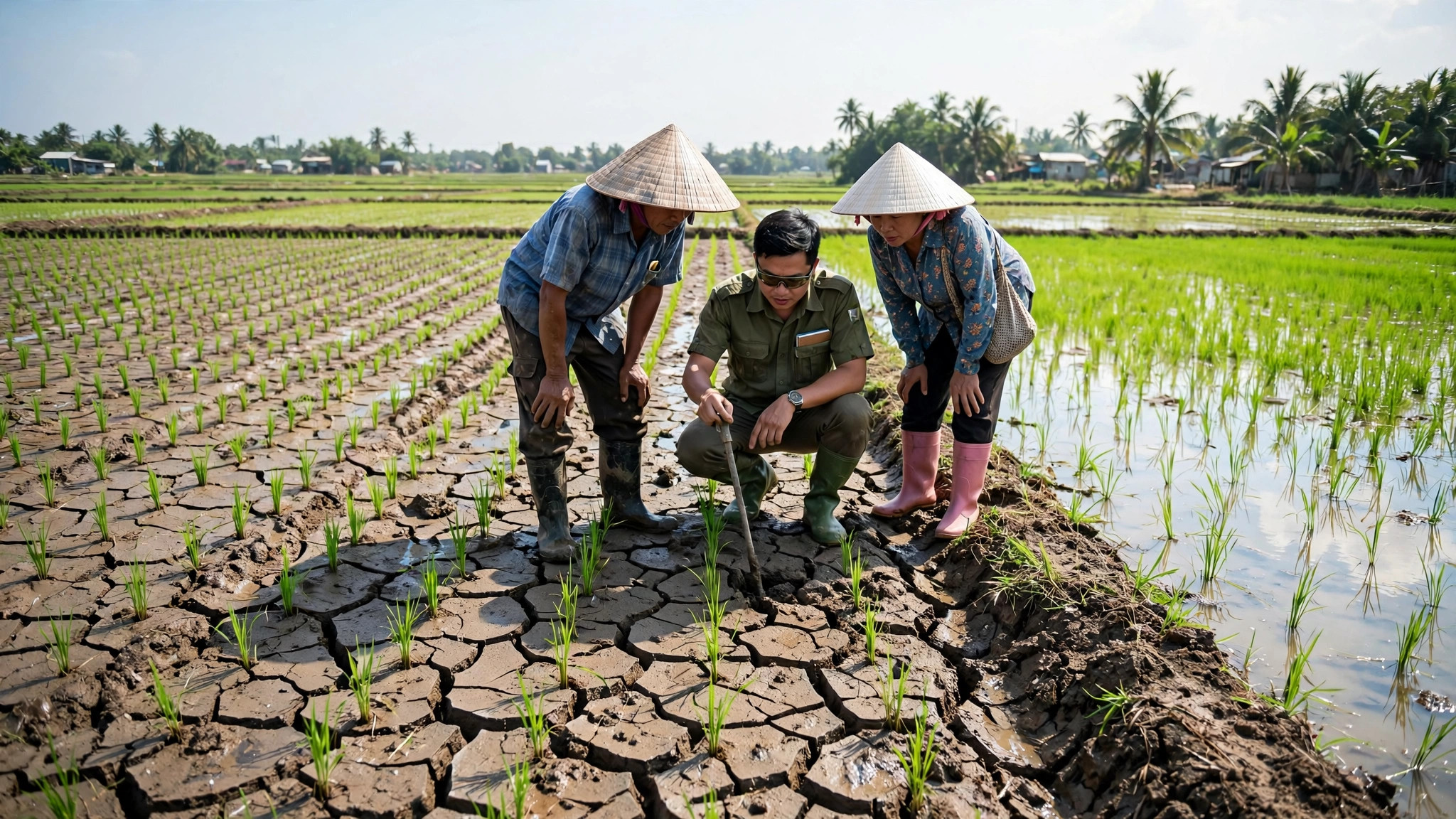
Provincial officials presenting the model drew the obvious conclusion: productivity, profit and emission reduction can coexist on the same field. That matters because the Delta programme will never scale on climate arguments alone. It will scale if a farmer in Dong Thap, An Giang or Kien Giang can see a neighbour earn more while pumping less water and buying less fertiliser. The carbon credit, when it arrives, is meant to be the bonus on top of a better crop, not the reason for growing it.
A programme measured in hundreds of thousands of hectares
The one million hectare programme, approved in 2023, is the vehicle carrying these field models across 12 Mekong Delta provinces and cities. Its stated goals for 2030 include cutting production costs by about 20 percent and raising farmer profits by about half. Reporting from a November working session in Can Tho, where the agriculture ministry met the World Bank, put the early progress in concrete terms: nearly 400,000 hectares were already being cultivated under sustainable practices, and about 20,000 hectares were set to apply formal measurement, reporting and verification procedures during the 2025 to 2026 winter and spring crop.
Behind those hectares sits serious money. In 2024 the World Bank committed a loan of USD 350 million to support the programme. The Transformative Carbon Asset Facility has committed a further USD 20 million linked to low emission rice, and ministry officials have asked the Bank to help protect that pledge and to extend preferential green credit so cooperatives can mechanise and turn rice straw into organic fertiliser instead of burning it. A separate infrastructure proposal discussed in Can Tho would add about USD 375 million, most of it World Bank lending, for irrigation, transport, logistics and mechanisation across the programme area.
Who actually gets paid, and when
This is the question farmers ask first, and it is the one with the slowest answer. A carbon credit is not paid for good intentions. It is paid for a verified tonne of avoided emissions, measured against a baseline, recorded under an approved protocol and sold to a buyer. Vietnam’s agriculture ministry has built a measurement, reporting and verification protocol for rice that now serves as the legal basis for provincial use, and the pilot models in the Delta have already produced measurable reductions that could form the basis for payments. But at the Can Tho session, officials were clear about timing: the government has set 2027 to 2028 as the earliest period for allowing the sale of rice carbon credits.
That sequencing is deliberate. Credits sold before the measurement system is trusted would fetch low prices and damage the programme’s credibility with the international buyers Vietnam wants. The intended flow of money, once sales open, runs from buyers through the programme to the farmers and cooperatives whose fields generated the reductions, with the World Bank’s carbon finance experience from the earlier VnSAT sustainable agriculture project as the template. That project raised farmer incomes by about 30 percent through more efficient water and input use and removed about 1.5 million tonnes of carbon dioxide, a stock of reductions Bank specialists have argued is ready to be monetised.
The hard seasons ahead
None of this is automatic. Alternate wetting and drying needs water control, which needs functioning canals, gates and coordination among neighbours sharing an irrigation block. One farmer draining while the next keeps flooding achieves little. The programme’s answer is organisation: larger fields, cooperatives and shared schedules, backed by the infrastructure investment now being prepared. Straw is the second test. Low emission rice still produces mountains of straw, and if it is burned or left to rot in flooded fields, part of the climate gain leaks away. Turning it into fertiliser, feed or substrate is where the green credit proposals come in.
The Delta farmer’s new harvest, then, is really three harvests. The first is rice that costs less to grow and sells as a higher quality product. The second is water and input savings that already show up in the Dong Thap profit figures. The third, arriving from 2027 to 2028 if the verification system holds, is a payment for carbon that was never emitted. The first two harvests explain why nearly 400,000 hectares have already joined. The third will decide whether the programme reaches its million.
Related reading
- Seven Trades and 1,310 Allowances: Vietnam’s Carbon Exchange Finds Its First Price
- One Delta, Two Crops: Rice Credits vs Shrimp Credits
- Biogas and Biomass: the Delta’s Other Renewable
Sources
Vietnam.vn reporting on the Dong Thap high quality, low emission rice model, September 2026, on drainage cycles, yield, profit and per kilogram emission figures. Vietnam News and VietnamNet reporting on the Can Tho working session between the Ministry of Agriculture and Environment and the World Bank, November 2025, on programme hectares, MRV rollout, the USD 350 million World Bank loan, TCAF funding and the 2027 to 2028 credit sale timing. Vietnam News reporting on the VnSAT project and World Bank carbon credit estimates for rice, 2026.