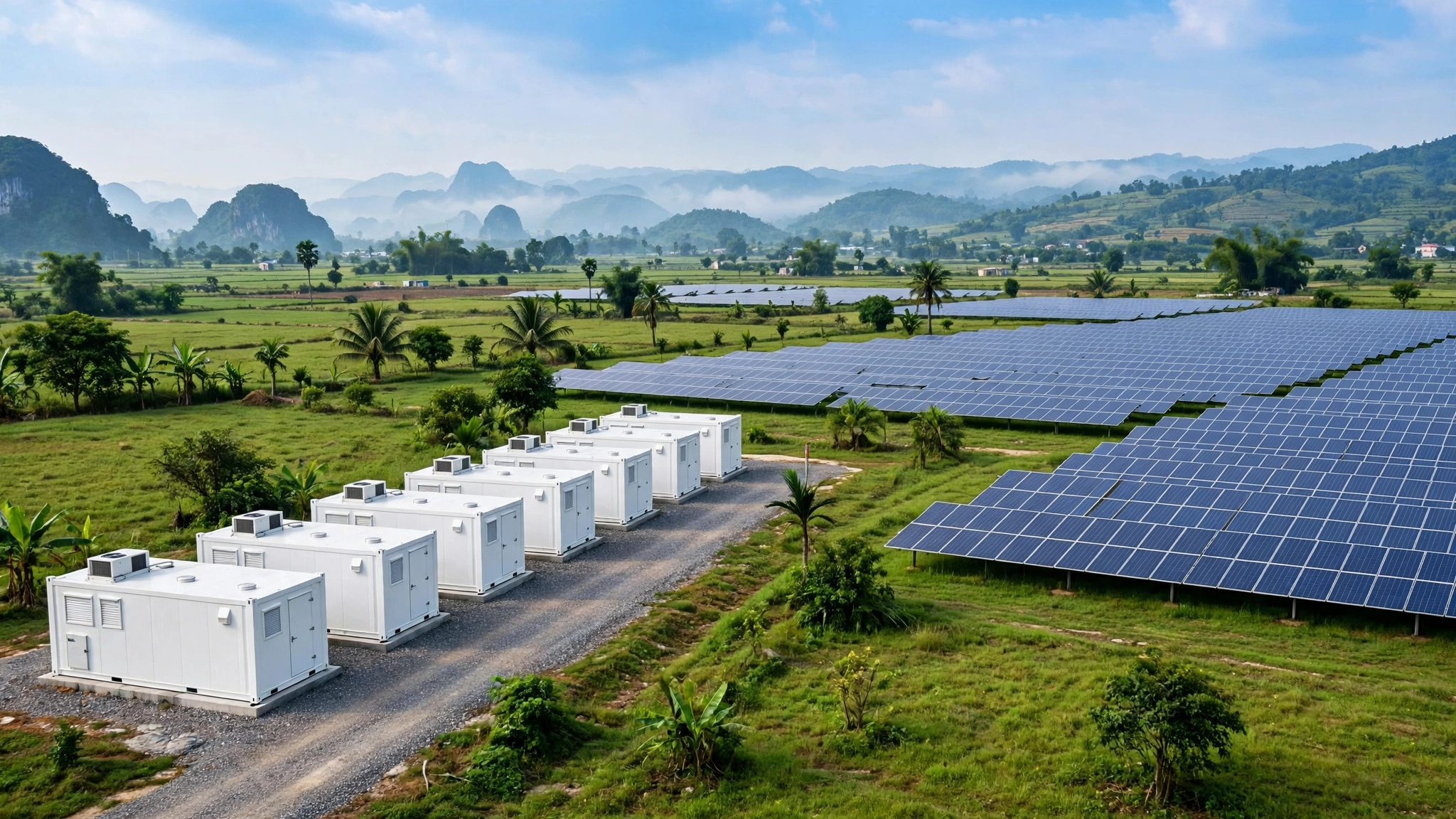
Standalone battery storage in Vietnam has a price ceiling for the first time. Decision 2987/QD-BCT, signed by the Ministry of Industry and Trade on November 11, 2026, sets the maximum generation price for standalone battery energy storage systems at VND 3,209.98 per kWh, excluding value added tax. The decision took effect on the day it was signed, and it completes the set of 2026 generation price frameworks the ministry issued in the same month for wind, solar and storage.
Document facts
Issuing body: Ministry of Industry and Trade
Document number: Decision 2987/QD-BCT
Signed: November 11, 2026
Effective: November 11, 2026 (from the signing date)
Status: In force
Unofficial English summary for reference only. Not a legal translation and not legal advice. The Vietnamese text linked at the end of this page is authoritative.
What the document does
The decision approves the 2026 generation price framework for battery energy storage systems, known as BESS, that operate as standalone facilities. It sets one number: a maximum price of VND 3,209.98 per kWh, excluding value added tax, for the type of storage system defined at point a, clause 2, article 1 of Circular 62/2025/TT-BCT. At roughly VND 26,000 to the dollar, that ceiling is about 12 US cents per kWh.
The decision rests on the Electricity Law 61/2024/QH15, Decree 351/2026/ND-CP on the organization of the ministry, and Circular 62/2025/TT-BCT, which sets the method for determining and approving generation price frameworks for storage systems. The ministry acted on proposals from Vietnam Electricity, dated June 17, 2026 and October 19, 2026, and on the recommendation of the Electricity Department. The decision was signed by Deputy Minister Truong Thanh Hoai.
The appendix publishes the six parameters used to calculate the ceiling: a storage cycle is assumed to have a two-hour discharge duration; the system is assumed to complete at least 8,000 charge and discharge cycles over its economic life; average capacity loss is 2 percent a year; round-trip efficiency is 85 percent; economic life is 15 years; and the off-peak retail electricity price for manufacturing used in the calculation is VND 1,146 per kWh.
What changes in practice
Before this decision, a developer building a standalone storage project had no published price reference to negotiate against. The ceiling now gives lenders, developers and Vietnam Electricity a common starting point for power purchase talks. It applies to storage systems connected to the national grid at 110 kV or above, with capacity of 10 MW or more, serving the needs of the national power system and consistent with power planning, which is the scope set by Circular 62/2025/TT-BCT.
The ceiling is a cap, not a purchase price. The actual generation price of each project is set under the method in Circular 62/2025/TT-BCT, from the project’s investment, operation and maintenance costs over its full life, with an internal rate of return of no more than 12 percent. No project is paid VND 3,209.98 per kWh automatically, and the decision does not by itself create a power purchase agreement. Under Circular 62, the investor must send the feasibility study documents to Vietnam Electricity within 15 days of the feasibility study being approved and the basic design being appraised. The timing matters: Vietnam’s revised Power Development Plan VIII, known as PDP8, sets a target of 10,000 to 16,300 MW of battery storage by 2030, and a published ceiling lets storage projects move from planning documents into financing discussions.
What changed from the previous rules
There was no previous standalone storage price to amend, so this decision creates a framework rather than replacing one. What existed before it was two related pieces. First, Circular 62/2025/TT-BCT, in force since January 26, 2026, already set the method, the file requirements and the approval procedure for a storage price framework. Decision 2987 applies that method and publishes the resulting number; it does not change the method. Second, Decision 2946/QD-BCT of November 5, 2026 set the 2026 generation price framework for solar power, with separate bands for solar plants paired with storage, and storage paired with a solar plant had to be at least 10 percent of the plant’s capacity with two hours of storage and discharge.
The change is therefore one of scope. Storage built together with a solar plant was already priced inside the solar framework. Storage built on its own, selling grid services to the national system, had no price at all. Decision 2987 closes that gap with its own ceiling, and it is the first time the ministry has published a maximum price for storage as a standalone generation type.
Who is affected
Developers of grid-scale standalone storage are the direct audience, along with their lenders and the engineering firms that build the systems. Vietnam Electricity is the counterparty that will negotiate project prices under the ceiling and receive the feasibility documents. Solar developers gain a comparison point: a standalone storage project is now priced on its own terms, separate from the solar-plus-storage bands in Decision 2946.
Two groups are not covered. Behind-the-meter storage at factories or industrial parks, which sits behind a customer’s own meter rather than selling to the grid, is a different model and is not priced by this framework. Household storage is outside it as well. The decision speaks only to storage systems that connect to the national grid and serve system needs.
Notes for investors and operators
Read the ceiling as the top of a negotiation, not as revenue. A project that models its income at VND 3,209.98 per kWh will overstate its case, because the agreed price must come out of the Circular 62 method and stay within the ceiling. The appendix parameters are also worth reading as a design signal: the ministry’s calculation assumes a two-hour discharge and 8,000 cycles, so a system built for shorter bursts or fewer cycles will price differently under the same method. Watch the calendar as well. This is the 2026 framework, issued in November 2026, and price frameworks in this sector are set year by year. A project that reaches financial close in 2027 will need the 2027 framework, which the ministry has not yet issued.
What businesses should do next: developers with a standalone storage project should send the feasibility study and appraised basic design to Vietnam Electricity within 15 days of approval, as Circular 62 requires, and open price discussions from the published ceiling rather than from an assumed tariff. Lenders should test project models against the appendix parameters, above all the two-hour discharge, the 8,000-cycle life and the 85 percent efficiency, and confirm that the project meets the 110 kV and 10 MW thresholds for the framework to apply.
Sources and the official text
Thu Vien Phap Luat (legal database), Decision 2987/QD-BCT, November 11, 2026, full text: https://thuvienphapluat.vn/phap-luat/ho-tro-phap-luat/quyet-dinh-2987qd-bct-phe-duyet-khung-gia-phat-dien-loai-hinh-he-thong-pin-luu-tru-nang-luong-nam-2-301341.html
LuatVietnam (legal database), Decision 2987/QD-BCT, November 11, 2026, full text: https://luatvietnam.vn/dien-luc/quyet-dinh-2987-qd-bct-2026-phe-duyet-khung-gia-phat-dien-he-thong-pin-luu-tru-nang-luong-455916-d1.html
CNC Counsel, November 11, 2026, update on renewable generation price frameworks from November 2026, including the first standalone storage ceiling: https://cnccounsel.com/an-pham/cap-nhat-khung-gia-phat-dien-nang-luong-tai-tao-tu-thang-11-2026
Bao Dau Thau, November 12, 2026, report on the 2026 BESS generation price framework and its calculation parameters: https://baodauthau.vn/khung-gia-phat-dien-bess-nam-2026-toi-da-320998-dongkwh-post212487.html
About this explainer: VoltViet prepared this summary in English from the official Vietnamese text so that investors and operators can follow what the document does. It is a reading aid, not a translation of record and not legal advice. Where any wording here differs from the Vietnamese text, the Vietnamese text governs. For decisions with legal or financial consequences, rely on the official text linked above and take advice from a qualified Vietnamese lawyer.
—
Related reading
More explainers from the Policy & Law desk, and reporting from the Clean Energy desk.