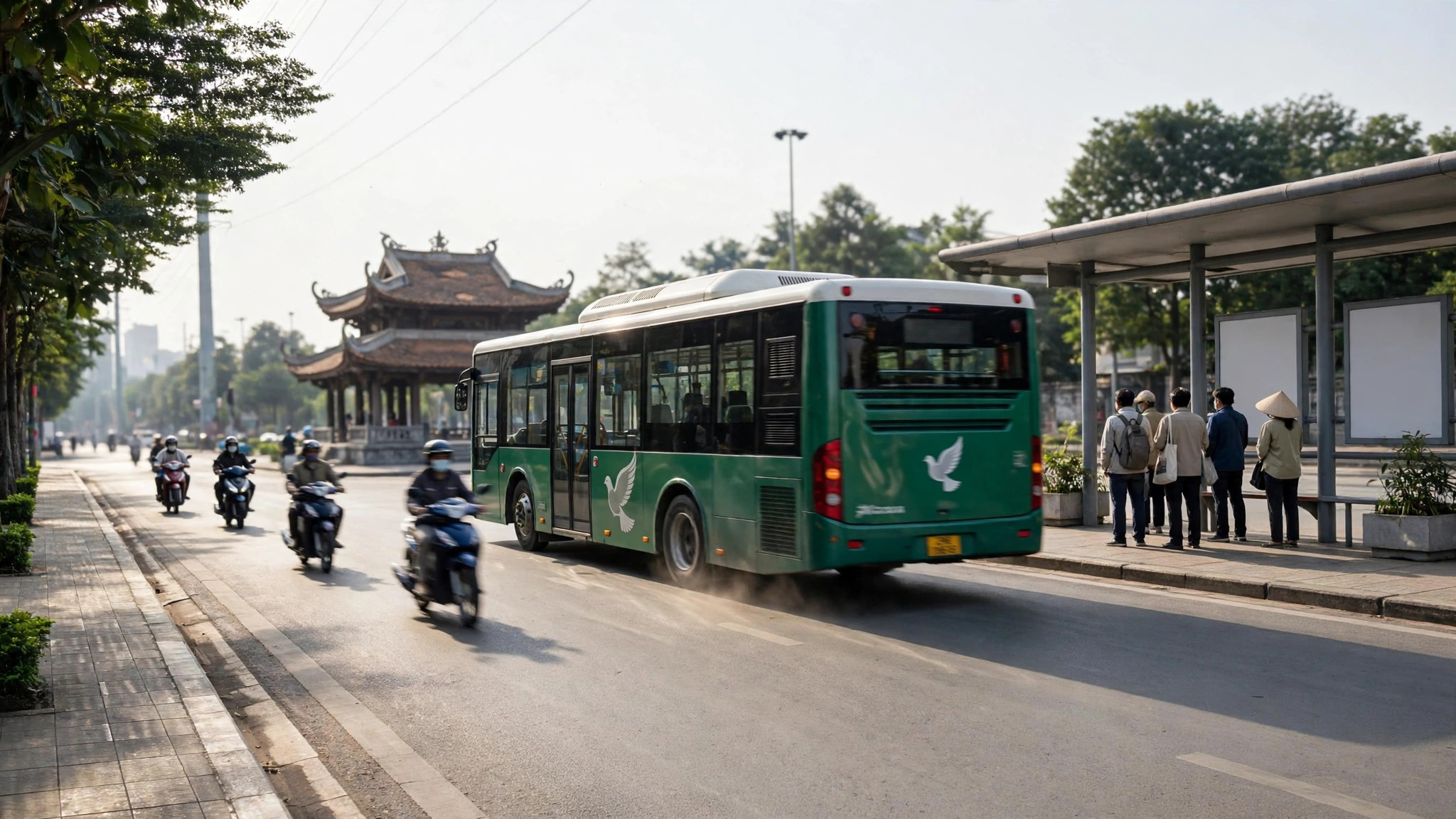
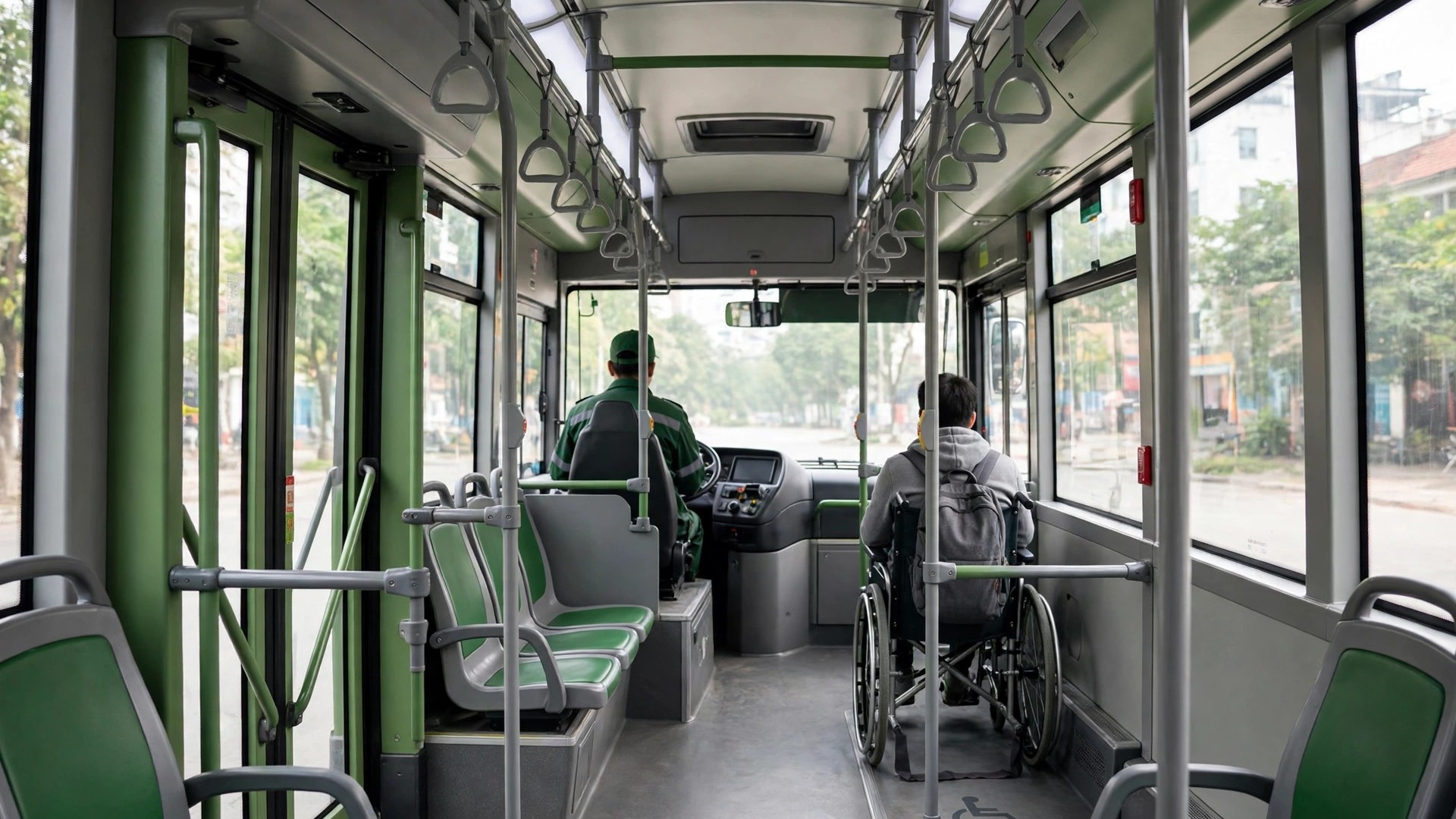
On November 7, Hanoi’s bus operator Transerco replaced all diesel buses with 31 electric buses on three routes. They are 03B, from Nuoc Ngam Bus Station to Giang Bien in Long Bien; 28, from Nuoc Ngam to Dong Ngac and the University of Mining and Geology; and 100, from Long Bien to Dang Xa in Gia Lam. The operator also adjusted the timetable on route 100 to suit electric-bus operation. The new buses carry 60 passengers each, wear the green Hanoibus livery with a dove and the Khue Van Cac pavilion, and have low floors and fittings for passengers with disabilities.
The 31 buses are the latest step in a conversion that has moved fast. By the end of October 2026, Transerco had put 375 electric buses into service on 24 routes. Of those, 281 ran on 17 routes in the first half of the year and 94 on seven routes in October alone. On November 1, the operator put 15 more electric buses on route 40, from Thong Nhat Park to Van Lam in Hung Yen, replacing all diesel buses there too. Adding the 31 buses from November 7 brings the calculated total to 421 electric buses in service. That figure is calculated from Transerco’s own figures, not a figure the operator has officially announced.
The pace is the story. In the first six months of the year, Transerco converted 17 routes. In October it added seven more. In the first week of November it has converted four routes, 40 and now 03B, 28 and 100, in the space of a week. A municipal program that once seemed a distant 2030 deadline is now arriving route by route, in visible batches, on the streets of the capital.
The buses themselves
The route 40 buses, the batch before this one, show what passengers are getting. They are 15 VinFast EB8 buses, 8.6 meters long, carrying 60 passengers. Each has a 200 kW motor, a 359 kWh LFP battery, a range of more than 290 km and 120 kW DC fast charging. Thirteen of the 15 are in regular operation. Transerco has not named the model of the 31 buses put into service on November 7, and this article does not assume it: the October batches mixed VinFast Green Bus and EB8 models, and the November 7 batch may or may not match them.
What is consistent across the batches is the service standard. The new buses are low-floor, with boarding aids for passengers with disabilities. The green livery, with the dove and Khue Van Cac pavilion, marks them as part of one system rather than a trial. The route 100 timetable change is a small detail that matters: electric buses charge and run on different schedules from diesel buses, and the operator is adjusting schedules to fit the vehicles rather than forcing the vehicles to fit old schedules.
An earlier wave set the pattern. On October 5 and 6, Transerco put 53 VinFast electric buses into service on routes 22A, 22B, 30 and 50. The batch mixed 28 Green Bus models and 25 EB8 models. The November batches follow the same model of full-route replacement rather than mixing electric and diesel buses on the same route, so passengers on a converted route ride electric buses every time, not sometimes.
The 2030 target, and the 2026 one
Transerco aims to have vehicles converted to green energy exceed 51 percent of its fleet by the end of 2026, above the target in the city plan. Hanoi’s municipal program, revised in May 2025, requires a full conversion to electric and green-energy buses by 2030. All buses inside Ring Road 4 must run on electricity. That total does not by itself show whether the 51 percent target is within reach, because Transerco’s total fleet size is not disclosed in the same reports, but the direction and the pace are both clear.
The bus program is the visible side of the capital’s green-transport policy. Hanoi’s low-emission zone began operating around Ring Road 1 in July 2026. The national government confirmed on November 5 that the wider transition to electric vehicles will be voluntary, with no mandatory switch for private owners (see our report on the directive). Buses are the part of the transition the city can control directly, and it is directing them quickly: the operator, not the market, decides which routes convert and when.
That control is also the program’s advantage. A private buyer weighs price, range and charging access before switching, and the switch takes years. A bus operator with a conversion target replaces whole routes at once. The effect on the street is immediate: every bus on route 03B, 28 or 100 is now electric, every day, for every passenger on those routes.
What to watch
Three questions follow from the November 7 batch. First, the year-end target: whether Transerco achieves more than 51 percent green vehicles in its fleet by December 31, and how many more routes convert in the remaining seven weeks of the year. Second, the infrastructure behind the buses: depot charging capacity has to grow with the fleet, and the operator has said little in public about it so far. Third, the question of vehicle models: whether the November 7 batch matches the VinFast models used in October, and whether other makers enter the supply.
Hanoi’s buses will not decide the city’s air quality on their own, and 421 electric buses are a fraction of the traffic on the capital’s roads. But the conversion is now seen as one of the fastest-moving parts of Vietnam’s electric transition, and it is moving in full routes rather than pilot projects. The next batch will say whether the pace holds.
Sources
Bao Xay Dung (Construction Newspaper), November 7, 2026: From November 7, 2026, Transerco replaced all diesel buses with 31 electric buses on routes 03B (Nuoc Ngam Bus Station to Giang Bien, Long Bien), 28 (Nuoc Ngam to Dong Ngac and the University of Mining and Geology) and 100 (Long Bien to Dang Xa, Gia Lam); route 100 timetable adjusted for electric-bus operation; 60 seats per bus, green Hanoibus livery with dove and Khue Van Cac; low floors and fittings for passengers with disabilities; 375 electric buses on 24 routes by end-October 2026, 281 on 17 routes in the first half of 2026 and 94 on 7 routes in October 2026; 15 electric buses on route 40 on November 1, 2026; Transerco aims for green-converted vehicles to exceed 51 percent of its fleet by end-2026, above the city plan. https://baoxaydung.vn/transerco-tang-toc-xanh-hoa-bo-sung-31-xe-buyt-dien-tren-3-tuyen-192261107095627118.htm
Tap chi Xay Dung (Construction Magazine, transport section), November 7, 2026: Hanoi continues to put 31 electric buses into service on three routes 03B, 28 and 100 from November 7, 2026, replacing diesel buses. https://giaothong.tapchixaydung.vn/ha-noi-tiep-tuc-dua-31-xe-buyt-dien-vao-khai-thac-tren-3-tuyen-183290000000002554.htm
electrive, November 2, 2026: Hanoi converts bus route 40 to all-electric operations from November 1, 2026 with 15 VinFast EB8 buses, 8.6 meters, 200 kW motor, 359 kWh LFP battery, more than 290 km range, 120 kW DC fast charging, 60-passenger capacity, built in 2026, 13 of 15 in regular operation; Hanoi municipal program revised May 2025 requires full conversion to electric and green-energy buses by 2030, all-electric inside Ring Road 4. https://www.electrive.com/2026/11/02/hanoi-converts-another-bus-route-to-all-electric-operations/
Sustainable Bus, October 13, 2026: 53 VinFast electric buses on routes 22A, 22B, 30 and 50 on October 5 to 6, 2026, 28 Green Bus and 25 EB8 models. https://www.sustainable-bus.com/electric-bus/hanoi-53-vinfast-electric-buses-transerco/