Every watt a server consumes becomes heat, and in the tropics that heat has nowhere forgiving to go. A traditional data hall moves heat with air, and air is a weak courier: it takes large volumes, large fans and constant chilling to carry energy away from a processor. That model worked while a rack of servers drew 5 to 15 kilowatts. Artificial intelligence hardware broke it. The Tay Ninh AI data center proposal reported in August 2026 specifies designs up to 150 kilowatts per rack, ten times the old norm, using direct liquid cooling and immersion cooling. This explainer walks through why air fails at that density, how the two liquid approaches differ, and why a tropical climate changes the engineering answers.
Step one: find the density where air stops working
Air cooling fails gradually, then completely. Fans must move ever more air through ever denser servers, fan energy climbs steeply, and hot spots form where airflow cannot reach. Guidance summarised from Uptime Institute analysis puts the practical crossover clearly: below about 20 kilowatts per rack, well managed air cooling with containment usually works; through the middle densities, hybrid approaches appear; above about 50 kilowatts per rack, liquid cooling is typically employed for high performance computing and AI hardware. Operators can spread equipment across more racks to stay under that line, but that trades away the density that AI clusters are built to achieve and still leaves fan power consuming a meaningful share of load. At 100 kilowatts and above in a single rack, moving the required air through the box becomes a mechanical problem before it is an economic one.
Step two: direct to chip liquid cooling
The first liquid answer brings coolant to the hottest components. Cold plates sit directly on processors, and a sealed loop carries heated liquid to a coolant distribution unit, which exchanges the heat into the facility water system. The rest of the server, memory, storage and power supplies, still releases some heat to room air, so direct to chip systems are hybrids: liquid removes the majority of heat at source, and a smaller air system handles the remainder. The attractions are practical. Servers keep familiar rack shapes, maintenance resembles plumbing plus electronics rather than a full process change, and operators can retrofit rows one at a time. At Data Centre World Asia in Singapore on 29 to September 30, 2026, suppliers including INVT showed modular liquid cooled systems built around exactly this pattern, integrating liquid cooled cabinets, coolant distribution units with redundant pumps, leak detection and real time temperature and pressure monitoring. That product direction matters for Southeast Asia, because it turns liquid cooling from a bespoke experiment into a purchasable module.
Step three: immersion cooling
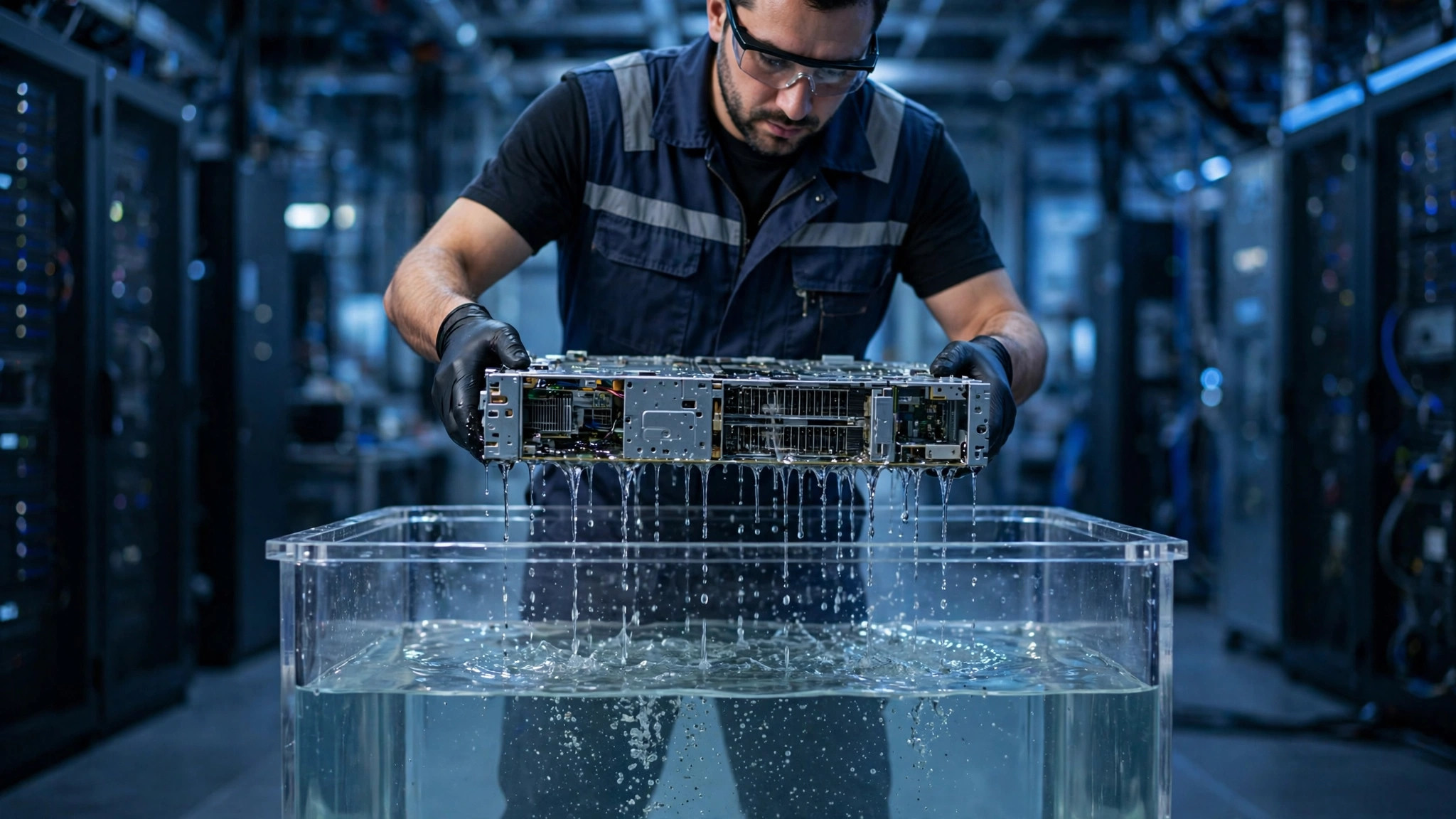
Immersion takes the logic to its limit. Whole servers are submerged in a dielectric fluid that does not conduct electricity, and heat passes from every component into the liquid, which is then cooled through heat exchangers. Fans inside servers can be removed entirely, and densities well beyond direct to chip designs become manageable. The costs are operational rather than thermal. Technicians lift wet, heavy servers from tanks for maintenance, fluid must be managed and kept clean, hardware warranties and service habits built around dry racks need rewriting, and not every component or connector is immersion ready. Immersion therefore appears first where density is extreme and the operator controls the whole stack, while direct to chip spreads faster through general AI facilities. Both approaches share one tropical advantage: liquid loops reject heat at higher temperatures than chilled air systems, which reduces the penalty a hot, humid climate imposes on refrigeration.
Step four: why the tropics punish the old model
In a temperate climate, operators can use cool outside air for part of the year, the free cooling that keeps the best northern facilities so efficient. Vietnam offers almost no such hours: wet bulb temperatures stay high, so chillers work hard in every month. That is one reason the global average efficiency measure, power usage effectiveness or PUE, has stalled near 1.52 to 1.54 in Uptime Institute survey reporting, with older air cooled floor space and hot climate regions holding the average up. PUE compares total facility power with IT power, so a figure of 1.5 means half as much power again is spent on cooling and electrical overhead. Liquid systems attack the largest part of that overhead, because moving heat in liquid takes far less energy than moving it in air and because warmer coolant loops can reject heat with less chilling. Vendor claims of figures near 1.1 should be read as design targets for specific new halls, not as guarantees for a whole site in a Vietnamese summer, but the direction is not in dispute.
Step five: what an operator in Vietnam should actually specify
The specification sequence now looks like this. Set the rack density from the workload first, because a 150 kilowatt design point forces liquid from the first drawing. Choose direct to chip for general AI capacity that must stay serviceable by ordinary data center teams, and reserve immersion for the densest, most controlled clusters. Design the facility water loop for tropical rejection temperatures, with redundancy in pumps and coolant distribution, leak detection everywhere liquid meets electronics, and monitoring that treats temperature and pressure as first class alarms. Then negotiate the power contract with the honest PUE range for that design, since a cooling choice that saves even a tenth of PUE across a 100 megawatt site frees capacity worth more than the plumbing costs. The cloud, in the end, is a heat engine with a software problem attached. In the tropics, the operators who solve the heat first are the ones whose specifications everyone else will copy.
Related reading
- A USD 3.5 Billion AI Data Centre Bet Lands in Tay Ninh
- Data Centers Are Power Projects Now
- ASEAN’s Data Center Map in 2026
Sources
Vietnam Investment Review, August 2026, on the Tay Ninh AI data center design targets, including direct liquid cooling, immersion cooling and densities up to 150 kW per rack. Uptime Institute analysis and survey reporting, 2025 to 2026, on liquid cooling typically being employed above 50 kW per rack and global average PUE stalling near 1.52 to 1.54. PR Newswire, October 2, 2026, on INVT liquid cooled modular systems with coolant distribution units shown at Data Centre World Asia in Singapore, 29 to September 30, 2026.