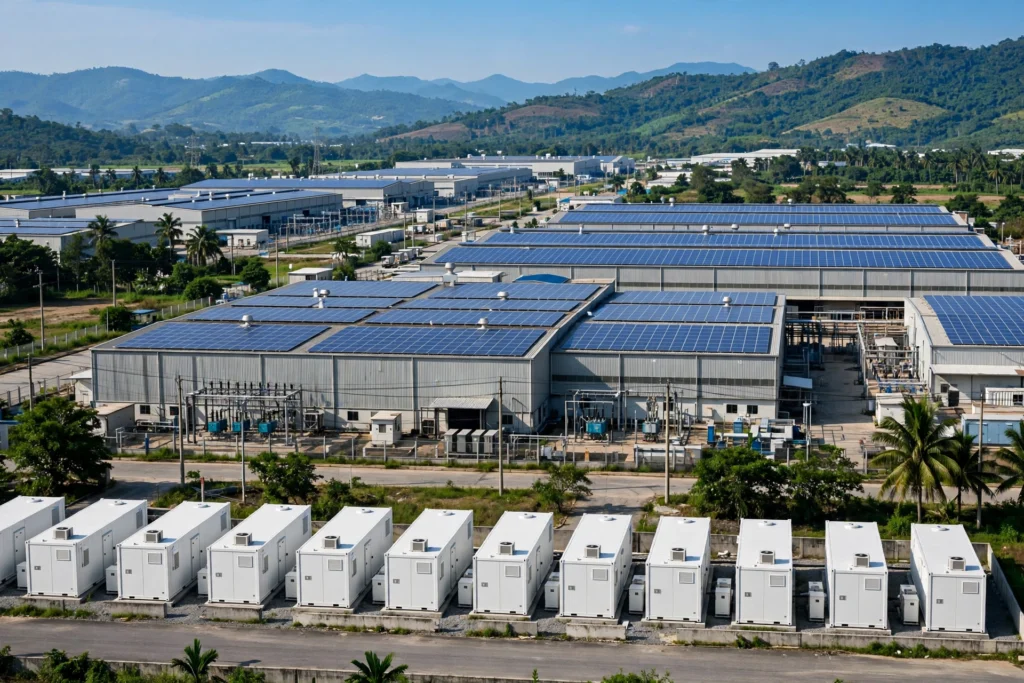
The Ca Mau People’s Committee office announced on November 1 that Vice Chairman Huynh Chi Nguyen has signed in-principle investment approvals for two wind power projects, Ngoc Hien-Tan An 1 and Dong Hai 6. The pair totals 90 MW with VND 3.73 trillion in registered capital, about USD 143.6 million. The approvals are the province’s latest major wind decisions and land as Ca Mau positions itself as the Mekong Delta’s wind energy center, a role the province has been building toward with a steady drumbeat of project-level decisions through 2026.
The larger project, Ngoc Hien-Tan An 1, is planned at 60 MW with ten 6 MW turbines and VND 2,714 billion in capital, spanning Tan An and Phan Ngoc Hien communes with a sea area of more than 362 hectares. Its distinctive feature is shared infrastructure: the project will use common facilities with the operating Tan An 1 wind farm, which cuts the cost of grid connection, access roads and substations that each standalone project would otherwise have to build alone. It is the kind of brownfield-adjacent development lenders prefer, because the counterpart asset is already generating. Construction is scheduled for the fourth quarter of 2026, equipment installation in the first quarter of 2027, and commercial operation in the second quarter of 2027, with a 50-year project life.
Dong Hai 6, the smaller project, is planned at 30 MW with VND 1,018.6 billion in capital in Dinh Thanh commune, on 10.34 hectares of land, and is expected to generate about 75 million kWh a year. Its schedule runs longer: construction in September 2027, or twelve months after approval, with operation in September 2028, or twenty-four months after approval, and a 50-year term.
Approval in principle is not a green light
The November 1 decisions grant in-principle investment approval, a Vietnamese administrative step that endorses a project’s location, scale and conditions without yet selecting the investor. The proposals came from Song Lam Hydropower Investment JSC for Ngoc Hien-Tan An 1 and XCE Energy JSC for Dong Hai 6, but the Department of Finance will lead an open investor selection process, and the final developers may differ from the proposers.
The distinction matters for anyone tracking Vietnam’s project pipeline. In-principle approvals create a queue of entitled projects; they do not guarantee construction. Vietnam’s wind history has examples on both sides: entitled projects that reached operation on schedule, and entitled projects that stalled for years waiting on grid connection or financing. The shared-infrastructure design of Ngoc Hien-Tan An 1 improves its odds, because the grid connection it would share with an operating farm is often the longest lead-time item in Vietnamese wind development.
The timelines also deserve a careful read. Ngoc Hien-Tan An 1’s eighteen-month path from approval to commercial operation is aggressive but plausible for a project piggybacking on existing infrastructure. Dong Hai 6’s schedule, with its built-in twelve-month and twenty-four-month alternatives, reads as the province giving itself room for the investor selection and land procedures to run their course. This kind of schedule framing is normal in Vietnamese project approvals; the test is whether the selection process moves.
The delta’s wind bet
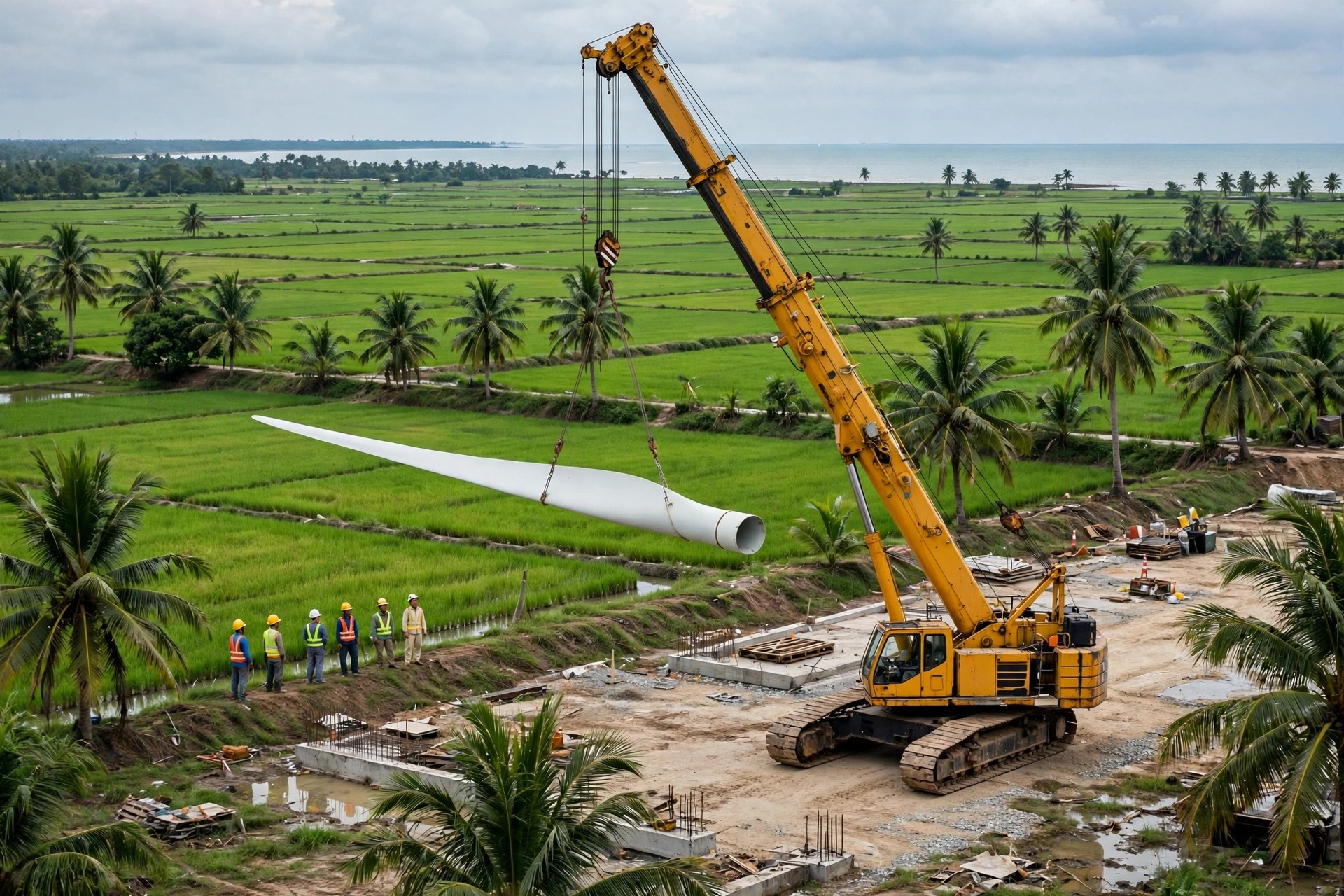
The two approvals fit a larger provincial plan. Ca Mau is targeting about 2,409 MW of new wind capacity by 2028 under its provincial program, and the province has stated an ambition of roughly 1,000 MW of offshore wind by 2030, aiming to become a regional energy and power-export hub. The 90 MW approved on November 1 is a first installment, not the program itself.
The economics behind the bet are straightforward. The Mekong Delta coast has some of Vietnam’s more consistent nearshore wind, and the province’s shallow waters keep foundation costs below deep-offshore levels. Vietnam’s offshore wind export route to Singapore and the Danish-backed 1,000 MW offshore project show the direction of travel; Ca Mau’s nearshore pipeline is the lower-cost complement. Read the province’s full program in our earlier piece on the 2,409 MW plan.
What to watch next is the investor selection. If the Department of Finance runs the open selection on schedule and the shared-infrastructure model holds through contracting, Ngoc Hien-Tan An 1 could be generating by mid-2027, eighteen months after approval. For a province racing to build its wind credentials, that timeline is the real test.
The deeper logic is cost. Nearshore projects in the Mekong Delta avoid the deep-water foundations and long export cables that make true offshore wind expensive, while still capturing steadier coastal winds than onshore sites further inland. Sharing substations and grid connections between adjacent projects, as Ngoc Hien-Tan An 1 plans with Tan An 1, trims the capital cost further. If Ca Mau can standardize that model across its 2,409 MW program, the province’s wind will compete less on subsidies and more on its own economics, the more durable basis for scaling.
Sources
vietnamplus.vn (Vietnam News Agency), November 1, 2026, reporting the Ca Mau People’s Committee office announcement: Vice Chairman Huynh Chi Nguyen signed in-principle investment approvals for two wind projects on November 1, 2026; Ngoc Hien-Tan An 1 (60 MW, ten 6 MW turbines, VND 2,714 billion, Tan An and Phan Ngoc Hien communes, sea area over 362 ha, shared infrastructure with Tan An 1 wind farm, construction Q4/2026, equipment installation Q1/2027, commercial operation Q2/2027, 50-year term) proposed by Song Lam Hydropower Investment JSC; Dong Hai 6 (30 MW, VND 1,018.634 billion, Dinh Thanh commune, about 75 million kWh a year, 10.34 ha, construction September 2027 or 12 months after approval, operation September 2028 or 24 months after approval, 50-year term) proposed by XCE Energy JSC; Department of Finance to lead open investor selection; Ca Mau’s target of about 1,000 MW offshore wind by 2030 and regional energy hub ambition. https://www.vietnamplus.vn/ca-mau-bo-sung-90-mw-dien-gio-voi-hai-du-an-hon-3733-ty-dong-post1145514.vnp