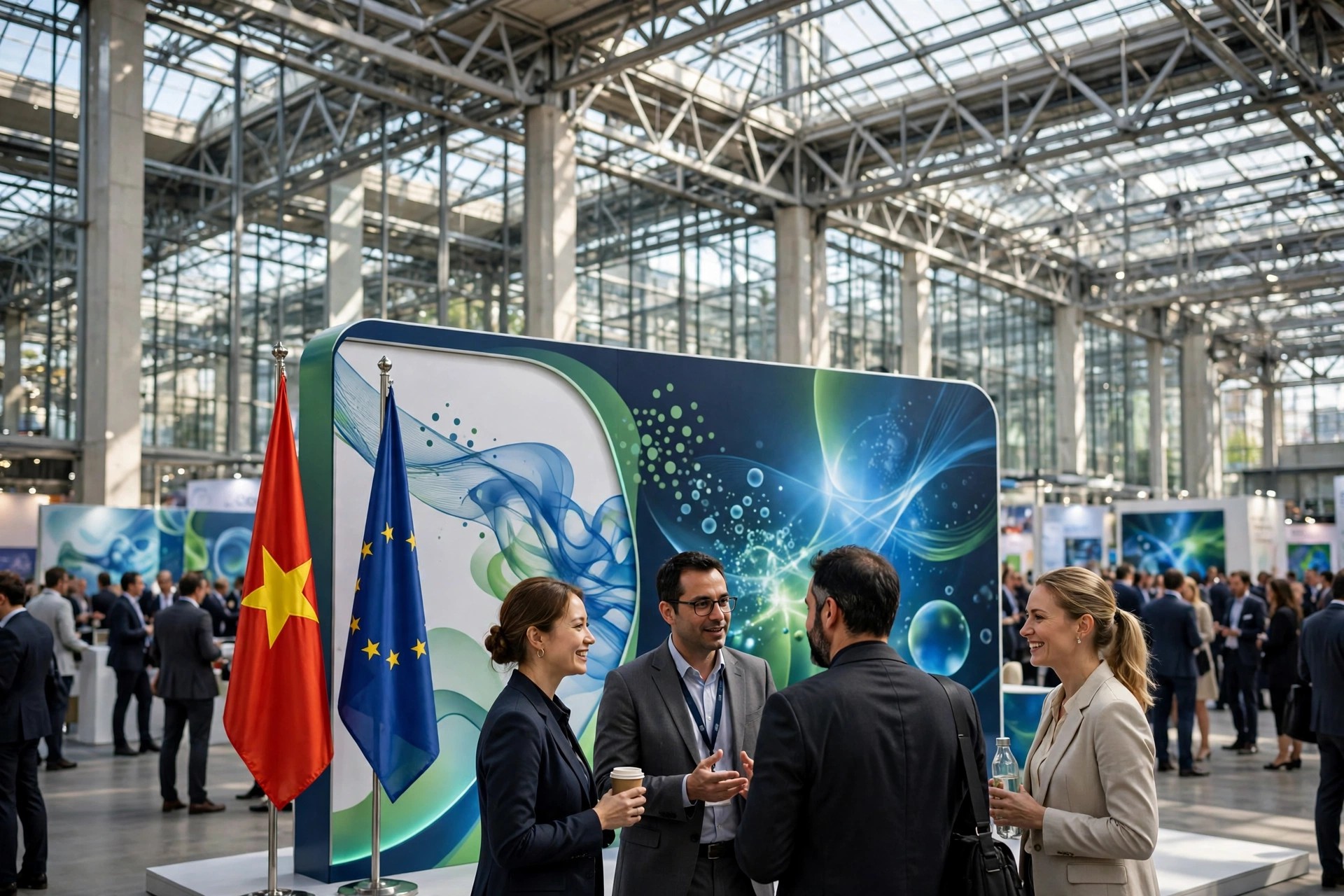
Vietnam had its own stand at European Hydrogen Week for the first time, as the five-day event closed at Brussels Expo on October 30. According to the Vietnam Trade Office in Belgium and the European Union, which organized the stand, the delegation used the week to pitch Vietnam’s offshore-wind potential and national hydrogen targets to European investors and technology firms.
The event itself is independently documented. The European Commission’s events calendar lists the 2026 edition for October 26 to 30 at Brussels Expo. It was co-organized by the Commission, Hydrogen Europe and the Clean Hydrogen Partnership under the theme “Scaling Hydrogen, Strengthening Resilience”. It was the seventh edition of Europe’s main annual hydrogen gathering; the sixth, according to the Clean Hydrogen Partnership, took place in Brussels in late September and early October 2025.
What the week looked like
The Brussels program featured three stages: the High-Level Policy Conference, the B2B Forum and the Innovation Forum. The Innovation Forum ran on October 27 and 28. Organizers advertised more than 220 exhibitors and over 9,000 attendees, with more than 200 speakers across the hydrogen value chain. The schedule closed with a site visit to the Port of Antwerp-Bruges on October 29, focusing on the role of ports in hydrogen supply chains. For Vietnam, that final-day visit sat at the center of the pitch, which is as much about ports, logistics and export infrastructure as it is about production. The 2026 edition also named Japan as country partner, a sign of how national hydrogen pavilions now compete for the same European investor attention Vietnam was trying to capture.
What Vietnam put on the table
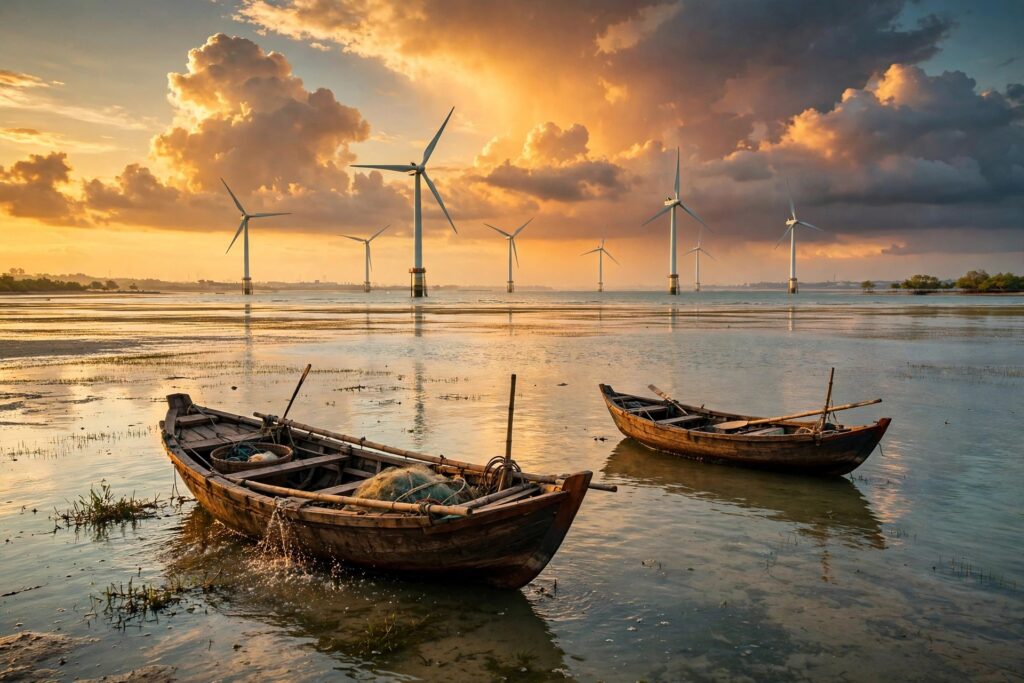
At the stand, the trade office promoted Vietnam’s estimated offshore-wind potential of more than 600 GW and a coastline of more than 3,000 kilometers. It also presented the country’s port and logistics conditions as favorable for producing and exporting clean energy. The briefing cited the national hydrogen energy development strategy to 2030, with a vision to 2050. The strategy sets targets of about 100,000 to 500,000 tonnes of hydrogen a year by 2030, rising to 10 to 20 million tonnes a year by 2050, in support of the country’s net-zero-by-2050 commitment.
Cooperation was organized into four groups. They cover hydrogen production from renewables plus green ammonia; storage, transport, pipeline and port infrastructure; hydrogen in industrial decarbonization and transport-fuel conversion; and hydrogen technology for steel, fertilizer, chemicals, cement and power generation. For context on the domestic pipeline side of that pitch, see our explainer on Vietnam’s green hydrogen pilots and the timelines for its planned hydrogen valleys; the steel angle is covered in our Hoa Phat green steel explainer.

What came back
According to the trade office’s account, more than 50 European partners visited the Vietnam stand to learn about the market and the country’s hydrogen policy. Some visitors already interested in hydrogen investment or cooperation told the delegation they saw a clear, specific direction in the plans on display. Others said they were ready to import and distribute Vietnamese hydrogen if the country establishes a hydrogen export market. The office frames the week as advancing Vietnam-EU green-economy cooperation. It cites the EU-Vietnam free trade agreement, the Just Energy Transition Partnership and the EU’s Global Gateway initiative.
A cautious read
Two points offer a cautious perspective. First, the account of the stand is self-reported. The vietnam.vn write-up is authored by the trade office itself, and the visitor figures above are its own count, not an independent tally. Second, the strategy targets are exactly that: targets. A 2030 production band of 100,000 to 500,000 tonnes a year is a policy ambition presented at an exhibition stand, not a rule in force, and it should be read the way the office presented it, as an invitation to talk, not as capacity booked.
Even read that way, the act of appearing is significant. At the policy conference, according to the trade office’s report, speakers acknowledged that hydrogen demand is growing more slowly than earlier projections. That slowdown comes at a moment when some major powers are tilting back toward oil, gas and nuclear power. Showing up with a stand, a target band and a port-to-export story is how a country argues that the slowdown is a delay to plan around, not a verdict to accept.
The harder test comes after the stands come down. Exhibition conversations are non-binding by nature. The import interest reported at the stand becomes real only when European buyers sign offtake terms, and the pipeline and port cooperation groups become real only when they turn into financed projects. Until then, the week did what a first stand is supposed to do: introduce the pitch, collect the contacts and give both sides a reason to meet again.
Sources
vietnam.vn / Vietnam Trade Office in Belgium and the EU, October 30, 2026, on Vietnam’s first stand at European Hydrogen Week 2026, the offshore-wind pitch, strategy targets, four cooperation groups and the 50+ partner visits. https://www.vietnam.vn/tuan-le-hydrogen-chau-au-2026-nhung-dau-chan-dau-tien-cua-viet-nam
European Commission, Research and Innovation, European Hydrogen Week 2026 event page: October 26-30, 2026, Brussels Expo; co-organized by the Commission, Hydrogen Europe and the Clean Hydrogen Partnership. https://research-and-innovation.ec.europa.eu/events/upcoming-events/european-hydrogen-week-2026-2026-10-26_en
Clean Hydrogen Partnership, European Hydrogen Week overview: exhibition and conference format; the sixth edition took place from September 29 to October 3, 2025. https://www.clean-hydrogen.europa.eu/european-hydrogen-week_en
Meeting Media Group, European Hydrogen Week 2026 preview: theme ‘Scaling Hydrogen, Strengthening Resilience’; more than 220 exhibitors, over 9,000 attendees expected, more than 200 speakers; Port of Antwerp-Bruges site visit on October 29. http://meetingmediagroup.com/article/european-hydrogen-week-2026-scaling-hydrogen-strengthening-resilience