Hydrogen announcements travel faster than hydrogen plants. Vietnam has a national strategy, a first large project with signed partners, and power plan targets that reach to 2050. It also has high costs, unfinished rules and no operating green hydrogen plant of scale today. This Q&A separates the two, question by question, using the targets and project facts on the record in 2026.
What has Vietnam actually committed to?
The hydrogen energy development strategy issued in early 2024 set indicative production targets of 100,000 to 500,000 tonnes of hydrogen a year by 2030, rising to 10 to 20 million tonnes by 2050, according to Vietnam Investment Review’s summary of the strategy and the revised Power Development Plan VIII. The same framework calls for pilot projects to co fire hydrogen with gas and ammonia with coal before 2030. Those are directional targets, not contracted output, and the fivefold range in the 2030 figure is itself a signal of how early the sector is.
What is a hydrogen valley, and does Vietnam have one?
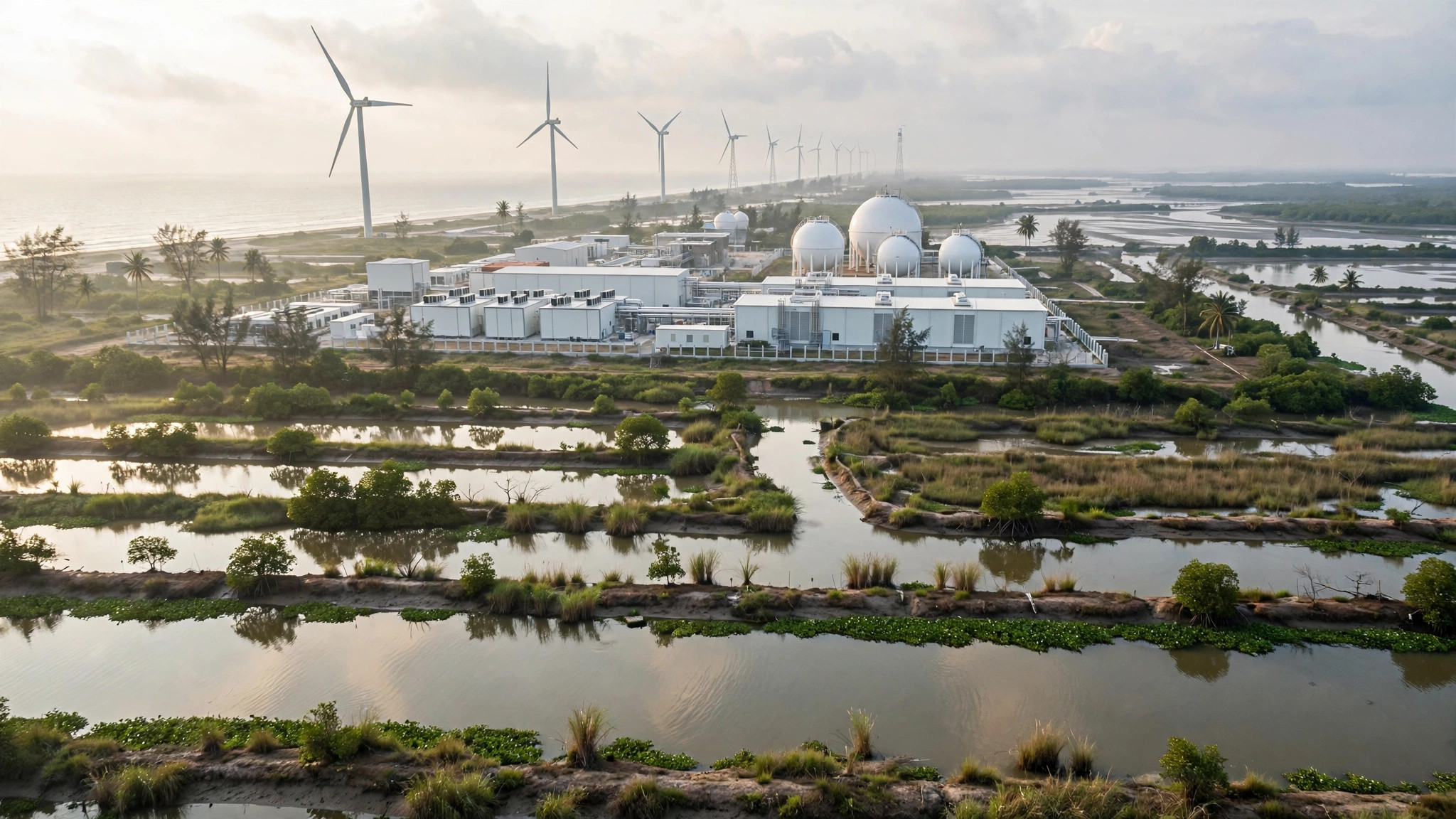
A hydrogen valley is a cluster where production, storage, transport and several end users sit close together, so no single buyer carries the whole risk of new infrastructure. Vietnam’s closest example is the Tra Vinh project led by The Green Solutions Group. In June 2026 the project signed three agreements in Hanoi: Plug Power to supply an electrolyser system of about 240 MW, Sinopec for front end engineering and construction of a plant described at 260 MW, and Allied Biofuels for a 25 year offtake of about 36,500 tonnes of green hydrogen a year, feeding production of about 91,000 tonnes a year of synthetic sustainable aviation fuel. Reporting on the project also cites expected emissions cuts of 400,000 to 450,000 tonnes a year. Construction of an earlier phase in Tra Vinh was reported by Vietnam News with initial output of 24,000 tonnes of green hydrogen a year. The valley logic is visible: renewable power in, hydrogen through one gate, and a fuel buyer contracted for 25 years.
When could ammonia co firing realistically start?
As pilots, before 2030, which is what the strategy calls for. The revised power plan expects green ammonia to partly replace coal in thermal generation over the long term, contributing about 25,800 MW of capacity by 2050, and hydrogen fired generation to substitute part of gas capacity, at about 37,000 MW of a projected 49,000 MW gas total by 2050. Those are mid century system shares, not dates for the first burn. A credible sequence is a small percentage co firing trial at one coal unit late this decade, results published, then a decision on wider ratios in the 2030s, because burner changes, ammonia supply chains, safety codes and cost recovery all have to be proven together.
What is the biggest obstacle, price or rules?
Both, and they multiply each other. Research cited in 2026 reporting put fossil-based hydrogen production in Vietnam at about USD 0.8 to USD 1.5 per kg, with green hydrogen costing at least three to four times more. Without a certification and traceability system, a buyer cannot prove the green attribute that justifies the premium, and Vietnam Investment Review noted in 2026 that a comprehensive framework covering production, storage, transport, certification and trade has not yet been established. Commentary on the national strategy describes three phases: pilot in 2025 to 2027, expansion in 2028 to 2030, and commercialization after 2030. Investors price the gap between phase one promises and phase three rules into every financing offer.
Where would the hydrogen and ammonia actually be used first?
The earliest credible uses are industrial, not electrical. Hydrogen is already a feedstock for fertilizer, refining and chemicals in Vietnam, produced today mostly from coal gasification and natural gas at the lower cost range cited above. Swapping that existing input for green hydrogen changes one link in a plant rather than the whole plant, which is why analysts cited in 2026 commentary identify the chemical and fertilizer industry as the most promising first field. The Tra Vinh offtake takes a second route, converting hydrogen into aviation fuel for a buyer with a compliance driven market. Both routes share one virtue: a named customer who needs the molecule itself. Electricity co firing, by contrast, burns an expensive molecule to make a commodity kilowatt hour, so it will normally be the last use to clear an economic test, whatever its value for long term system planning.
Ammonia has one further advantage in sequencing. It is already traded, shipped and stored at scale worldwide as a fertilizer input, so ports, tanks and safety practice exist in a way they do not for liquid hydrogen. A co firing program can therefore start from imported or blended supply while domestic green production ramps up, then localize supply as valleys such as Tra Vinh prove themselves. That staged path, imports and pilots first, domestic scale second, is the realistic reading of the strategy’s own three phases.
So what timeline should a reader believe?
Believe the signed project milestones first: engineering, equipment supply and a 25 year offtake at Tra Vinh are real steps, and first production in the late 2020s is plausible if construction proceeds. Believe pilot co firing before 2030 as an experiment, not a system change. Treat the 2030 production range as an aspiration whose lower bound, 100,000 tonnes, is the serious planning case. And treat 2050 figures for ammonia and hydrogen capacity as direction for land, ports and skills, not as a schedule. Green hydrogen in Vietnam is neither a press release nor a near term pillar. It is a decade long build whose first valley is now under contract, and whose co firing chapter starts, realistically, with one careful flame.
Related reading
- Green Hydrogen in Vietnam: Pilot Projects or Press Releases?
- Bac Ai Pumped Hydro: the Battery Vietnam Is Building into a Mountain
- Nuclear Returns to the Conversation
Sources
Vietnam Investment Review and Vietstock, January 2026, on the hydrogen strategy targets for 2030 and 2050, pilot co firing before 2030, and ammonia and hydrogen capacity expectations in the revised Power Development Plan VIII. vietnam.vn, 2026, reporting the Tra Vinh green hydrogen value chain agreements of June 25, 2026, including the roughly 240 MW electrolyser supply, the 260 MW plant and the 25 year offtake of about 36,500 tonnes a year. Vietnam News, 2026, on construction start for the Tra Vinh green hydrogen plant and initial production of 24,000 tonnes a year. Vietnam Chamber of Commerce and Industry News, 2026, on the hydrogen strategy phases of pilot, expansion and commercialization and on cost comparisons for green hydrogen.