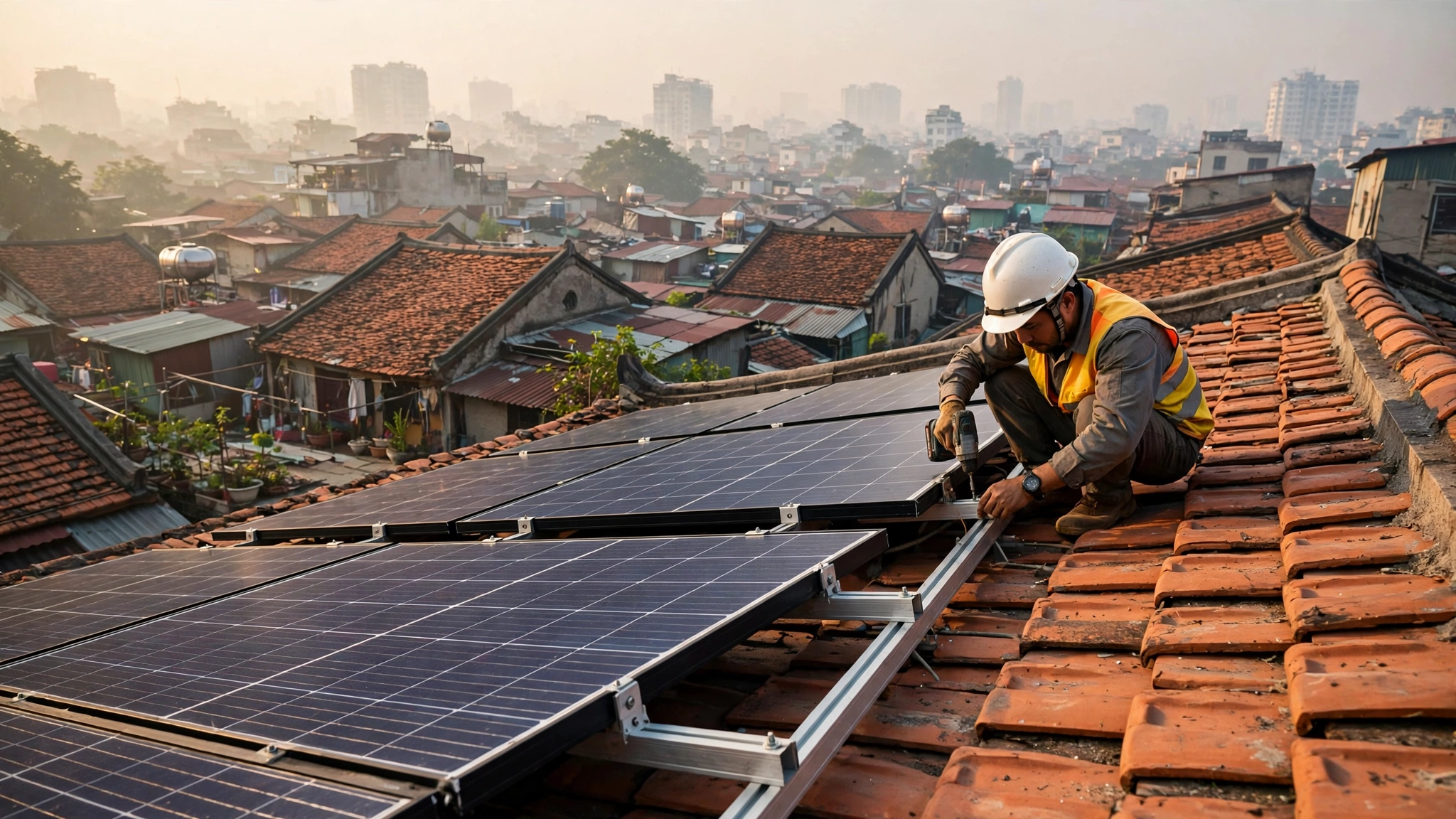
Hanoi City People’s Council approved a household rooftop-solar subsidy on October 28, 2026. The capital is now the largest city to comply with the government’s order that every province introduce support policies for rooftop solar by the end of December 2026. Households that install panels and a battery can receive up to VND 6 million, about USD 230 at VND 26,000 per dollar, from the city budget. The resolution runs until December 31, 2030, with total funding estimated at VND 158.76 billion for the 2026 to 2030 period. The resolution number has not yet appeared in the published coverage, and the final text is still awaited.
The decision came at the council’s 7th special session on October 28, 2026. The draft was presented by Nguyen Xuan Luu, Vice Chairman of the Hanoi People’s Committee. Nguyen Xuan Sang, Head of the council’s Economic and Budget Committee, presented the verification report and recommended simpler procedures, research on supporting vulnerable and poor households, and interest-rate subsidies as an alternative.
How much can a household actually get?
The subsidy has two parts. Households installing solar panels receive VND 1 million per kWp for systems of at least 1 kWp, capped at VND 3 million per household. Storage receives VND 1 million per kWh for storage systems of at least 1 kWh, also capped at VND 3 million per household. A household that installs both can receive up to VND 6 million in total.
The arithmetic is simple. A 3 kWp solar array receives the full VND 3 million solar payment, and a 3 kWh battery receives the full VND 3 million storage payment, for a combined VND 6 million. A smaller system receives less: a 1 kWp array receives VND 1 million, and a 1 kWh battery receives VND 1 million. A larger system earns no more than the caps, so a 5 kWp array still receives VND 3 million for the solar part.
One figure needs a note. The approval report puts the storage minimum at 1 kWh, while the draft resolution published in August had set it at 2 kWh. This article treats 1 kWh as the approved figure, since it comes from the approval report, but the final text should be checked when it is published.
Who qualifies?
The support goes to households with detached houses in Hanoi that install a rooftop solar system for self-generation and self-consumption meeting the specified conditions. Each household receives support only once, and the funds are disbursed to the household head.
Further conditions come from the draft resolution published in August, and they may change in the final text. Under the draft, the system must be fully installed and operational after the resolution takes effect, and the household must commit to using it for its intended purpose for at least three years. Support is recovered if the system is dismantled early, if documents are forged, or if safety, fire, or environmental rules are breached.
How do you apply?
The application route also comes from the draft resolution and should be confirmed against the final text. Under the draft, the commune-level People’s Committee receives applications and its chairman makes the decision. Total processing time is no more than 15 working days from receipt of complete and valid documents. Households can apply in person at the Hanoi Public Administrative Service Center, by post, or online through the National Public Service Portal.
Why is Hanoi doing this now?
Hanoi is an unusual case in Vietnam’s power system. The city accounts for about 15 percent of national electricity demand and has virtually no large local power sources, so it relies mainly on power transmitted from outside the city. Average solar radiation in the city is about 1,329 kWh per square meter per year, according to the Hanoi People’s Committee proposal cited in the draft coverage.
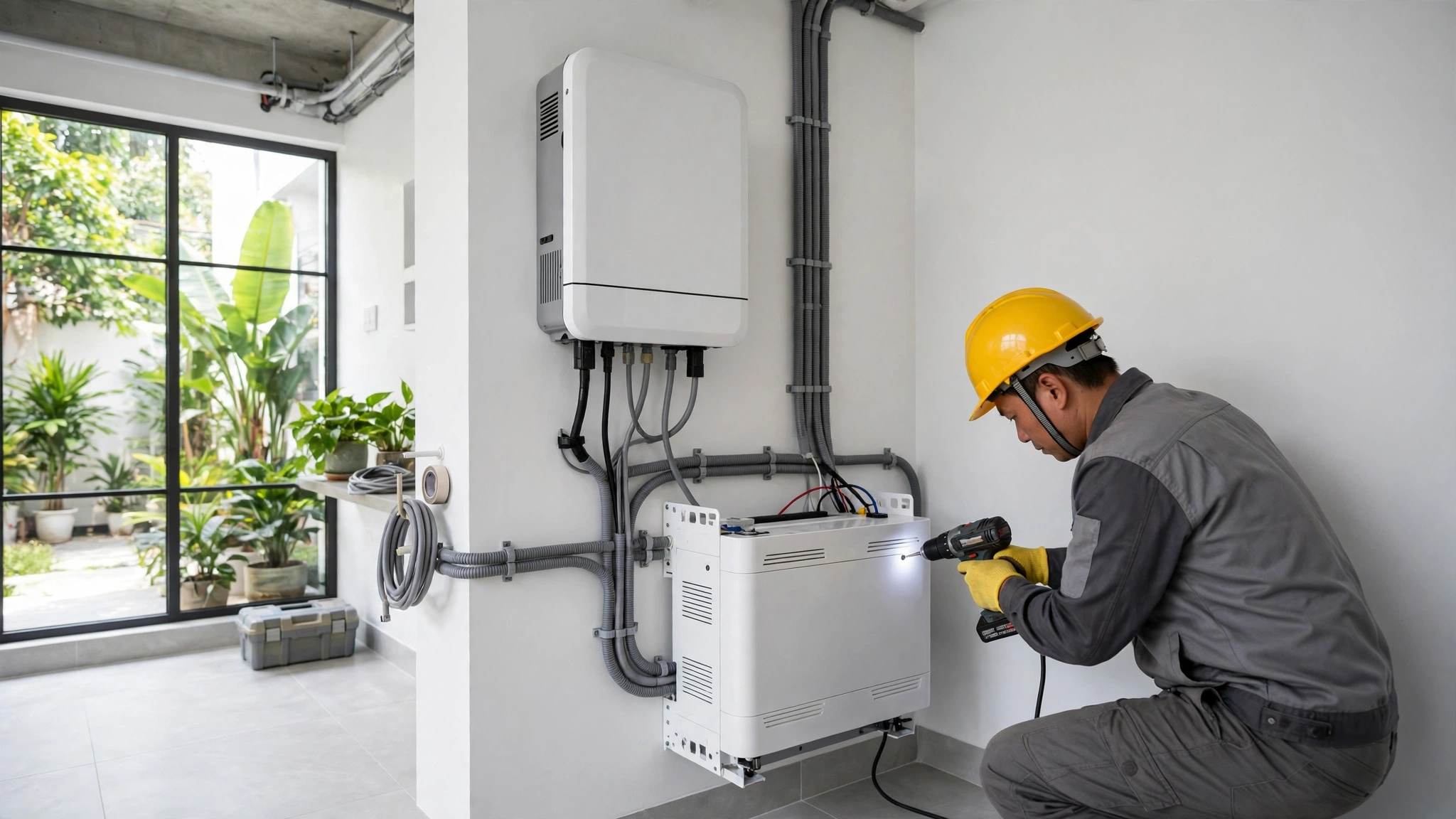
The timing is set by the national government. Government Office Dispatch 10790/VPCP-CN, issued on October 22, 2026, orders every province and city to introduce household rooftop-solar support policies by the end of December 2026. The Ministry of Industry and Trade reported in September 2026 that only 2 of Vietnam’s 34 provinces and municipalities, Bac Ninh and Lai Chau, had adopted the required policies. Hanoi is now the biggest city to comply, and its VND 6 million ceiling is the highest household rate reported so far, above the VND 4 million that Quang Tri pays. The capital is following the national order VoltViet covered on October 25, 2026, and the count of compliant provinces is now the number to watch.
The national context is significant. Vietnam Electricity reported 134,410 rooftop solar installations with combined capacity above 11.45 GW at the end of August 2026, nationwide. Grid-side storage is also progressing: a USD 105 million green loan arranged in October 2026 is funding battery storage at 110 kV substations across northern Vietnam.
Is VND 6 million enough to matter?
Only a little. The subsidy is small compared to the upfront cost of a full system, and no published figure for a typical household system price was available at the time of writing, so no payback period can be stated here. It lowers the first cost and signals that the city wants rooftop solar on detached houses, which is a real but modest push.
Nguyen Huy Hoach, an expert at the Vietnam Energy Association, makes the same point more sharply. He says a cash subsidy alone will not be the sole deciding factor for an investment: with current electricity prices, households using about 600 kWh per month or more, with a bill around VND 2 million, start to see economic benefit from rooftop solar. Households that can afford to invest may not need the support, he adds, while low-income households struggle with the remaining capital. That gap is the policy’s weak point, and it is why the council’s budget committee asked for research on supporting vulnerable and poor households and on interest-rate subsidies.
What to watch
The Ministry of Industry and Trade’s province rooftop-solar targets are due on October 30, 2026, and the December 2026 deadline for every province to adopt support policies follows two months later. The final text of Hanoi’s own resolution, including its number and the exact application conditions, has yet to be published. When it appears, the draft-based details in this article should be checked against it. The count of compliant provinces, which stood at 2 of 34 in September 2026, will show whether Hanoi’s move is the start of a wave or an outlier.
Sources
vietnam.vn, October 28, 2026: https://www.vietnam.vn/en/ha-noi-ho-tro-toi-da-6-trieu-dong-voi-ho-gia-dinh-lap-dien-mat-troi-mai-nha
pv magazine, October 24, 2026: https://www.pv-magazine.com/2026/10/24/vietnam-orders-provinces-to-introduce-rooftop-solar-incentives-by-december-2026/
vietnam.vn, August 2026: https://www.vietnam.vn/en/ha-noi-tinh-ho-tro-toi-6-trieu-dong-cho-ho-dan-lap-dien-mat-troi-mai-nha
vietnam.vn, October 2026: https://www.vietnam.vn/en/ho-tro-tien-lap-dien-mat-troi-mai-nha-vi-sao-chua-hap-dan
vietnam.vn, October 28, 2026: https://www.vietnam.vn/en/ha-noi-xem-xet-22-nghi-quyet-tai-ky-hop-chuyen-de-hdnd-thanh-pho