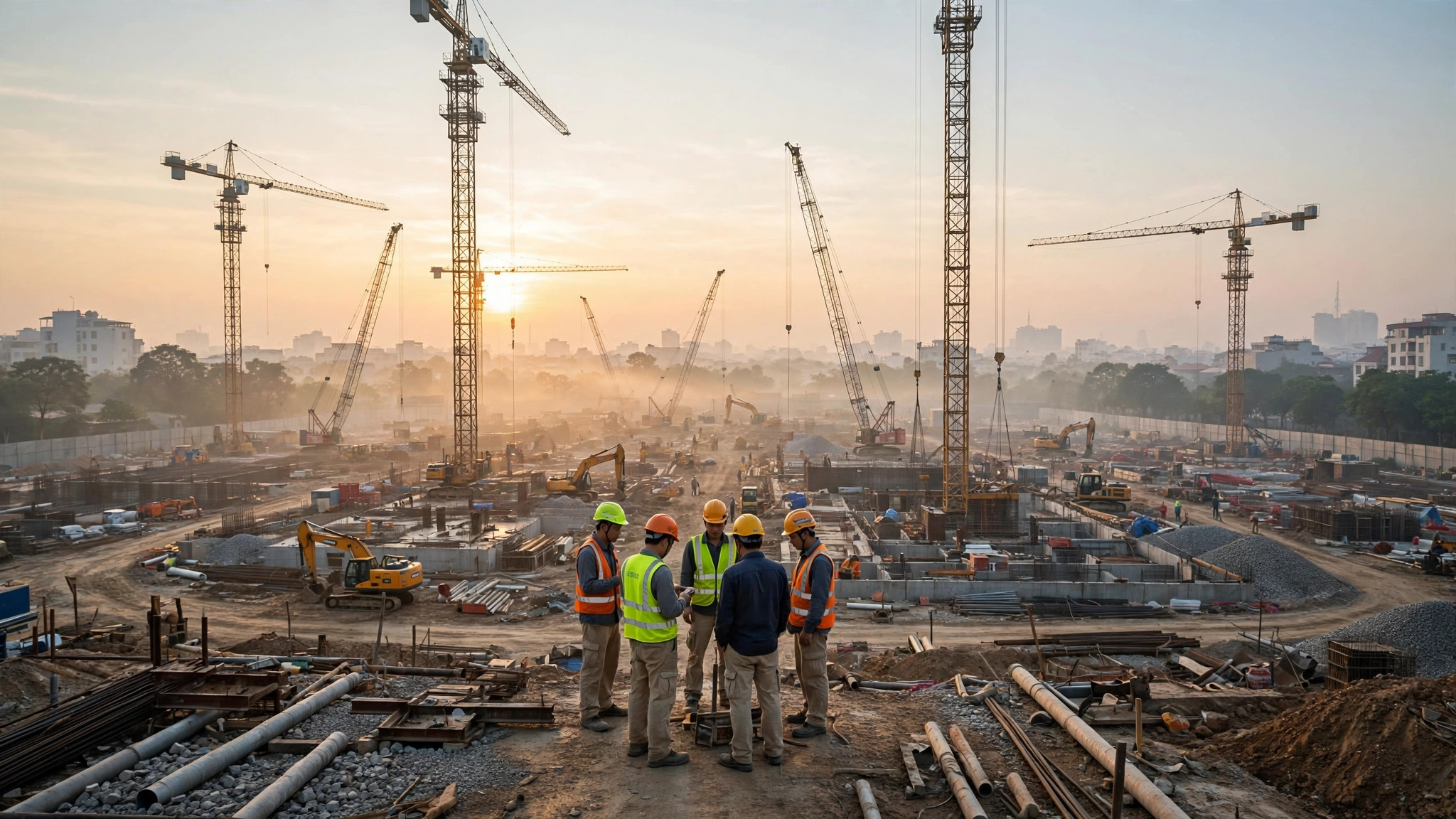
A technology park is easy to announce and hard to fill. In January 2026, Hanoi and FPT broke ground on a digital technology and mixed use park across Tay Tuu and Phu Dien wards, spanning nearly 200 hectares with total investment of VND 50 trillion, about USD 1.9 billion at VND 26,000 to USD 1. This news analysis examines the wager inside the renderings: that Vietnam can supply, train and retain the roughly 60,000 digital technology specialists, innovation engineers and support workers the park is designed to hold.
The project on paper
Nhan Dan’s report of the groundbreaking describes three principal components. The core is a concentrated digital technology park of about 168.9 hectares. Within it, a core functional zone of about 25 percent will host research, development and production of digital products and services: software, digital platforms, data services, artificial intelligence, big data, the Internet of Things, blockchain and metaverse applications. Training facilities, technology incubators and spaces linking institutes, universities and businesses sit inside the same zone.
The remaining area follows an open model, with internal transport, parking, green spaces and water features intended to make the district a place to live and work, not only to work. The Investor reported construction running from 2026 to 2031, with first components expected to operate in 2027. City officials framed the park as a nucleus of the capital’s innovation ecosystem; FPT’s chairman, in remarks reported at the ceremony and paraphrased here, presented it as a step toward a Vietnamese Silicon Valley. It is FPT’s largest concentrated digital technology park in the country.

Why Hanoi wants this park
The capital is competing for a different kind of foreign investment. Hanoi’s Department of Finance reported FDI attracted of about USD 4,067 million by September 25, 2026, equal to 90.38 percent of the city’s full year target of USD 4.5 billion and 105.88 percent of the same period in 2025, according to vietnam.vn. The city’s stated direction is quality over volume: projects in science, technology and the digital economy that raise its claim to be the national center for innovation.
The FPT park is a domestic anchor inside that strategy. Around it, the same vietnam.vn report lists a semiconductor plant begun by Viettel in Hoa Lac High Tech Park in January 2026 and a G Group high technology and AI data center complex with investment of nearly VND 7,600 billion. Hanoi is assembling a corridor of digital assets, and the FPT park is its largest single bet on workspace and talent concentration.
The talent pipeline question
Sixty thousand workers is the number that decides whether this is a property project or an ecosystem. Vietnam’s digital workforce is growing, but senior engineers, AI specialists and product talent are contested by employers in Ho Chi Minh City, Da Nang, regional hubs and remote foreign firms. A park in Tay Tuu and Phu Dien must persuade talent to choose it over established districts and overseas offers.
FPT brings one structural advantage: it is also an education and training operator, and the park design embeds training facilities and incubators rather than treating skills as someone else’s problem. The model on paper is a loop: universities and institutes connect into the park, startups incubate beside larger tenants, and research groups work near production teams. Whether that loop produces 60,000 filled desks depends on execution over five construction years, including housing, transport and schools in the surrounding wards that make daily life work for young engineers with families.
The risks inside the rendering
Three risks deserve plain statement. First, phasing risk: a 2026 to 2031 build window spans economic cycles, and technology tenants commit late. Second, specialization risk: the core zone lists many fashionable fields at once, from AI to the metaverse, and parks that try to host everything can end up distinctive in nothing. Third, competition risk: Hoa Lac, Saigon Hi Tech Park and regional rivals are chasing overlapping tenants and talent, often with incentives of their own.
There is also a measurement risk. Workspace for 60,000 is a capacity figure, not an employment guarantee. The honest test arrives in stages: first components operating in 2027, credible anchor tenants beyond the FPT group itself, and training partners graduating people into park jobs rather than into emigration queues.
What success would look like
Success has a recognizable shape. By the early 2030s, the park would host a mix of FPT units, domestic startups that grew up inside its incubators, foreign research teams drawn by Hanoi’s universities, and shared facilities busy enough to justify their cost. The 60,000 figure would describe people actually working there on an ordinary weekday, across research, production and support roles.
Failure also has a shape, and Vietnam has seen versions of it in underfilled industrial and technology zones elsewhere: completed roads and landscaping, a flagship headquarters, and long quiet blocks waiting for tenants who chose another city. The difference between the two outcomes is rarely the concrete. It is whether the talent pipeline, the unglamorous system of training, housing, transport and tenant recruitment, is built with the same seriousness as the master plan.
The wager, stated plainly
Hanoi is wagering VND 50 trillion of planned investment and nearly 200 hectares of urban land that digital work will keep concentrating in physical hubs even in an era of remote work, and that the capital can out compete regional rivals for the people who do that work. FPT is wagering its name and balance sheet that it can fill its largest park. The first evidence arrives quickly: operations beginning in 2027 will show whether tenants and trainees arrive at the pace the renderings assume. Sixty thousand digital workers will not appear by decree. They will appear, if they appear, one graduating class, one relocating team and one signed lease at a time.
Related reading
- The Talent Equation: 50,000 Engineers Do Not Appear by Decree
- A USD 3.5 Billion AI Data Center Bet Lands in Tay Ninh
- A Prototyping Center Tries to Cut the Cost of a First Chip
Sources
Nhan Dan English, January 2026, on the groundbreaking, the nearly 200 hectare site, VND 50 trillion investment, 168.9 hectare core and the 60,000 worker capacity. The Investor, January 2026, on the 2026 to 2031 construction schedule, first operations in 2027 and project governance. vietnam.vn, October 2026, reporting Hanoi Department of Finance figures of USD 4,067 million FDI attracted by September 25, 2026 and neighboring Hoa Lac digital projects.