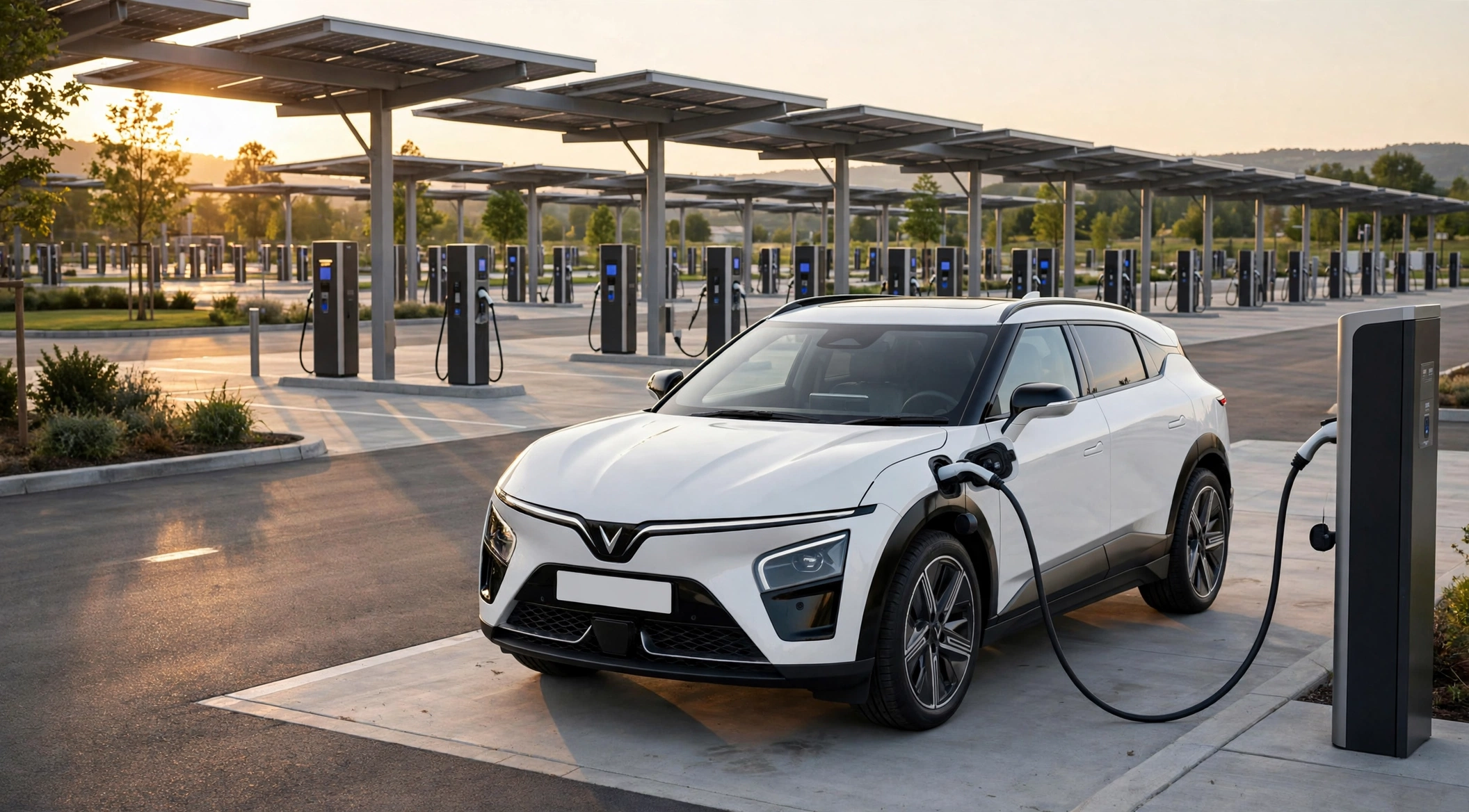
Vietnam’s capital now hosts what its builder calls the largest electric-vehicle charging station in the country. V-Green, which develops charging infrastructure for VinFast electric vehicles, has opened a parking-and-charging complex at Vinhomes Riverside in the Long Bien district. Its design capacity is 1,038 charging-integrated parking spots. Two of its three zones are live, with 866 connectors already serving cars; the rest will follow before the year ends.
What opened in Long Bien
The hub sits on two land lots, L2 and L3, inside the Vinhomes Riverside urban area, opposite the Vinmec Riverside hospital in Long Bien, Hanoi. The site covers nearly 29,000 square meters, built out as a combined parking lot and charging station rather than a row of chargers along a street.
The headline number requires clarification. V-Green describes the complex as Vietnam’s largest charging station, a claim Vietnamese press repeated in coverage on October 22 and 23, 2026. The 1,038 figure is the design capacity: parking spots planned with an integrated charging connector each. What is actually live today is smaller. Zones 1 and 2, now in operation, hold 814 charging pillars providing 866 connectors, enough for hundreds of cars to charge at the same time. Zone 3, with 172 more connectors, is under construction and expected to finish by the end of 2026, which would bring the site to its full planned scale.
For scale, the Vietnamese outlet nguoiquansat.vn compared the hub with public charging complexes elsewhere in the region and the world. Public hubs in Thailand and Singapore typically range from a few dozen to under a hundred connectors, the outlet noted. The much-cited Shell complex in Shenzhen, China has 258 fast-charging connectors, and Tesla’s large California supercharger site has 98 stalls. That comparison is the outlet’s framing, and it mixes slow overnight posts with fast chargers, but it shows the scale at which V-Green is building.
The electrical backbone
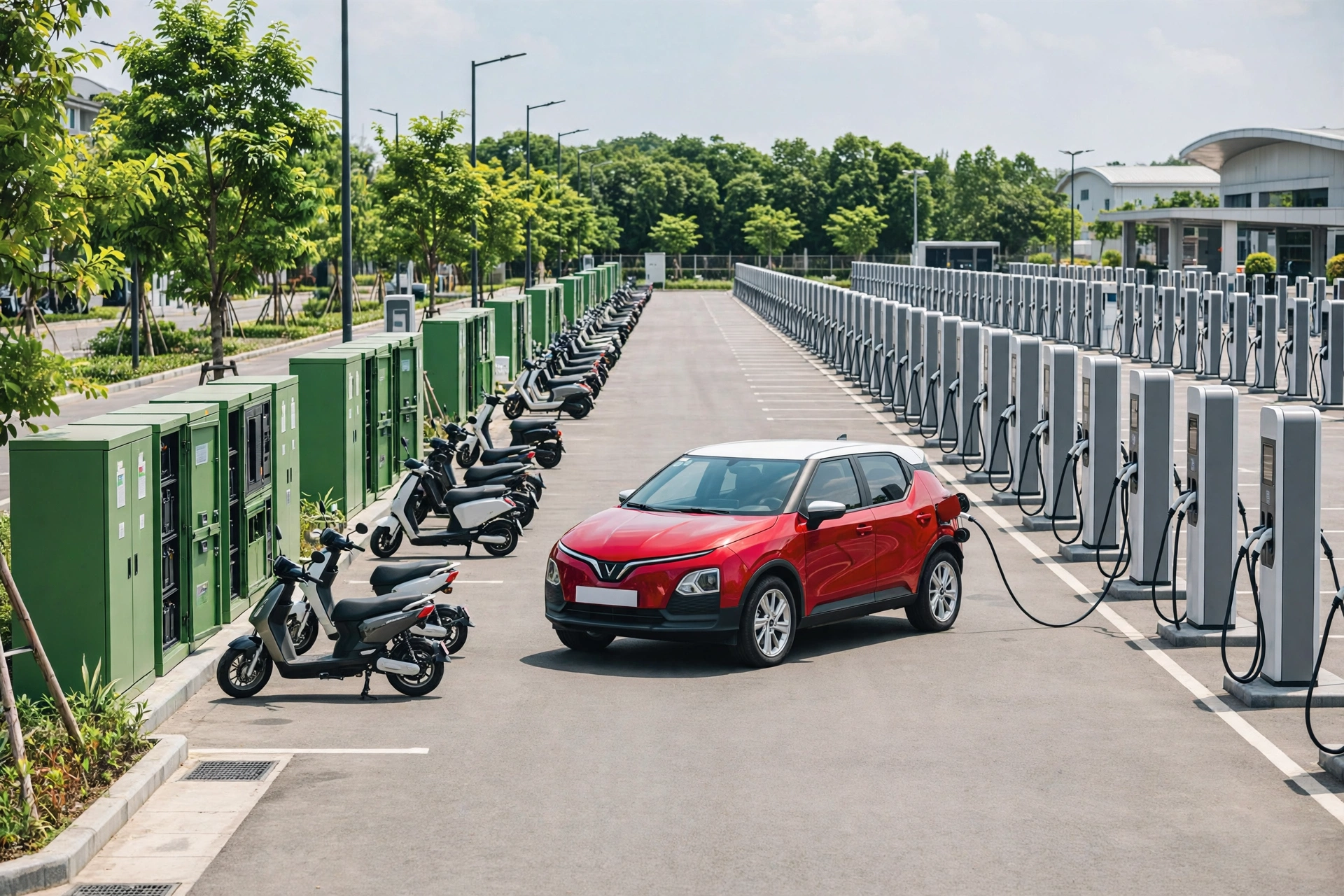
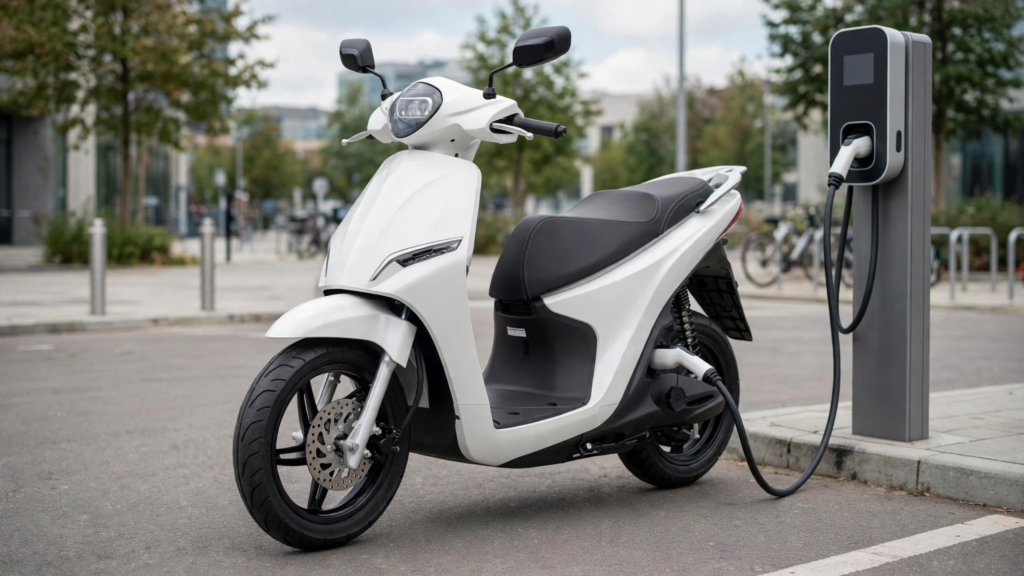
A thousand-car charging site is first and foremost an electrical engineering problem. The Riverside hub offers the full power range. AC posts at 22 kW suit overnight-style parking sessions; DC fast chargers at 120 kW serve drivers in a hurry. Alongside the car posts, the site includes 20 battery-swap cabinets serving electric motorbikes.
The part that matters to the neighbors is the power supply behind the posts: four dedicated substations, each rated at 2 x 1,600 kVA, feed the complex independently. The point, according to the developer, is that hundreds of cars drawing fast-charge current at once will not drag down the voltage of the residential grid around it. For a charging hub built inside a dense residential district, that isolation is the difference between an asset and a nuisance.
A network strategy, not a single station
The Riverside opening is one node in a larger build-out. V-Green says its nationwide network has surpassed 155,000 charging connectors across provinces and cities. That is a company figure, and it counts every connector in its system. In Hanoi alone the company has opened a 272-connector station at the Vietnam Exhibition Center in Dong Anh. A second site at the Minh Khai parking area in Nhon has 42 DC fast-charging pillars at 120 kW, able to serve 84 cars at the same time.
The next step extends beyond the cities. V-Green is working toward 99 supercharging stations along expressways and national highways. Each is designed to fast-charge at least 100 electric cars at the same time, timed for the year-end travel peak. The logic is straightforward: urban hubs solve daily charging, highway stations remove the distance limit that still keeps some buyers on gasoline.
What drivers get
Two drivers quoted in VnExpress coverage show who the hub serves. Pham Duc Minh, a VF 6 owner in Hanoi’s Phuc Loi ward, said he can now top up on his way home or fully charge before family trips. He described a large station in his own neighborhood as very convenient. Ngo Manh Hao, a ride-hailing driver who works in Long Bien in a Limo Green, said he monitors the charging network closely because he drives all day. He welcomed more large stations with varied power levels on his regular routes. The quotes are translated from Vietnamese.
The economics around the hub keep improving for drivers. V-Green’s free-charging campaign for VinFast owners runs until 2029. From July 1, 2027, every public charger in the country must meet the five national requirement groups of QCVN 32:2026, which standardizes plugs, safety, and payment.
Why this matters for investors
Charging infrastructure is a primary binding constraint on EV adoption in many emerging markets, and Vietnam’s answer is being built at a pace that is hard to find elsewhere in Southeast Asia. A single 1,038-connector complex does not prove a market, but it is concrete, countable evidence of the build-out behind Vietnam’s EV sales figures. For investors tracking the VinFast ecosystem or the region’s EV market, the Riverside hub is a data point worth more than another announcement: it is already delivering power.
The open questions are the usual ones for infrastructure at this scale. What utilization looks like once the novelty fades, how 814 pillars hold up in daily service, and whether the highway super-stations are completed on schedule are all unanswered. What is answered is that the capacity exists, the grid connection is dedicated, and the next 172 connectors have a deadline.
Sources
nguoiquansat.vn, October 23, 2026: Vietnam’s largest EV charging station begins operation, nearly 3 hectares, 1,038 connectors: https://nguoiquansat.vn/tram-sac-o-to-dien-lon-nhat-viet-nam-chinh-thuc-van-hanh-dien-tich-gan-3-hec-ta-quy-mo-1-038-cong-323688.html
VnExpress, October 22, 2026 (updated October 23, 2026): V-Green’s largest EV charging station in operation: https://vnexpress.net/tram-sac-xe-dien-lon-nhat-cua-v-green-van-hanh-5135753.html
BNEWS, October 22, 2026: V-Green puts Vietnam’s largest EV charging station into operation: http://bnews.vn/v-green-dua-vao-van-hanh-tram-sac-o-to-dien-lon-nhat-viet-nam/441458.html