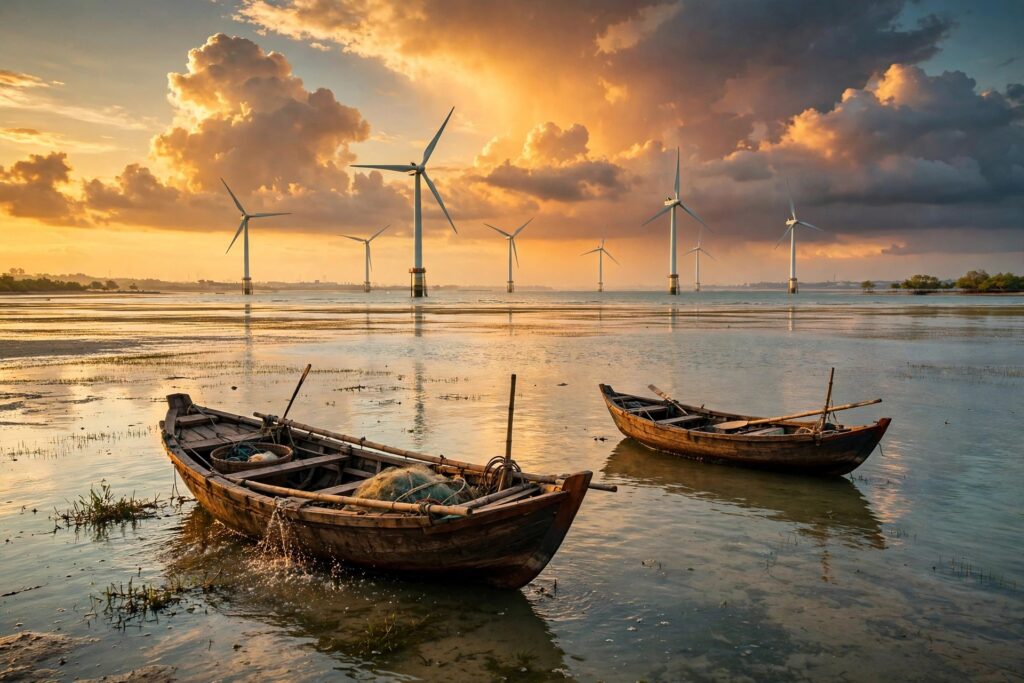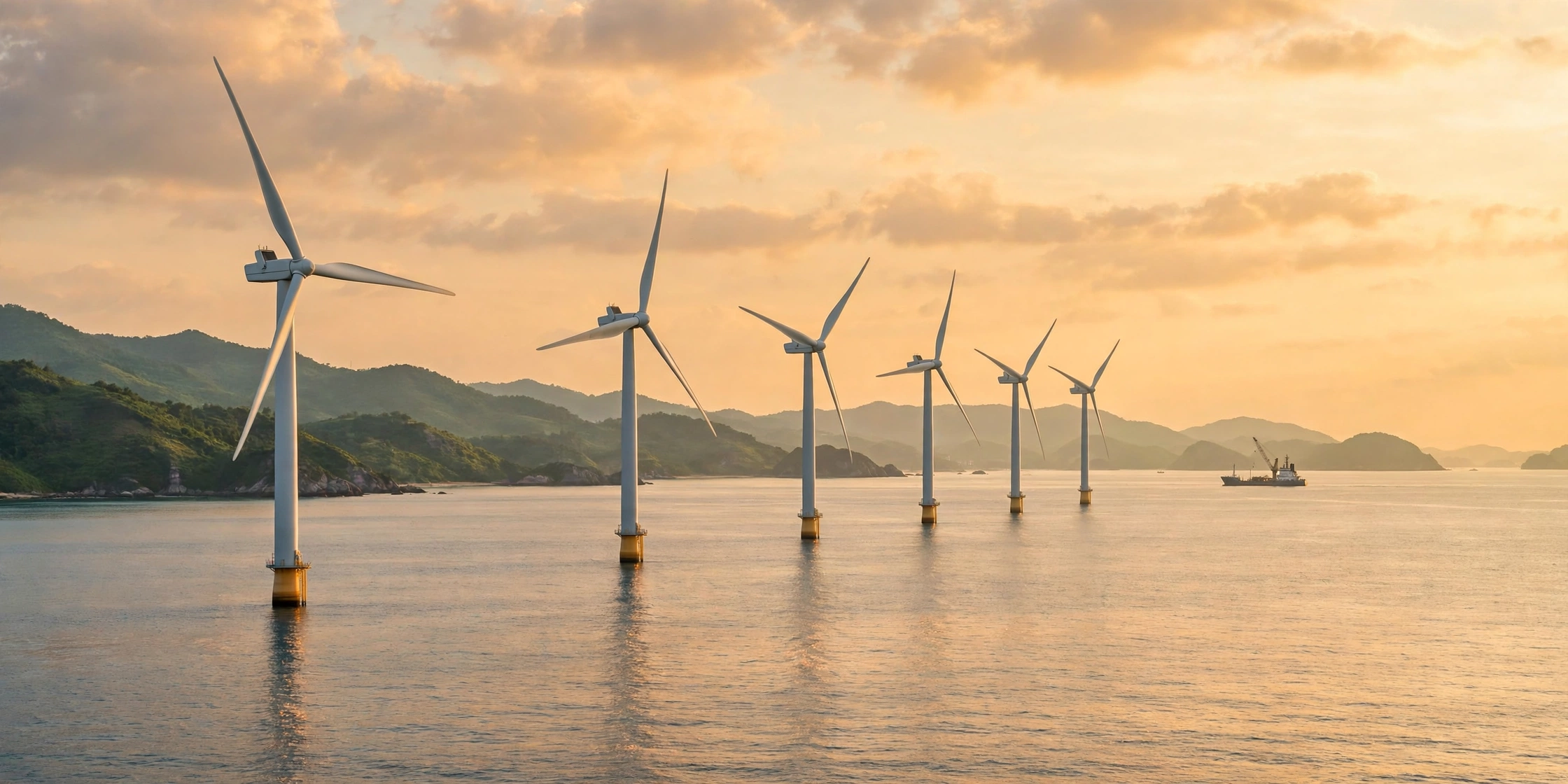
On October 26, 2026, Singapore’s Energy Market Authority (EMA) granted conditional approval for Sembcorp Utilities to import up to 1.3 GW of renewable electricity from Vietnam and Malaysia. It is the clearest regulatory green light yet for Vietnamese offshore wind to reach a paying foreign buyer. The approval was announced at the opening ceremony of Singapore International Energy Week (SIEW) 2026, with energy ministers from all three countries present.
The approval does not build a single turbine. It does something almost as important for a sector that has spent years waiting for a buyer: it gives the project a defined path to market, a designated importer and a target start date. Imports are expected to begin in 2035.
What the approval covers
The approval was granted to Sembcorp Utilities, a wholly owned subsidiary of Sembcorp Industries and the designated importer for the Vietnam-Malaysia-Singapore (VMS) renewable electricity initiative. It allows the consortia behind the initiative to advance to the next development stages, subject to further regulatory and project approvals.
Two consortia are developing the corridor. The first pairs Sembcorp Utilities with PTSC, the PetroVietnam Technical Services Corporation, a subsidiary of Petrovietnam. The second is the MY Energy Consortium, made up of Tenaga Nasional Berhad (TNB) and PETRONAS. The parties signed a joint development agreement in May 2025, on the sidelines of the 46th ASEAN Summit in Kuala Lumpur, and have since worked on technical and commercial studies while coordinating with governments and regulators in all three countries.
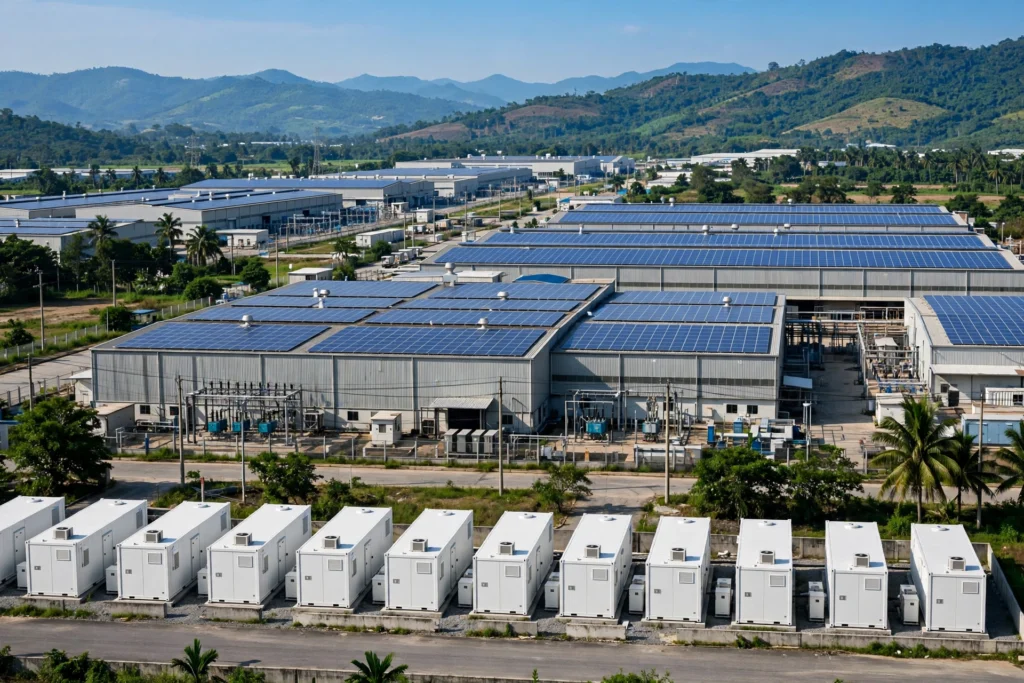
The electricity would come from two sources: offshore wind in Vietnam, and solar power and battery storage (BESS) in Malaysia. Power generated in Vietnam would be transmitted through Malaysia, which acts as both a transit country and a recipient, and supplied to Malaysia and Singapore. The 1.3 GW figure is the import capacity into Singapore, not Vietnam’s generation capacity, and the wind share of that total has not been specified.
The ceremony that announced it
The conditional approval was formally announced at the SIEW 2026 opening ceremony on October 26. Singapore energy minister Tan See Leng and Malaysia’s Deputy Prime Minister and Minister of Energy Transition and Water Transformation, Fadillah Yusof, attended alongside Vietnam’s Deputy Minister of Finance, Cao Anh Tuan. Sembcorp Industries chief executive Wong Kim Yin, Petrovietnam vice president Phan Tu Giang, PTSC chairman Tran Ho Bac, PETRONAS president Tengku Muhammad Taufik and TNB chief executive Shamsul bin Ahmad were also present.
The attendance list matters because a three-country power corridor needs three governments to move together. The same day, EMA and Malaysia’s Energy Commission renewed their energy cooperation memorandum. The renewal is a reminder that the VMS corridor sits inside a wider set of bilateral arrangements rather than standing alone.
Conditional, not final
Conditional approval is a milestone, not a construction start. The consortia must still secure further regulatory approvals across jurisdictions, finalize power purchase agreements, obtain financing and meet development milestones before reaching financial close. No project cost, tariff or cable route has been disclosed.
The precedent is instructive. In August 2026, EMA granted conditional approval for two projects to import 900 MW of low-carbon electricity from Johor, Malaysia. The first, 300 MW, went to Sembcorp Utilities for a floating solar and battery storage project at Linggiu Reservoir. The second, 600 MW, went to Southern Solar Alliance, a subsidiary of Malaysian developer Ditrolic Energy. Sembcorp’s Johor project could begin supplying electricity by 2029 using existing infrastructure, while the remaining 600 MW would likely need a second interconnector that is still at the feasibility study stage.
Singapore’s plan is to import about 6 GW of low-carbon electricity by 2035. Research firm Wood Mackenzie reported in October 2026 that EMA has approved 9.25 GW of import capacity across six corridors, but that none of the projects has reached financial close or begun construction. The firm estimated that imports may reach only about 15 percent of Singapore’s generation mix by 2035, roughly half of the target of about one-third. The VMS corridor should be read in that light: approved, but a long way from delivered.
Why the route matters for Vietnam
Vietnam’s offshore wind resource is not in doubt. A 2025 report by the Department of Meteorology and Hydrology, under the Ministry of Agriculture and Environment, put the country’s technical offshore wind potential at 1,068 GW. The revised Power Development Plan VIII sets renewables, excluding hydropower, at 28 to 36 percent of total power supply by 2030. Offshore wind for domestic use is set at 6,000 to 17,032 MW in the 2030 to 2035 period, with a target for renewable power exports to Singapore, Malaysia and other regional partners.
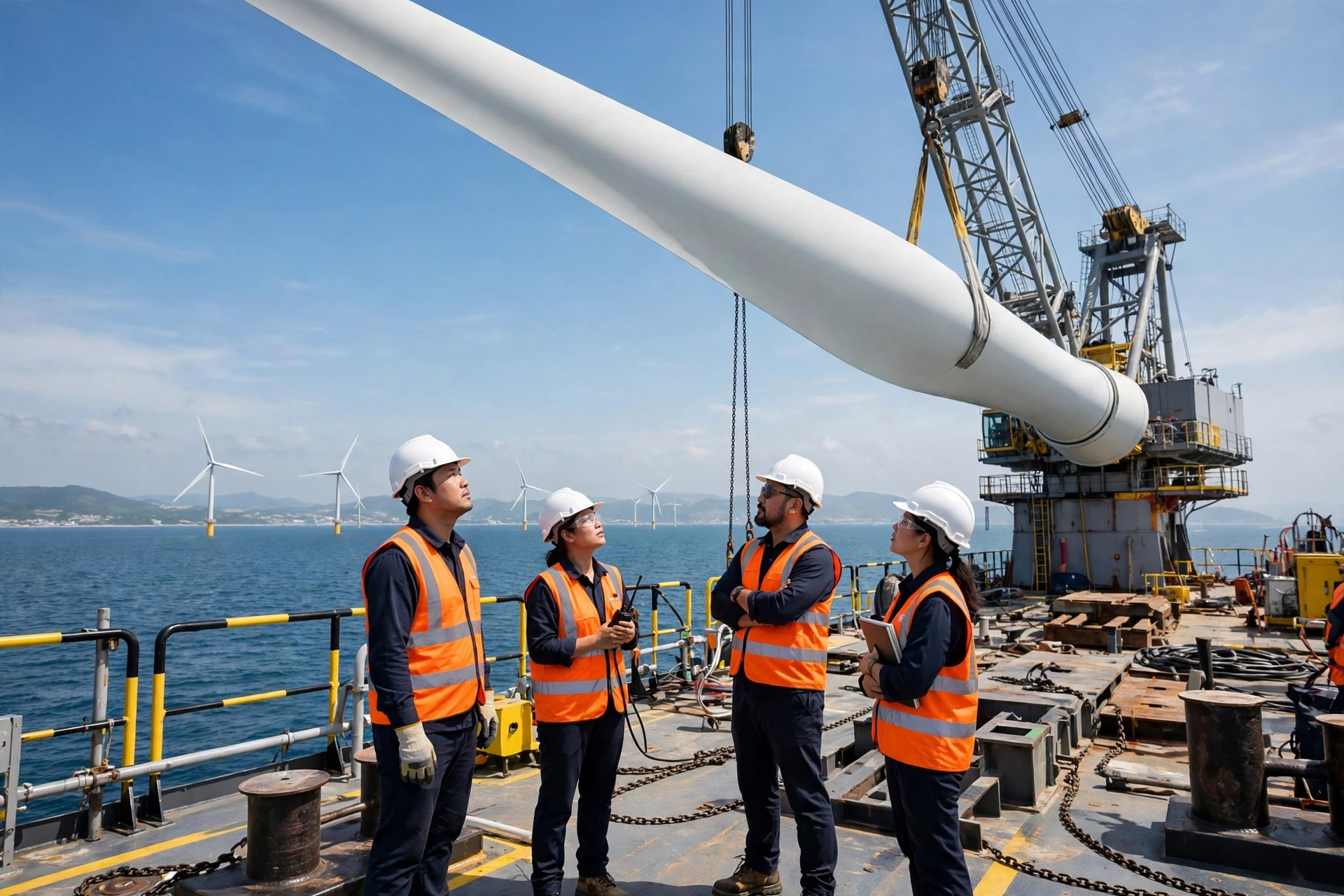
What has been missing is a buyer willing to sign. Vietnam’s offshore wind sector has survey licenses, port studies and bankability questions, but no operating export project. The gap between potential and delivery is the sector’s defining problem. Offshore installation is already underway in Vietnam: crews are installing Southeast Asia’s largest turbines off Vinh Long for a 128 MW nearshore project. A conditional approval from the buyer at the end of the cable changes the conversation: the question is no longer whether anyone wants Vietnamese wind power, but whether the corridor can be financed, permitted and built on schedule.
That is also why the Malaysian leg matters. Vietnam’s wind alone does not make a corridor. Malaysia provides the transit route, adds its own solar and storage, and also consumes some of the power, which spreads the benefit across two selling countries and one buyer. It is the closest thing yet to the ASEAN Power Grid idea working as a commercial project rather than a diagram: three countries, two grids and one subsea cable, stitched together by contracts.
What to watch
Four things will show whether the approval becomes a project. The first is the regulatory sequence in Vietnam, Malaysia, and Singapore, where export licenses and grid approvals are still to come. The second is financing: a subsea interconnector of this scale needs lenders comfortable with cross-border regulatory risk. The third is the offtake terms, including who signs the long-term power purchase agreement and at what price. The fourth is the 2035 start date, which leaves nine years for any of those steps to slip.
None of that diminishes the approval itself. A foreign regulator has now cleared Vietnamese wind power for import at scale, and a Vietnamese state-linked contractor, PTSC, is a named partner in the corridor. Vietnam has spent years describing itself as a future clean power exporter. On October 26, the future gained a concrete timeline.
Sources
Enerdata, October 27, 2026: https://www.enerdata.net/publications/daily-energy-news/singapore-supports-13-gw-vietnam-malaysia-singapore-renewable-interconnection.html
VietnamFinance, October 27, 2026: https://vietnamfinance.vn/viet-nam-se-xuat-khau-13-gw-dien-tai-tao-sang-malaysia-va-singapore-d152712.html
Malay Mail, October 26, 2026: https://www.malaymail.com/news/singapore/2026/10/26/singapore-malaysia-renew-energy-partnership-covering-power-gas-and-renewables/240678
Business Today, August 7, 2026: https://www.businesstoday.com.my/2026/08/07/singapore-grants-two-companies-to-import-solar-energy-from-malaysia/
KLSE Screener, October 2026: https://www.klsescreener.com/v2/news/view/1804929/Singapore_set_to_miss_2035_green_power_import_target