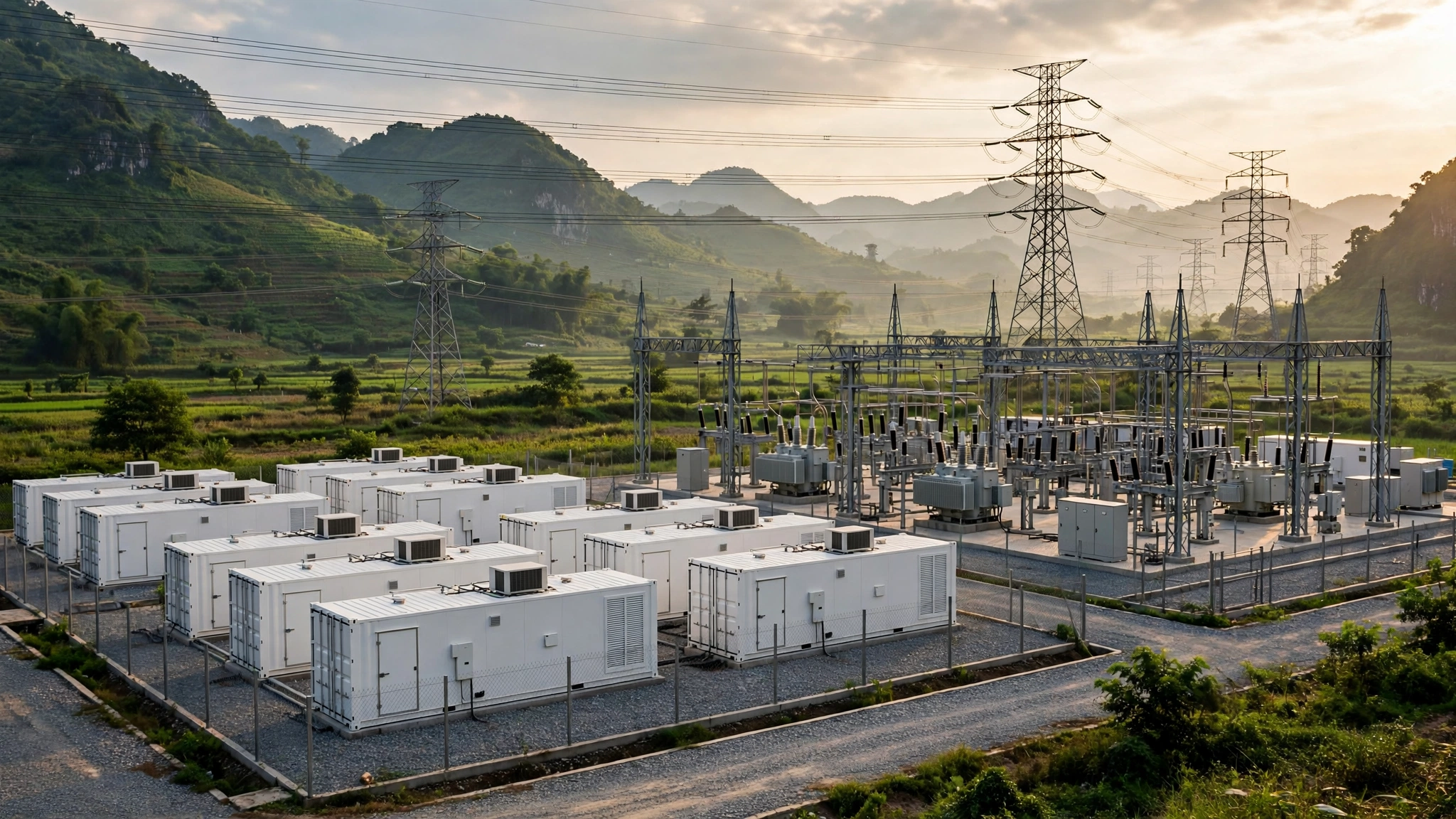
HSBC Vietnam announced on October 27, 2026, that it has arranged Northern Power Corporation’s (EVNNPC) debut offshore USD 105 million syndicated green term loan. It is EVNNPC’s first international syndicated green loan and its first offshore syndicated US dollar financing. The money will pay for battery energy storage systems (BESS) installed alongside existing 110 kV substations across northern Vietnam.
The deal is small beside Vietnam’s multibillion-dollar power investment plans. Its significance is different: it is the first offshore syndicated green loan raised to put batteries on Vietnam’s grid. Lenders are treating storage as bankable infrastructure, not a pilot project.
The deal in brief
HSBC acted as sole mandated lead arranger, underwriter and bookrunner, sole green coordinator and facility agent for the transaction. The loan carries an eight-year door-to-door tenor, from first drawdown to final maturity. HSBC described that as sitting at the longer end of Vietnam’s offshore syndicated loan market, where comparable precedent remains limited.
The facility was significantly oversubscribed and attracted 15 lenders from China, South Korea, Taiwan, and Thailand. It is structured in line with the international Green Loan Principles, with HSBC working with EVNNPC to align the financing with the environmental benefits of its storage program. The transaction also aligns with the State Bank of Vietnam’s direction to encourage syndicated financing for large-scale projects.
“HSBC is proud to support EVNNPC’s first offshore syndicated US dollar financing and its investment in battery energy storage infrastructure,” said Tim Evans, chief executive and head of banking at HSBC Vietnam. “This landmark transaction combines tailored green financing with the practical infrastructure needed to strengthen grid resilience and support Vietnam’s transition towards a more flexible and sustainable power system.”
What the money buys
The loan proceeds will finance BESS units installed alongside existing 110 kV substations across northern Vietnam. EVNNPC’s storage program is to be deployed across 70 existing substations, to strengthen grid stability and reliability, meet growing electricity demand and reduce the risk of grid congestion and outages. The program also supports the revised Power Development Plan VIII and the National Energy Master Plan’s storage goals.
The total storage capacity funded by this loan has not been disclosed, and no per-substation figure can be derived from the announcement. What is disclosed is the shape of the program: batteries placed at substations the grid already has, rather than a single large storage plant. That design fits the problem in northern Vietnam: local congestion and stability at many points on the network, not one big shortfall in one place.
Why storage, why now
Vietnam’s rooftop solar fleet has grown faster than its grid’s ability to absorb it. As of August 2026, the country had 134,410 rooftop solar systems with combined capacity of more than 11,450 MWp. The figures were cited by former Vietnam Electricity deputy general director Vo Quang Lam at a conference in Hung Yen province on October 16, 2026. Yet self-produced, self-consumed installations equipped with battery storage remained very limited.
The grid operators are catching up. EVNNPC had completed 155 MW of battery storage capacity and aimed to reach 305 MW in October 2026, Lam said at the same conference. Hanoi Power Corporation had completed 50 MW. Power Generation Corporation 3 and Electricity Project Management Board No. 2 were pursuing investment procedures for centralized storage projects in northern Vietnam, with planned capacities of 300 MW and 550 MW respectively.
The barriers are not only money. At the Hung Yen conference, Mai Duy Thien, chairman of the Vietnam Clean Energy Association, said market development remains constrained by high initial investment costs and limited access to finance. Gaps in technical standards, fire safety requirements and complicated connection procedures add to the problem. The government has called for research into preferential credit mechanisms to support investment in rooftop solar and battery storage. Directive 10/CT-TTg, issued on March 30, 2026, identifies renewable energy development, electricity savings and rooftop solar as priorities.
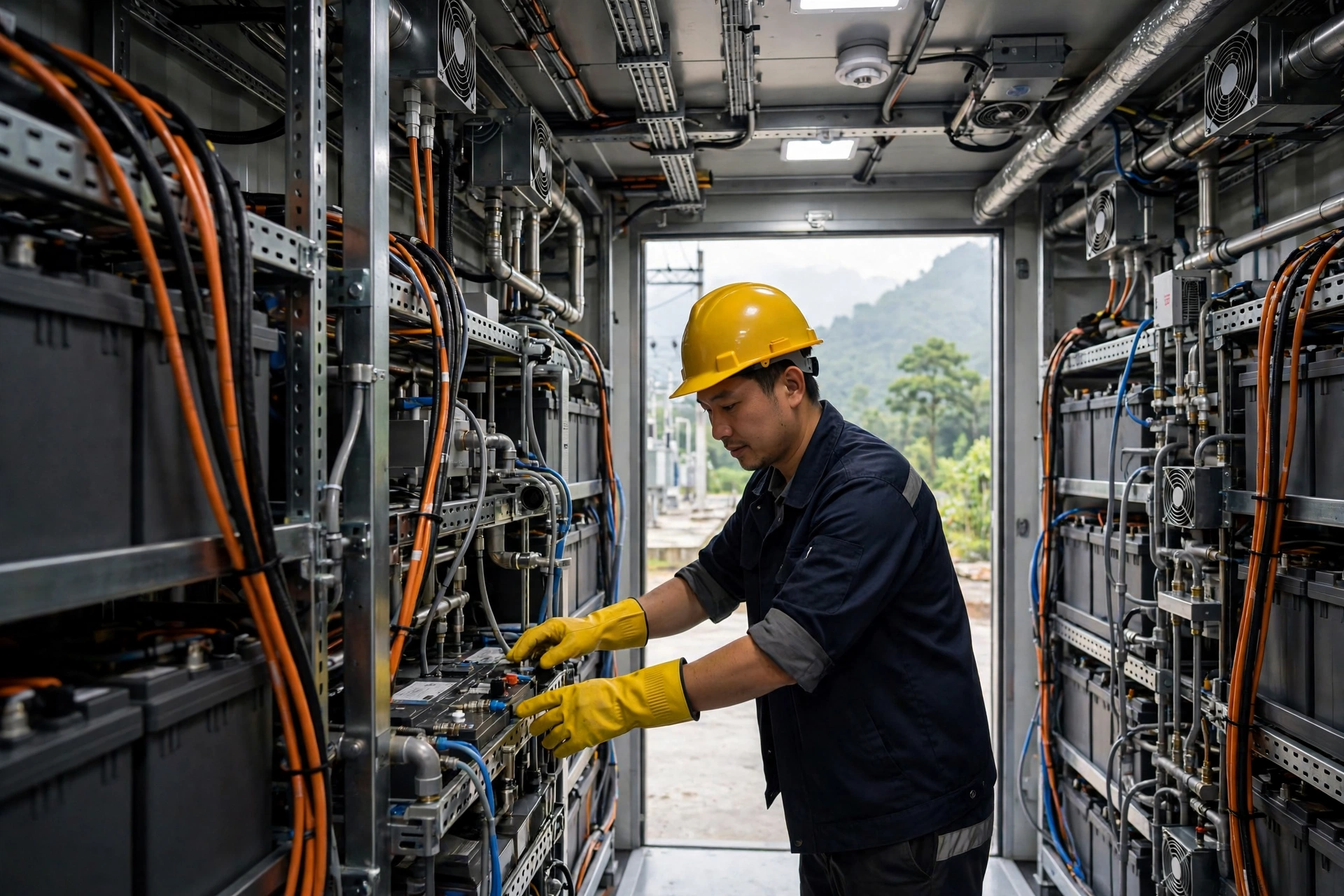
That context is what makes a green loan for substation batteries different from a green loan for a solar farm. The solar farm adds generation to a grid that already has more midday solar than it can use. The substation battery adds flexibility, the ability to store power when the sun is strong and release it when demand peaks in the evening. Vietnam’s evening peak is the grid’s daily stress test, and storage is the tool built for it. The new rooftop solar rules already push solar-plus-storage pairing for households and factories, and this loan funds the grid-side half of the same shift.
What it signals for lenders
Three features of the deal will be watched by other borrowers. The first is the tenor: eight years is long for Vietnam’s offshore syndicated loan market. A longer tenor signals that lenders are comfortable with the asset, not only with the borrower. The second is the oversubscription: 15 lenders from four markets competed for a debut facility from a borrower that had never raised offshore syndicated dollars before. The third is the use of proceeds: the money goes to equipment at 70 existing substations, which gives lenders a concrete, verifiable asset base rather than a general corporate purpose.
The structure also shows how green finance labels are being used in Vietnam. The loan is a green loan under the Green Loan Principles. That label requires the proceeds to fund projects with clear environmental benefits, rather than a green bond, which is a capital markets instrument with its own disclosure regime. For a state-owned grid company raising its first offshore dollars, the syndicated loan route offered a smaller, more controlled debut than a bond issue.
What to watch
The next evidence to watch will likely be operational, rather than financial. The first test is drawdown and installation pace across the 70 substations, and whether EVNNPC reaches its 305 MW target for October 2026. The second is whether other power corporations follow with their own offshore green loans, now that a precedent exists. The third is the policy follow-through: technical standards, grid connection rules, fire safety regulations and a pricing mechanism for storage services, all of which the Hung Yen conference identified as still missing.
If those follow, the USD 105 million loan will look like the start of a funding line for grid flexibility rather than a one-off transaction. Vietnam’s power system often faces challenges not with overall generation, but with the ability to move power from when it is made to when it is needed. On October 27, international lenders put money behind closing exactly that gap.
Sources
Vietstock, October 27, 2026: https://en.vietstock.vn/2026/10/hsbc-arranges-evnnpcs-debut-105-million-green-loan-37-646088.htm
Stockbiz, October 27, 2026: https://stockbiz.vn/en/news/hsbc-arranges-usd-105-million-syndicated-green-loan-for-evnnpc/42482402
Vietstock, October 19, 2026: https://en.vietstock.vn/2026/10/energy-storage-seen-as-key-to-rooftop-solar-growth-974-645492.htm