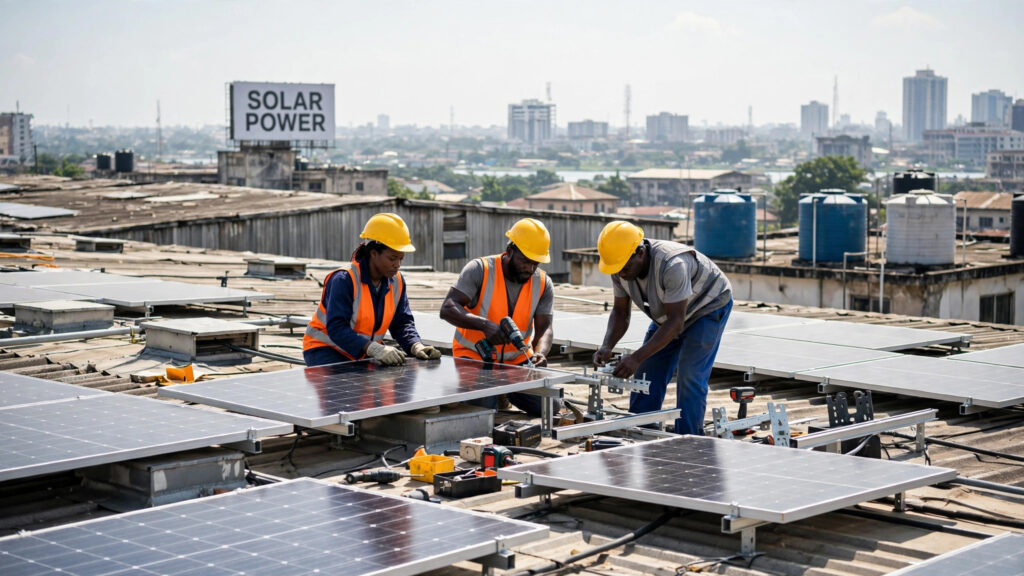
A rooftop solar system without a battery lives on the sun timetable. It generates most at midday, when many homes use least, and nothing at the evening peak, when the family is home and the national grid is under most strain. Battery energy storage, known as BESS, exists to move those midday kilowatt hours a few hours later. Vietnam new rooftop framework makes that move central. Ministry of Industry and Trade guidance issued in September 2026, reported by VnEconomy and vietnam.vn, asks provinces to build programs supporting households to install rooftop solar linked to BESS under Decree 243 from 2026, and asks public agencies to plan solar plus storage for offices, schools and hospitals, with budget support considered where agencies need capital. This explainer covers why pairing is now the default design, how to size a battery honestly, and what payback really depends on. The surplus sales rules were covered in an earlier VoltViet analysis; here the subject is the battery itself.
Why the rules now point at storage
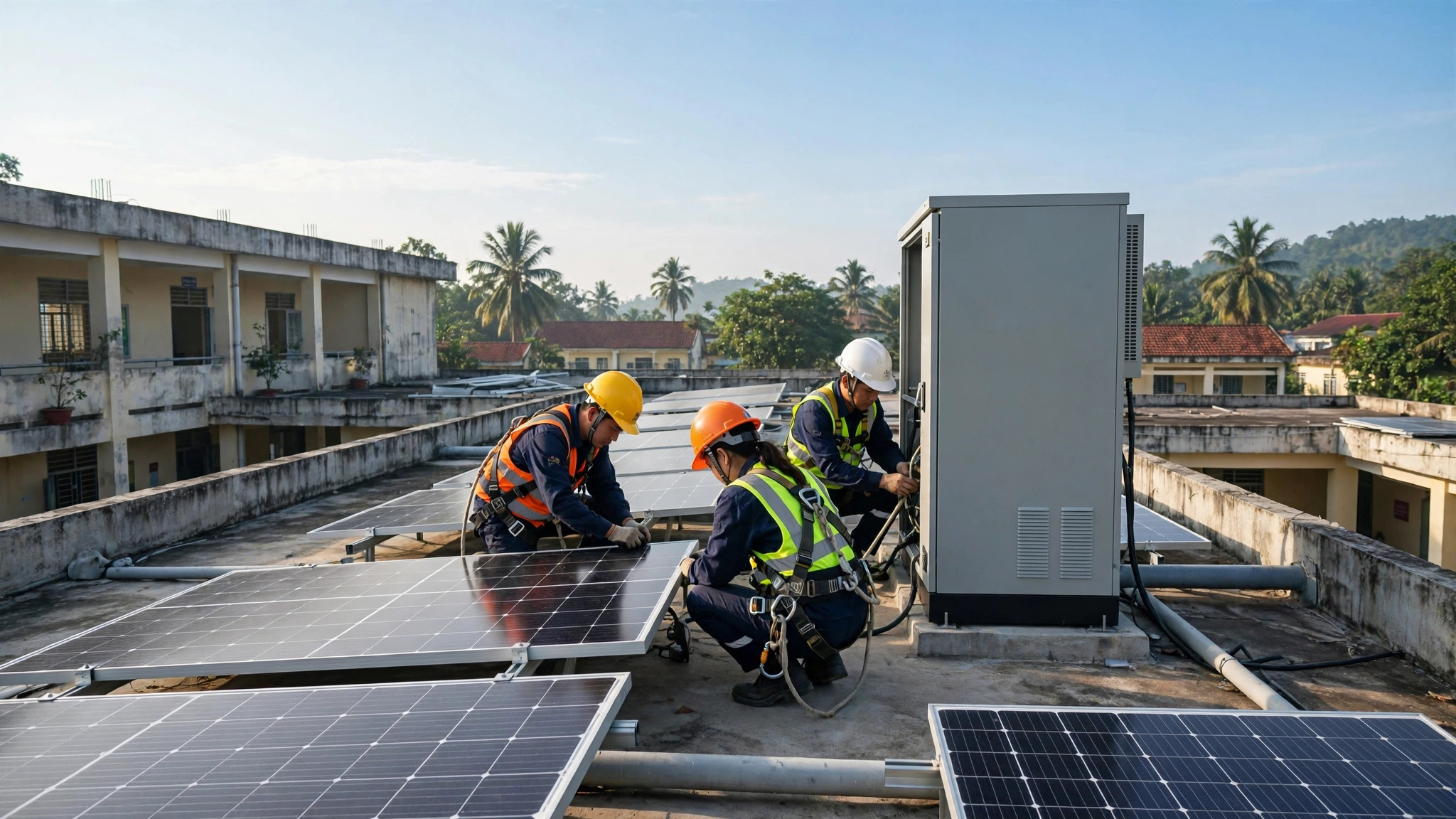
The policy logic is system logic. By the end of July 2026, Vietnam had 130,811 rooftop solar systems operating with total capacity above 11,200 MWp, and those systems fed 6.6 billion kWh to the grid in the first seven months of the year, according to EVN data reported by vietnam.vn. That is a triumph of installation and a growing scheduling problem: midday solar arrives whether the grid needs it or not. Every kilowatt hour a household stores and uses at 7 pm is one the grid does not have to absorb at noon or generate at peak. The ministry program design reflects that, pairing household promotion of solar with BESS rather than panels alone, and targeting public buildings, offices, schools and hospitals, for combined systems to be operating before March 31, 2027 under the Directive 10 implementation drive. Progress is uneven, and the ministry said so: only two of 34 provinces, Bac Ninh and Lai Chau, had issued household support policies when the guidance was sent, and only two of 17 ministries had completed implementation plans. Storage pairing is the direction of policy even where local execution still lags.
Step one: size the battery to the evening, not the roof
The common sizing error is matching battery capacity to panel capacity. The correct match is to the load the battery must serve. A household should start from its evening and night consumption, the hours between sunset and the next solar morning, and from the appliances it genuinely wants backed up or shifted: lighting, refrigeration, fans or air conditioning on a timer, cooking and entertainment. Storage that covers most of that evening block, commonly in the range of one half to one full evening of use, captures most of the available value. A much larger battery sits partly empty on ordinary days and earns its cost back slowly, while a much smaller one fills by mid morning and leaves the midday surplus problem unsolved. Factories and public buildings run the same calculation at larger scale, with the added factor of demand charges and the value of shaving a site peak. In every case the design question is identical: which hours, which loads, how many kilowatt hours move.
Step two: understand what payback is made of
Payback on a paired system has three income streams, and honest installers separate them. The first and largest is avoided purchase: electricity generated and consumed on site displaces electricity that would be bought at retail price, and storage raises the share of generation that can be consumed on site, because the evening load finally meets the midday supply. The second is any payment for surplus that is still exported under the prevailing rules, which is deliberately not the centrepiece here, since export prices and shares are policy variables that can change over a battery life. The third is resilience value, harder to price but real in areas with unreliable supply: a charged battery keeps lights, communications and refrigeration running through an outage, a benefit households and clinics value beyond the bill. Against those streams sit the battery cost, which remains the largest single addition to a rooftop system, replacement or degradation over the system life, and round trip losses, since storing and releasing energy returns less than was put in. A payback estimate that depends mainly on stream one, self consumption at retail prices, is the most robust, because that stream exists under any export policy. Estimates that need generous export payments to work should be treated as speculation.
Step three: the habits that make storage pay
Hardware is half the pairing. The other half is scheduling. Loads that can move into solar hours should move: washing, water heating, vehicle charging and, for businesses, any flexible process. Loads that cannot move are what the battery is for. Monitoring matters more with storage than with panels alone, because a battery charging from grid power at the wrong hour, or sitting full before the solar peak, quietly destroys the economics the owner paid for. The ministry push for public buildings carries an operational lesson for households too: combined systems were specified with investment plans and responsible agencies, not as equipment drops, because a solar plus storage system is a small power plant that must be run, not an appliance that can be forgotten.
The new default
A decade of rooftop policy asked one question: how many panels can Vietnam install? The count, 130,811 systems and more than 11,200 MWp, answered it. The Decree 243 era asks a better question: how much of that solar energy can be used at the hour it is worth most? Storage is the answer the new rules keep giving, in household promotion programs, in public building plans and in the ministry insistence that solar and BESS be planned together. Panels made a household a generator. A battery makes it a participant in the evening grid, and that is why, in the new rooftop rules, storage stops being an optional extra and becomes the design starting point.
Related reading
- 130,811 Rooftops and Counting: Vietnam’s Solar Policy Meets Its Moment
- The 6.6 Billion kWh Rooftop Surplus
- The Evening Peak Problem in Numbers
Sources
VnEconomy, September 2026, on Ministry of Industry and Trade guidance urging rooftop solar with BESS for public buildings and households under Decree 243 from 2026 and Directive 10 from 2026. vietnam.vn, September 2026, reporting EVN data of 130,811 rooftop systems and more than 11,200 MWp by the end of July 2026, 6.6 billion kWh fed to the grid in seven months, and ministry programs for solar linked to BESS. Lao Dong News, September 2026, on only two of 34 provinces, Bac Ninh and Lai Chau, having issued household rooftop support policies at the time of the ministry guidance.