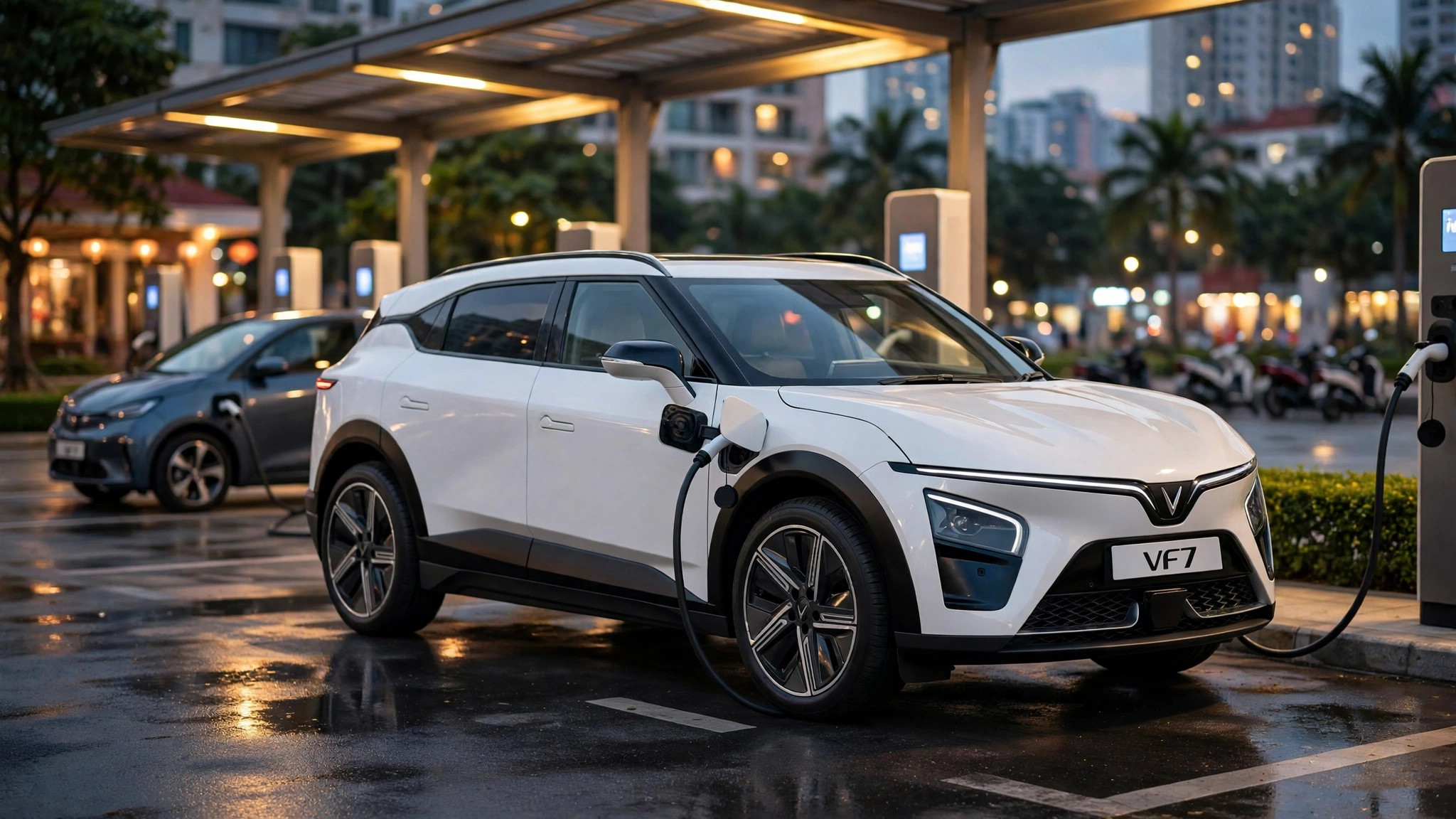
Vietnam’s state-owned utility EVN announced on November 4 a dedicated retail electricity tariff for electric vehicle charging, under Decision 2892/QD-BCT of the Ministry of Industry and Trade (MOIT). Until now, charging had no tariff category of its own. Stations paid for electricity as ordinary business or industrial customers, depending on the case. The price of a charge had no formal link to the time of day.
The decision changes that. Charging now has its own entry in the retail tariff table, with three time bands and two voltage levels. The gap between the cheapest and the most expensive kilowatt-hour is wide enough to change behavior. At low voltage, a peak-hour kilowatt-hour costs 2.6 times an off-peak one.
The new prices
The tariff applies per kilowatt-hour, excluding value-added tax (VAT), and depends on the voltage level of the connection:
| Time band | Medium voltage and above (over 1 kV) | Low voltage (up to 1 kV) |
|---|---|---|
| Peak hours | VND 3,758 per kWh | VND 4,212 per kWh |
| Normal hours | VND 2,549 per kWh | VND 2,700 per kWh |
| Off-peak hours | VND 1,534 per kWh | VND 1,620 per kWh |
Low voltage applies to the small connections typical of neighborhood charging points and swap cabinets, while medium voltage and above applies to larger stations and depots. At either level, the pattern is the same: peak power costs roughly 2.5 times off-peak power, and normal hours sit in between.
When each rate applies
Peak hours run from 5:30 p.m. to 10:30 p.m., Monday to Saturday, five hours a day. There are no peak hours on Sundays. Normal hours run from 6:00 a.m. to 5:30 p.m. and from 10:30 p.m. to midnight, Monday to Saturday, thirteen hours a day. On Sundays, normal hours run from 6:00 a.m. to midnight. Off-peak hours run from midnight to 6:00 a.m. every day, six hours a day.
The tariff structure is deliberate. The evening peak, when households switch on lights and air conditioners and commuters plug in after work, is priced as the most expensive window. The overnight hours, when the grid has spare capacity, are priced as the cheapest. MOIT sets the charging tariff between the production price paid by factories and the business price paid by shops and offices. The ministry notes that charging is a load that can be shifted: drivers and operators can shift charging away from the peak, which eases pressure on the grid.
What changed, and what did not
Before this decision, a charging station’s electricity bill depended on how its connection had been classified. Stations serving the public generally paid the business or production rate based on their intended use, with no separate category for charging. That made the cost of a charge a matter of the station’s paperwork rather than of the service it provided.
The groundwork was laid in December 2025. Circular 60/2025/TT-BCT required commercial charging stations, charging posts and battery-swap cabinets to install separate meters and bill by charging purpose. Decision 2892 now supplies the tariff table that the metering rule required.
What did not change is home charging. A driver who charges an electric vehicle under a residential electricity contract still pays the residential rate, not the new charging tariff. Where one meter serves a non-residential contract covering several purposes, the buyer and seller agree on the share of electricity assigned to each purpose, based on actual use.
What it means in money
The arithmetic is straightforward, and the price difference is large. A 40 kWh top-up for an electric car, at a low-voltage connection, costs VND 64,800 off-peak and VND 168,480 at peak hours. The difference is about VND 103,700, or about US$4 at roughly VND 26,000 to the dollar. The same session at normal hours costs VND 108,000.
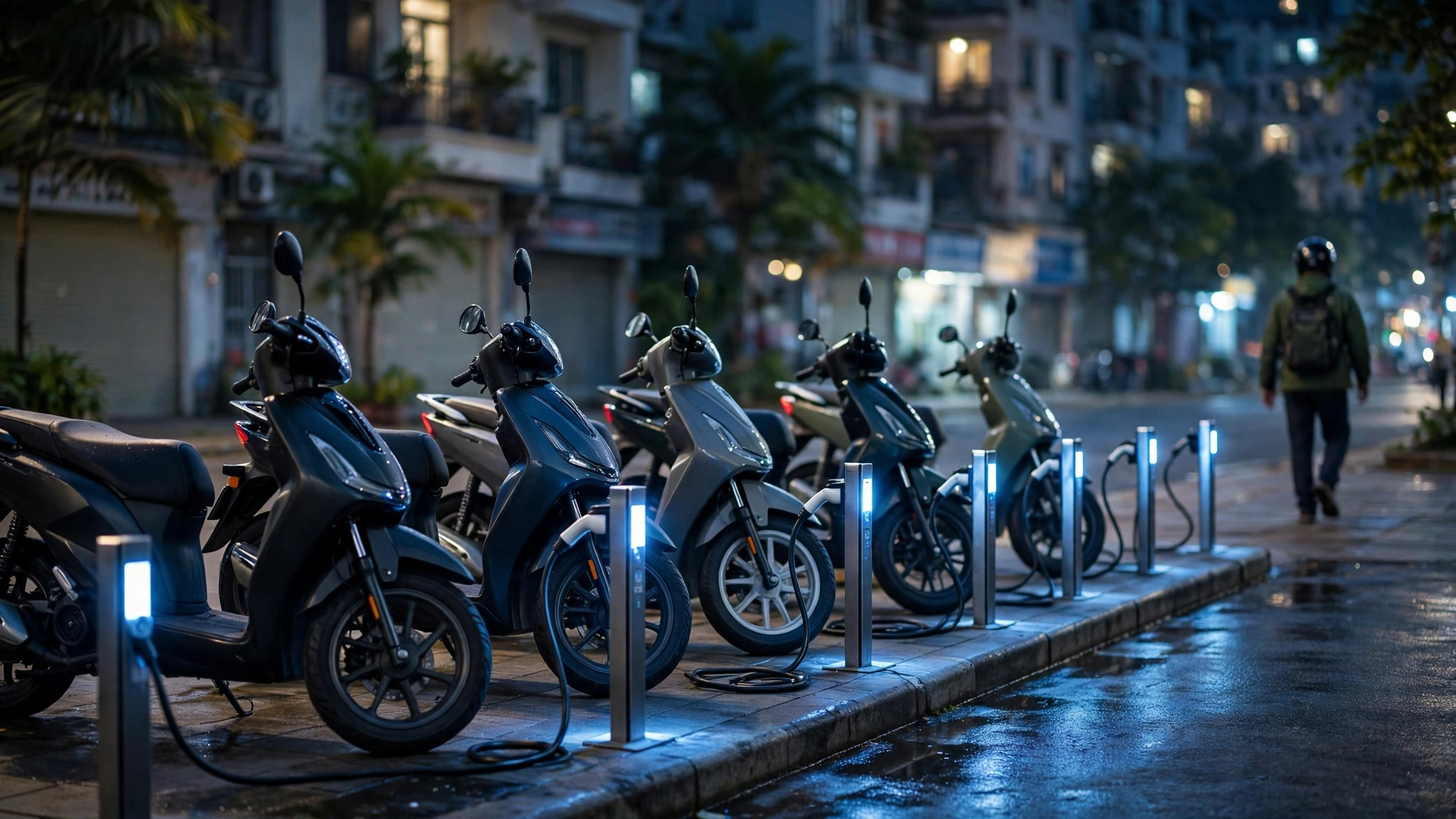
For two-wheelers the sums are smaller, but the logic is identical. A small electric motorbike with a battery of about 3.5 kWh can be fully charged for about VND 5,700 off-peak. The same charge costs about VND 14,700 at peak hours. Multiplied across a delivery fleet that charges every night, the choice of hour becomes a line item, not a detail.
For operators, the tariff sets the cost of the electricity they buy, not necessarily the price drivers pay. What a driver pays at a public charger depends on the operator’s own pricing, and several operators still run promotions, including free charging offers. The tariff narrows the room for that generosity at peak hours and widens it overnight, which is likely to push operator pricing toward time-of-day rates of its own.
Why the timing matters
The tariff is introduced as Vietnam’s electric fleet reaches a scale where charging load is no longer trivial. Nearly one million electric two-wheelers were in use in the first nine months of 2026. VinFast reported 177,697 electric cars delivered in Vietnam over the same period (see our overview of the two-wheeler market). Every one of those vehicles charges somewhere, and most of them charge after work, in exactly the window the tariff now prices highest.
The policy context is also relevant. Vietnam’s charging network is standardizing just as its electricity rates are being set. The national charging standard QCVN 32:2026 takes effect on July 1, 2027. It sets five groups of requirements for every public charger in the country (see why the standard matters beyond chargers). Standards define what a charger must be; the tariff now defines what the electricity inside it costs.
What to watch
Three things deserve attention as the tariff takes hold. First, the published prices exclude VAT, so the figure on a station’s bill will be higher than the table suggests. Second, the tariff is what the station pays EVN. The pass-through to drivers will be reflected in operator pricing over the coming months. A station that does not pass on the peak rate is choosing to cover that cost. Third, under the new tariff, the overnight window is now the cheapest electricity a driver can buy. It rewards the riders and fleets that can charge after midnight and penalizes the ones that cannot. Hanoi’s planned subsidy for poor households switching to electric motorbikes will have to account for that split (see the draft subsidy plan).
The tariff does not fully determine the economics of charging in Vietnam. It makes them visible, hour by hour, in this dedicated category for the first time.
Sources
Dan tri (Dan tri newspaper), November 5, 2026: EVN announced on November 4 Decision 2892 of the Ministry of Industry and Trade on retail electricity prices, adding a dedicated retail tariff for EV charging; medium voltage and above (over 1 kV): normal hours VND 2,549 per kWh, off-peak VND 1,534 per kWh, peak VND 3,758 per kWh; low voltage (up to 1 kV): peak VND 4,212 per kWh, normal VND 2,700 per kWh, off-peak VND 1,620 per kWh; all prices exclude VAT; peak hours 5:30 p.m. to 10:30 p.m. Monday to Saturday, five hours a day, no peak hours on Sundays; normal hours 6:00 a.m. to 5:30 p.m. and 10:30 p.m. to midnight Monday to Saturday, thirteen hours a day, and 6:00 a.m. to midnight on Sundays; off-peak hours midnight to 6:00 a.m. every day, six hours a day; MOIT positions the EV-charging price between the production price and the business price and notes charging load can shift away from peak hours; before this decision EV charging had no separate category in the retail tariff and stations paid business or production rates by case; Circular 60/2025/TT-BCT, from December 2025, requires commercial charging stations, charging posts and battery-swap cabinets to install separate meters and bill by charging purpose, while charging under a residential contract keeps the residential rate, and for a non-residential contract behind one meter the buyer and seller agree the share of electricity for each purpose based on actual use. https://dantri.com.vn/kinh-doanh/gia-dien-rieng-cho-tram-sac-xe-dien-cao-nhat-hon-4200-dongkwh-20261105075403623.htm
Lao Dong (Lao Dong newspaper), November 5, 2026, 09:18: confirms the new tariff table for charging stations, with the highest price above VND 4,200 per kWh. https://laodong.vn/kinh-doanh/bieu-gia-dien-moi-cho-tram-sac-cao-nhat-hon-4200-dongkwh-1795013.ldo
vietnam.vn (the state’s official external information portal), November 5, 2026: confirms the dedicated tariff for EV charging stations, highest price above VND 4,200 per kWh. https://www.vietnam.vn/fr/gia-dien-rieng-cho-tram-sac-xe-dien-cao-nhat-hon-4-200-dong-kwh