Document facts
Issuing body: Government of Vietnam (signed by Deputy Prime Minister Pham Gia Tuc, at the recommendation of the Minister of Industry and Trade)
Document number: Decree 344/2026/ND-CP on the application of science and technology and the development of the manufacturing industry in the electricity sector (implements Article 8 of the Electricity Law, Law 61/2024/QH15; it neither repeals nor amends any earlier decree)
Signed: September 4, 2026
Effective: October 20, 2026
Status: In force since October 20, 2026; the two product lists in Article 4(2) have not yet been issued, as the Ministry of Industry and Trade must submit them to the Prime Minister for approval and issuance, meaning no specific product yet qualifies for the incentives
Unofficial English summary for reference only. Not a legal translation and not legal advice. The Vietnamese text linked at the end of this page is authoritative.
What the document does
Decree 344/2026/ND-CP is a framework decree in five chapters and 24 articles. Its stated objective is to implement Article 8 of the Electricity Law, Law 61/2024/QH15, on the application of science and technology and the development of the manufacturing industry in the electricity sector, aiming to ensure continuous power supply, national energy security and localization of electrical-equipment production. It does not itself grant an incentive to any named product. It sets up the lists, the program and the mechanisms through which incentives will later be granted.
Chapter II creates the two lists upon which the entire decree is based (Article 4). The first is a critical list: items, equipment and consulting services that must be developed, produced and supplied domestically in some stages. An item qualifies by meeting one of four criteria. It directly and decisively affects national energy security, including stable supply, transmission reliability, safe grid operation and data security; it is a consulting service for a new, complex, high-technology power-source project to international quality standards; it is an operation and maintenance service for power plants, grids and critical power works; or it is a technology and security solution for grid control and operation. The second is an encouraged list of items for domestic production and supply. For each period, the Ministry of Industry and Trade submits both lists to the Prime Minister for approval and issuance. Neither list has been issued yet. Article 5 requires the ministry to build an application and development program for each period, for Prime Ministerial approval, setting out the products, their requirements, and evaluation indicators, the managing agency, the duration, the budget structure and the expected results.
Chapter III (Articles 6 to 13) establishes the incentives and support mechanisms. Chapter IV (Articles 14 to 19) creates the energy industry-service complex, an integrated zone for research and development, trial manufacture, production and construction, installation, operation, and maintenance services. Chapter V (Articles 20 to 24) assigns implementation duties to central agencies and provincial People’s Committees, and sets out supervision and sanctions.
What changes in practice
The most concrete commercial term in the decree is the order mechanism in Articles 7 and 8. Critical-list items that are produced domestically for the first time can be ordered by the State under the bidding law, and listed organizations must publicize and offer their items for sale and domestic supply. The State considers awarding orders to organizations whose listed items are domestically produced and tested to technical, safety and environmental standards, or are formed from research and innovation results meeting those standards. The order price and volume are determined based on reasonable, lawful production and supply costs plus a reasonable profit under the pricing law, with separate cost accounting and an independent audit of the order price.
Suppliers receiving orders are entitled to three benefits. First, a price preference of no more than 10 percent above the cost of a comparable imported product. Second, exemption from experience requirements when participating in orders. Third, a liability shield. In cases of loss to the State, a supplier is not subject to administrative or criminal liability, and is exempt from civil liability, provided it fully followed the science-and-technology and ordering procedures, had no profit motive, and committed no fraud or intentional legal violation.
Two specific financial incentives are available for listed items. Article 10 covers 50 percent of the cost of using state laboratories, test labs, design-support labs, shared research equipment and state testing, measurement, inspection, and assessment centers. Article 12 covers no more than 70 percent of the cost of hiring experts and scientists for research and development, design and manufacture of listed items, within budget capacity and under an approved program or project. Article 13 adds investment credit support under the state investment-credit law and priority borrowing from investment-support funds and science-and-technology funds for research and development and trial manufacture.
Article 9 adds a stringent requirement. Critical-list items already produced domestically to the prescribed technical, safety and quality standards must be supplied and used in power works. Project developers will have to check the critical list before importing equivalent equipment, and supplying contractors get access to technology-innovation support programs from the national science-and-technology funds. Noncompliance incurs penalties under Article 23: incentives wrongly claimed are recovered, and localization-commitment failures are sanctioned under the laws on administrative violations concerning investment, electricity, and environment. The Ministry of Industry and Trade monitors localization commitments, technology transfer and the use of domestic products and services.
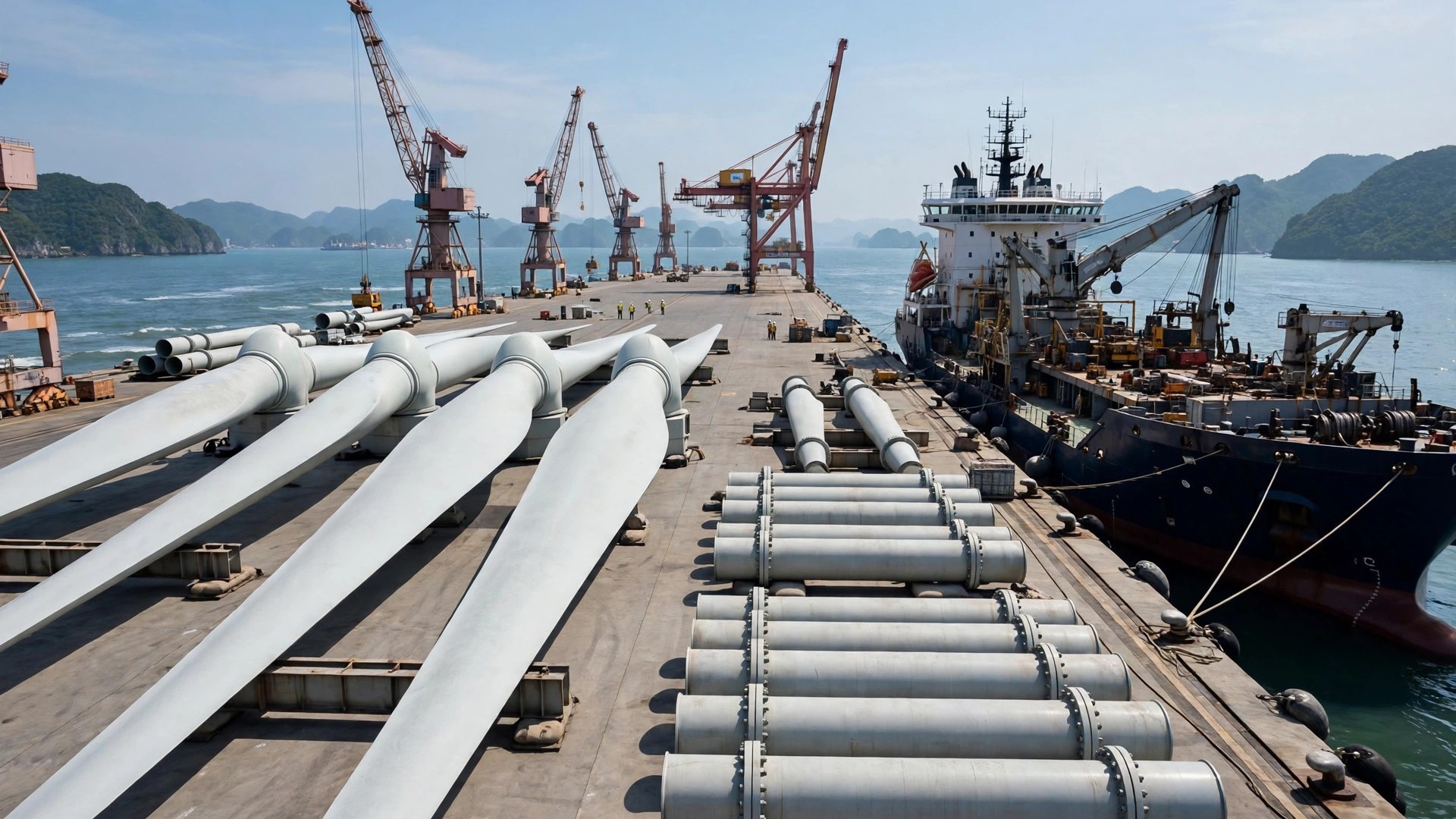
The energy industry-service complex is the decree’s new institutional vehicle. Its functions cover research, innovation and energy-technology development focused on electrical-equipment manufacture and renewables, new energy, smart energy and energy saving, plus construction, installation, operation, and maintenance services for power projects, digital transformation and data management, and training and technology transfer. Site criteria explicitly favor favorable geography near regions with large power-project potential and the ability to connect or build a deep-water port or specialized berth for heavy-lift vessels and oversized equipment. They also look for the potential to form industry clusters attracting world-leading original equipment manufacturers and suppliers in the offshore-wind value chain. A complex counts as formed from the date the competent authority approves the investment policy, decides the investment policy, or approves the investor selection (Article 16(4)). Projects inside a complex get a one-time land-rent payment for the whole lease term, corporate income tax and import-tax incentives, land-rent and land-use-fee exemption or reduction, and training and research support. The State prioritizes public investment, official development assistance (ODA) or public-private partnership (PPP) funding for shared technical infrastructure that is hard to attract privately.
What changed from the previous rules
Decree 344 does not repeal or amend any earlier decree. No repeal clause exists anywhere in its text, and no earlier instrument is identified as replaced. The comparison here is therefore not between an old decree and a new one. It is between having no dedicated implementing framework for Article 8 of the Electricity Law and having one.
Before this decree, the science-and-technology application and domestic-manufacturing agenda for the power sector had no standalone instrument that set the lists, the order mechanism, the testing and human-resource support rates, or the energy-complex vehicle. What is genuinely new is the two lists and the program, the order mechanism with its 10 percent price preference and liability shield, the 50 percent and 70 percent support rates, the energy industry-service complex, and the domestic-supply compulsion in Article 9.
What the decree mostly does by cross-reference is the general incentives in Article 6. Manufacturers of listed electrical equipment receive the incentives applicable to the key mechanical-engineering product sector under investment, tax, land, accounting, and related laws; listed products in the encouragement category receive supporting-industry incentives and incentives under high-technology laws; and listed-equipment investment projects of the prescribed scale get special investment incentives under the investment law. Those regimes already existed. The decree integrates power equipment into them rather than creating these new regimes.
One thing the decree deliberately does not do is set a numeric localization rate. Articles 1(4) and 22(2)(b) refer to localization requirements and targets and to maintaining and raising the localization rate, but the decree itself states no percentage. The numbers will come in the lists and the program, and no figure should be quoted from this decree.
Who is affected
Electrical-equipment manufacturers are the direct beneficiaries: makers of transmission and distribution gear, renewable-energy equipment, smart-grid technology, and control and security systems for grids. Investors in energy industry-service complexes and offshore-wind supply chains, including foreign original equipment manufacturers considering a Vietnam manufacturing base, face a new vehicle with defined site criteria and incentives. Power-project developers and engineering, procurement and construction contractors are affected from the other side: the domestic-supply compulsion in Article 9(1) and the order mechanism change sourcing decisions once the critical list is published. Domestic supporting-industry firms making components, spare parts and materials, and specialized logistics providers handling oversized transport, offshore installation and wind-turbine maintenance, are the intended supply-chain participants.
Notes for investors and operators
The decree has been in force since October 20, 2026, but its incentives are framework-level today. The lists and the program do not exist yet, so the honest starting point for any business is to monitor for the publication of the lists, not the decree date. Nothing in the decree is claimable for a specific product until that product is on a list.
The liability shield’s conditions matter. It protects suppliers who fully followed the science-and-technology and ordering procedures, had no profit motive and committed no fraud or intentional legal violation. A supplier that cuts a corner on procedure or inflates an order price does not get it, and the order-price accounting and independent-audit requirement in Article 8(2) is the control that makes the shield auditable. Localization commitments are also monitored: the Ministry of Industry and Trade tracks them, and failures trigger clawback and administrative penalties, so a manufacturer that takes the incentives should treat its localization commitments as a reporting obligation, not a slogan.
What businesses should do next: watch for the Ministry of Industry and Trade’s submission of the two Article 4(2) lists to the Prime Minister. Manufacturers of power equipment should check whether their products meet the Article 4(1) critical criteria and prepare testing and inspection evidence to the prescribed technical, safety and environmental standards (Article 8(1)(a)). First-time domestic producers should note the duty to publicize and offer listed items for ordering and domestic supply (Article 7(2)), and the order-price accounting and independent-audit requirement (Article 8(2)). Plan around the quantified supports: 50 percent of state lab, test and design costs (Article 10) and up to 70 percent of expert and scientist hiring costs (Article 12), both for listed items and within budget capacity. Complex investors should test sites against the Article 15 criteria, including deep-water port access and offshore-wind cluster potential, and note that a complex counts as formed only on the competent authority’s investment-policy approval or investor selection (Article 16(4)).
Sources and the official text
Thu Vien Phap Luat (legal database), full Vietnamese text of Decree 344/2026/ND-CP, reviewed in its entirety; confirms the document number, issuing body, signer, signing date of September 4, 2026 and effective date of October 20, 2026 under Article 24(1). No Official Gazette (Cong Bao) URL for this decree was verifiable at the time of writing; the Thu Vien Phap Luat text above is the full text relied on. https://thuvienphapluat.vn/documents/law.aspx?id=A=pJek5qWTTn&mode=
Government Portal (chinhphu.vn), policy explainer on Decree 344/2026/ND-CP, September 8, 2026. https://media.chinhphu.vn/chinh-sach-ho-tro-phat-trien-cong-nghiep-che-tao-thiet-bi-phuc-vu-nganh-dien-luc-102260907174545504.htm
About this explainer: VoltViet prepared this summary in English from the official Vietnamese text so that investors and operators can follow what the document does. It is a reading aid, not a translation of record and not legal advice. Where any wording here differs from the Vietnamese text, the Vietnamese text governs. For decisions with legal or financial consequences, rely on the official text linked above and take advice from a qualified Vietnamese lawyer.
Related reading
More explainers from the Policy & Law desk, and reporting from the Clean Energy desk.