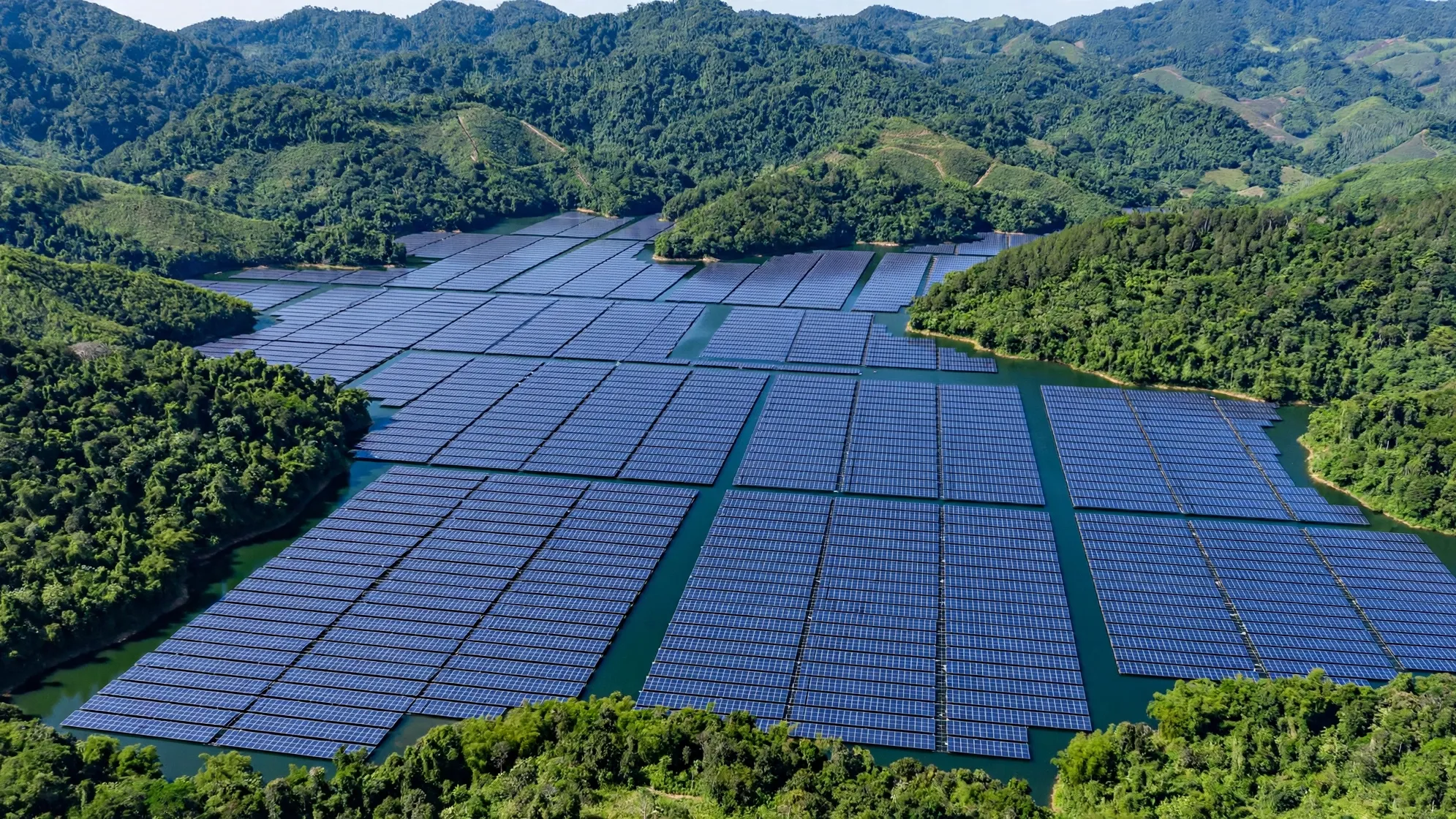
Dak Lak province has approved an inland floating solar plant that will be among the world’s largest. The 452 MW project on the Ea Sup Thuong reservoir, worth about VND 9.1 trillion, or USD 355 million, was approved by the Dak Lak Provincial People’s Committee under Decision 3526/QD-UBND on October 31, 2026. It is scheduled for completion by the end of 2028, and it will include a battery energy storage system.
The project is the latest sign that Vietnam’s floating solar pipeline is moving from pilot scale to utility scale. The country’s first large floating plant, the 47.5 MW Da Mi installation on a hydropower reservoir in Binh Thuan province, connected to the grid in May 2019. Two 35 MW plants followed in late 2020 on irrigation reservoirs in Chau Duc district. The Dak Lak project is roughly ten times the size of Da Mi.
What will be built
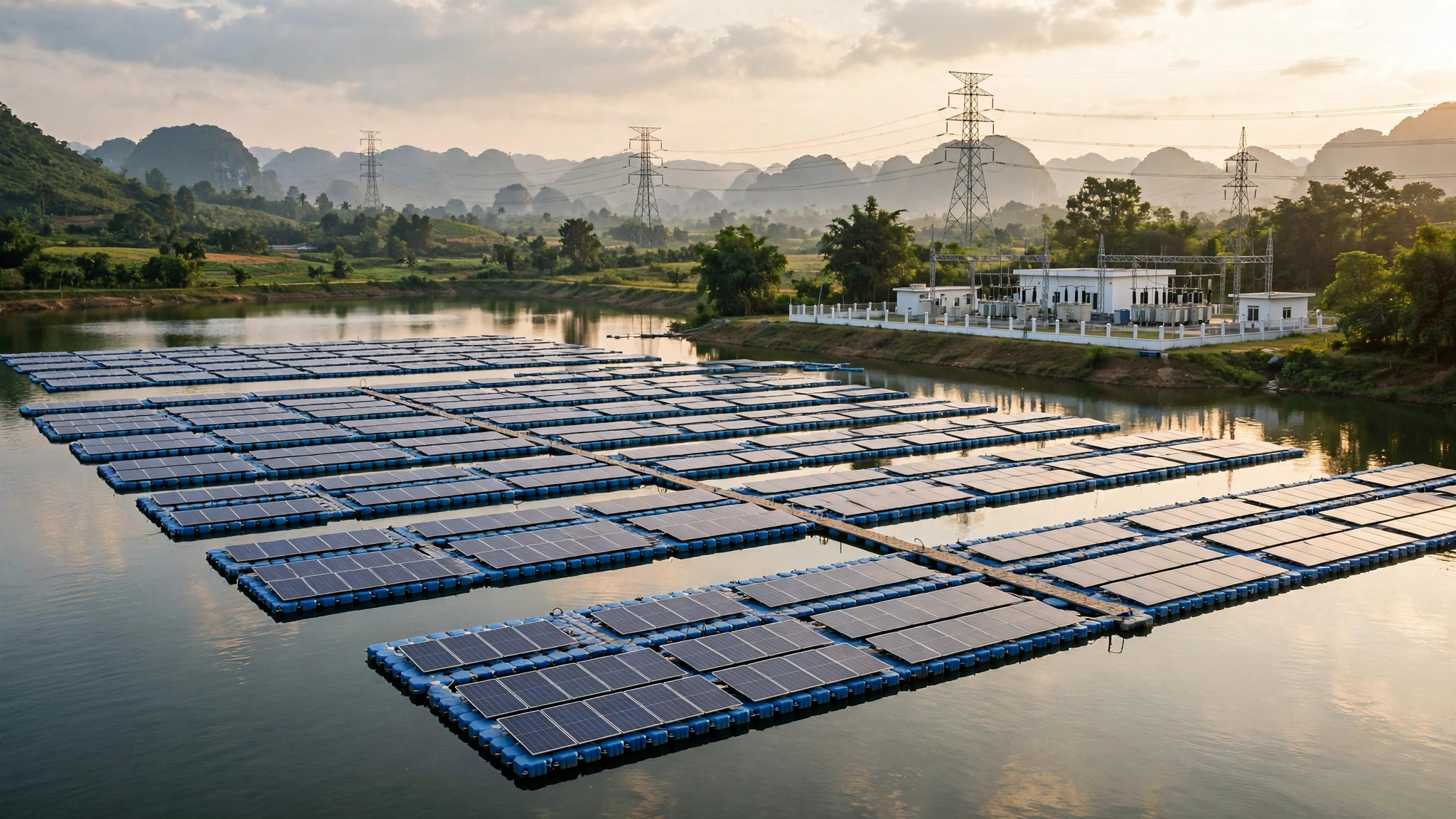
The plant will occupy about 527 hectares, including 524 hectares of reservoir surface. A floating 35 kV collection network will gather the power, feeding a 35/220 kV substation equipped with two 250 MVA transformers. A 6 km double-circuit 220 kV transmission line will connect the plant to the Krong Buk substation, where two additional 220 kV connection bays will be installed.
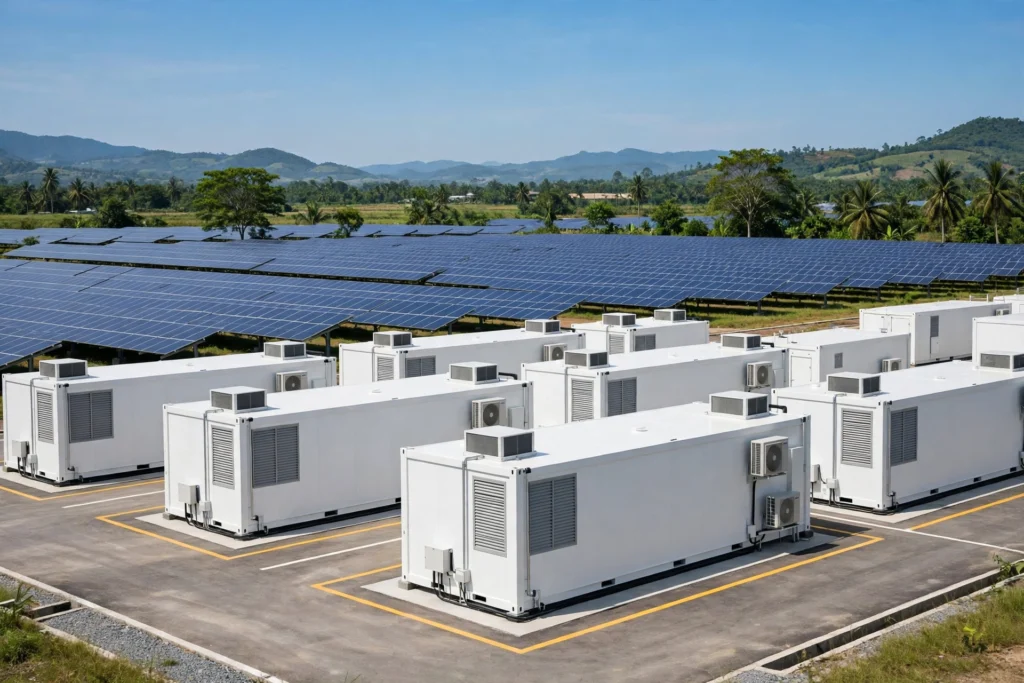
A battery energy storage system is part of the project, although its capacity has not been disclosed. The developers will contribute 20 percent of the total investment through equity, with the remaining 80 percent raised from other sources. The consortium behind the project comprises IPC Engineering and Construction, Tay Nguyen Infrastructure Construction and Development, SD Vietnam Construction Investment, and Ea Sup Investment.
Why floating solar, and why now
Floating solar helps address two problems that ground-mounted projects in Vietnam increasingly face: land and grid access. Reservoirs offer large water surfaces without competing for farmland, and many sit beside hydropower infrastructure that already connects to the grid. The Ea Sup Thuong project follows that logic, pairing a very large water surface with a dedicated substation and a short transmission link.
The economics have also improved. Under the 2025 framework, floating solar ceilings ranged from VND 1,228.2 per kWh in the South to VND 1,685.8 in the North. The Ministry of Industry and Trade’s 2026 framework, set on November 5, raised floating solar ceilings to VND 1,340.21 in the South, VND 1,560.63 in the Central region, and VND 1,939.74 in the North. Plants paired with storage get higher ceilings again. Dak Lak sits in the Central region, so the project’s ceiling is VND 1,560.63 per kWh without storage, or VND 1,703.21 with storage. Those ceilings are maximum prices for negotiating power purchase agreements with EVN, not guaranteed tariffs, but they give the developers and the utility a current basis to agree a price.
What to watch
The test for the project is execution. A 452 MW floating plant on a reservoir is a major civil and electrical undertaking. The 2028 completion date leaves about two years from approval. The battery storage component is the open question: its capacity is undisclosed, and the separate battery storage pricing mechanism the ministry is drafting for December 2026 will shape whether storage earns its keep. The grid connection is the other watchpoint. The 6 km line to Krong Buk and the two new connection bays are modest beside the plant itself, but timely grid access has decided the fate of renewable projects in Vietnam before.
If it completes on schedule, the Ea Sup Thuong plant will be among the largest inland floating solar installations in the world, and the biggest in Vietnam by a wide margin. It would also confirm a shift in where Vietnam builds solar: not only on rooftops and open land, but on the water its hydropower reservoirs already hold.
Floating solar’s place in the mix
Vietnam’s solar capacity passed 19 GW by the end of 2025, with about 586 MW added last year, and the mix is shifting. Rooftop solar grew fastest in the early boom, but utility-scale projects now face the land and grid constraints that floating solar helps to mitigate. Water surfaces on hydropower and irrigation reservoirs offer space without farmland, and many reservoirs already have grid connections through the hydropower plants beside them. The Da Mi project proved the model in 2019 at 47.5 MW. The two 35 MW plants at Gia Hoet 1 and Tam Bo in late 2020 proved it again on irrigation reservoirs. Ea Sup Thuong, at 452 MW, is the model at a different scale entirely: ten times Da Mi, and among the largest inland floating installations in the world.
The pricing framework is moving the same way. Floating solar earns the highest ceilings in the 2026 solar framework. The highest ceiling is VND 2,120.31 per kWh with storage in the North, against VND 1,813.48 for ground-mounted solar with storage in the same region. The premium reflects the higher cost of building on water and the value of the storage that smooths solar output into the evening peak. For a project the size of Ea Sup Thuong, that premium is worth tens of billions of dong a year in negotiating room, if the power purchase agreement captures it.
Why it matters for Vietnam
The country needs new generation that can be built quickly, and floating solar is among the fastest large-scale options available. The country’s electricity demand grows about 10 percent a year. Coal still generates nearly half of all power, and renewables stand at just under 14 percent of generation against a Power Development Plan VIII target of 20 to 25 percent. Every large renewable project that reaches completion narrows that gap. Ea Sup Thuong matters because of its size and because it proves that reservoir surfaces, of which Vietnam has many, can host generation at a scale that changes the national mix rather than decorating it.
Related reading: Vietnam sets 2026 price ceilings for wind and solar power and Savan 1 Wind Farm Posts $42 Million Nine-Month Gross Profit and Gia Lai Breaks Ground on 180 MW Van Canh 2 Wind Farm.
Sources
pv magazine, November 4, 2026: https://www.pv-magazine.com/2026/11/04/vietnam-approves-452-mw-floating-solar-project/
SolarQuarter, November 4, 2026: https://solarquarter.com/2026/11/04/vietnam-approves-355-million-452-mw-floating-solar-project-in-dak-lak-province/
—