Leaving Sydney in winter
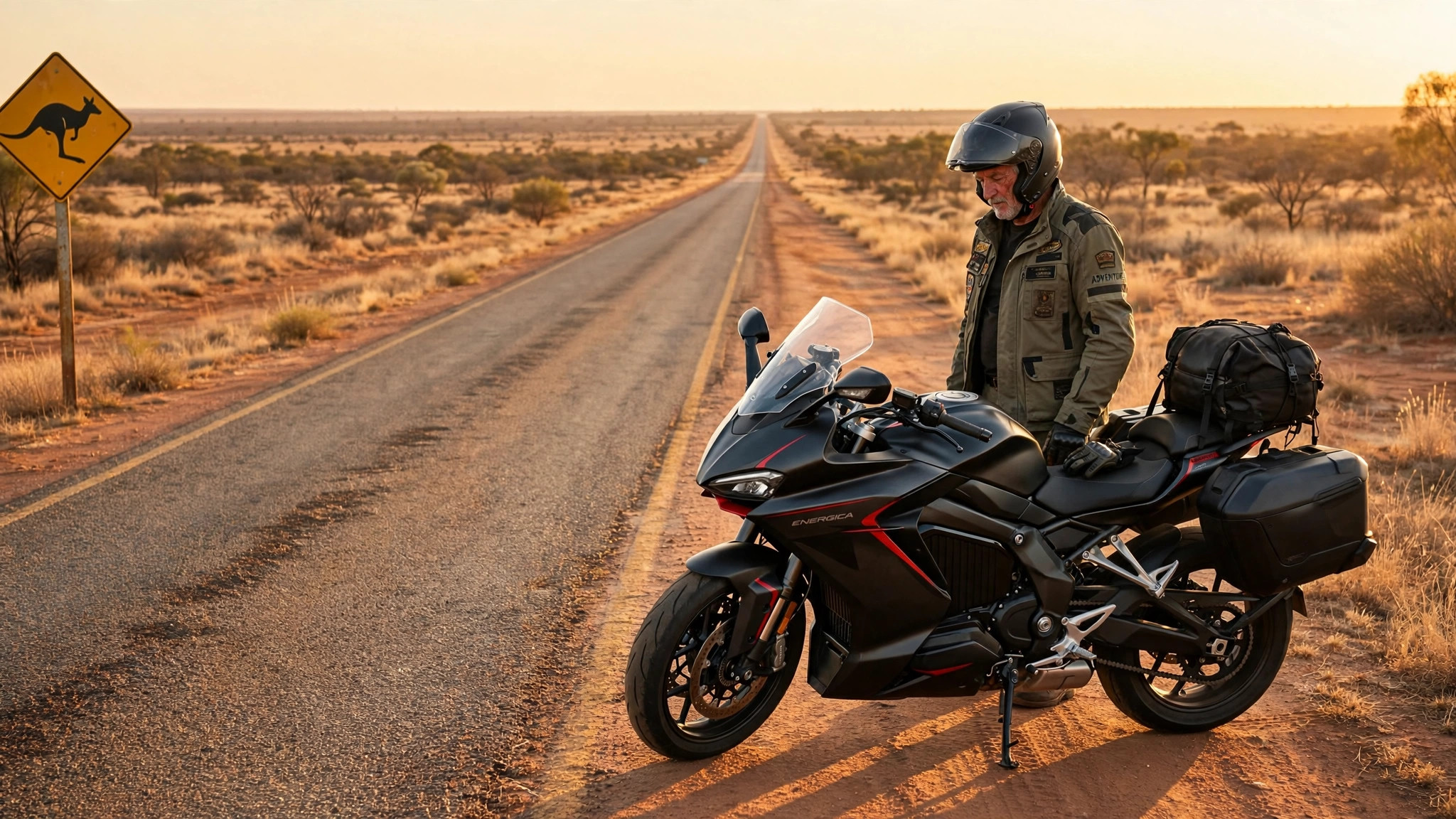
On 24 June 2026, Ed Darmanin left Sydney on an electric motorcycle and pointed it counterclockwise around Australia. He was 67 years old, a retired electrical engineer, and riding an Energica Experia. The plan was simple to state and hard to do. Ride all the way around a continent, on electricity alone, and come home.
He returned to Sydney on 27 September 2026. The journey had taken 95 days and covered 18,446 km, with zero petrol used. With that return, Darmanin became the first person to circumnavigate Australia on an electric motorcycle.
A first of that kind is not won on a single heroic day. It is accumulated slowly, in daily distances, in charging stops planned and sometimes endured, in weather accepted rather than chosen, and in the discipline to keep going when the map offers long empty stretches and very few certainties. His background as an electrical engineer makes the story fitting, but no professional knowledge removes the central challenge. Out on the road, a rider still has only the range the machine can deliver and the chargers the country has actually built.
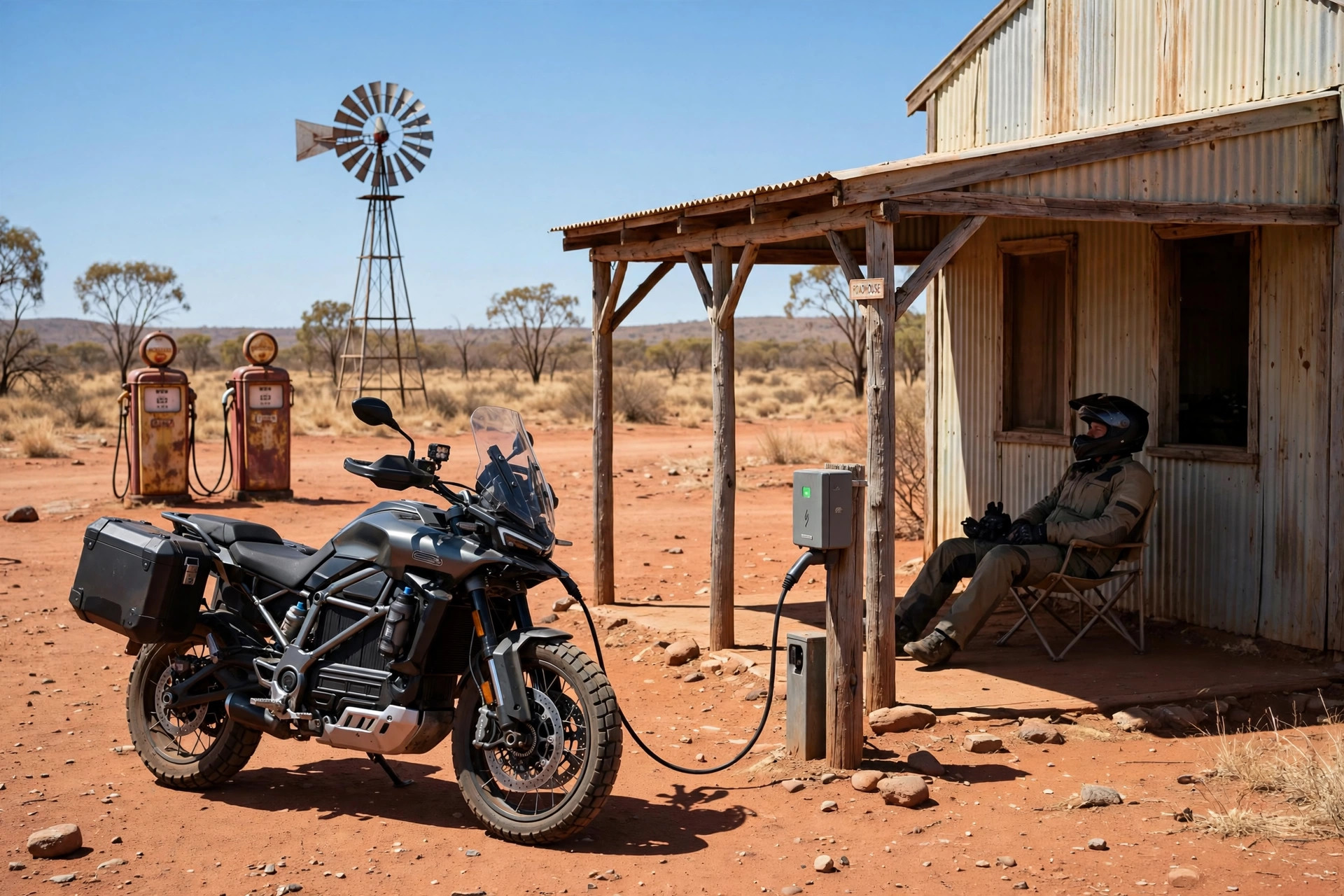
He did not ride every kilometre alone in spirit. His wife Sally rode two legs of the journey, and his son Evan rode two legs as well. Those shared sections give the record a human shape. This was an individual achievement carried within a family, a long circuit broken into parts that people who love the rider could join for a time, before he continued around the coast and across the wide stretches beyond it.
Where the gaps are longer than the range
The numbers that define the journey are not the biggest ones. The total of 18,446 km impresses, and 95 days shows endurance, but the real story sits in a smaller comparison. Darmanin’s real world range was about 160 km per charge, while some gaps between chargers ran from 260 km to 300 km.
Pause on that gap. A rider who can travel about 160 km before needing charge cannot simply ride through a stretch of 260 km to 300 km and hope for the best. Planning and patience become part of the machine, as essential as the motor or the battery. Each long section has to be thought through in advance. Where can energy be found? How long will it take? What happens if the wind turns against the bike and the range falls?
The price of energy at Balladonia
At Balladonia, the journey produced a pair of prices that captures how unusual roadside economics can become in remote places. Diesel cost AUD 3.09 per litre, while electricity cost AUD 3.00 per kWh. With AUD 1 at about USD 0.65, that is about USD 2.01 per litre for diesel and about USD 1.95 per kWh for electricity.
Those figures should be read for what they are, a snapshot from one remote stop, not a national comparison. Remote energy is expensive energy, whatever form it takes, because everything has to be brought far and supplied to few travellers. What matters for Darmanin’s logbook is that he could obtain the electricity he needed and keep moving. The record did not require electricity to be cheap at every stop. It required electricity to be there.
Fire, wind and waiting
Australia did not make the circuit easy. Darmanin dealt with a bushfire near Broome, headwinds of 30 km/h to 45 km/h, and a two day wait at Esperance. Each obstacle attacks an electric journey in a different way.
A bushfire is a safety problem before it is a travel problem, and no record is worth riding toward danger. Headwinds are an energy problem, because pushing against moving air drains range that was calculated for calmer conditions, turning a comfortable margin into a thin one. A two day wait is a patience problem, a reminder that a long journey is measured not only in kilometres per day but in days given up to circumstances the rider cannot control.
Taken together, the three episodes explain why 95 days is the right frame for pride. A faster trip in perfect conditions would prove less. Darmanin’s circuit absorbed fire, wind, and delay and still closed the loop back to Sydney. The motorcycle ran on electricity from start to finish, and the rider supplied the planning and patience that the network, in its present state, still asks of anyone who travels beyond the easy distances.
What his logbook says beyond Australia
It would be easy to file this journey as a curiosity, one determined rider, one motorcycle, one very large island continent. That would miss the point his logbook makes to every country now building public charging, including Vietnam.
Vietnam’s charging story is often told from its big cities, where vehicles, riders, and new infrastructure are concentrated. Darmanin’s 18,446 km asks the longer question. What happens between the cities? A network earns national trust when a driver can leave the dense places, cross the thinner country beyond them, and still find energy at planned intervals shorter than the range of the vehicles people actually ride and drive.
His figures set that test plainly. Real world range of about 160 km per charge. Gaps from 260 km to 300 km that forced planning and patience. A two day wait accepted as part of the price. Countries building beyond their capitals can shorten those gaps, space reliable chargers along real travel routes, and spare the next rider some of that waiting. The technology has already shown it can complete the loop. The task now belongs to the networks.
On 27 September 2026, Darmanin rode back into Sydney and closed a circle that no electric motorcyclist had closed before. Ninety five days earlier he had left with a machine, a route, and a continent sized question about whether the chargers would be enough. Eighteen thousand, four hundred and forty six kilometres later, the answer was parked beside him, still running on electricity, having never stopped at a petrol station at all.
Related reading
- The Nairobi Rider Who Halved His Fuel Bill by Going Electric
- Two Wheels, Three Models: Swapping, Plugging and Leasing Compared
- Africa’s 17 GW Solar Year, and the Lesson Vietnam Is Reading
Sources
CleanTechnica, 2026. Report on Ed Darmanin’s electric motorcycle circumnavigation of Australia. ABC reporting carried by The Cooldown, 2026. Coverage of the 95 day, 18,446 km journey on an Energica Experia.