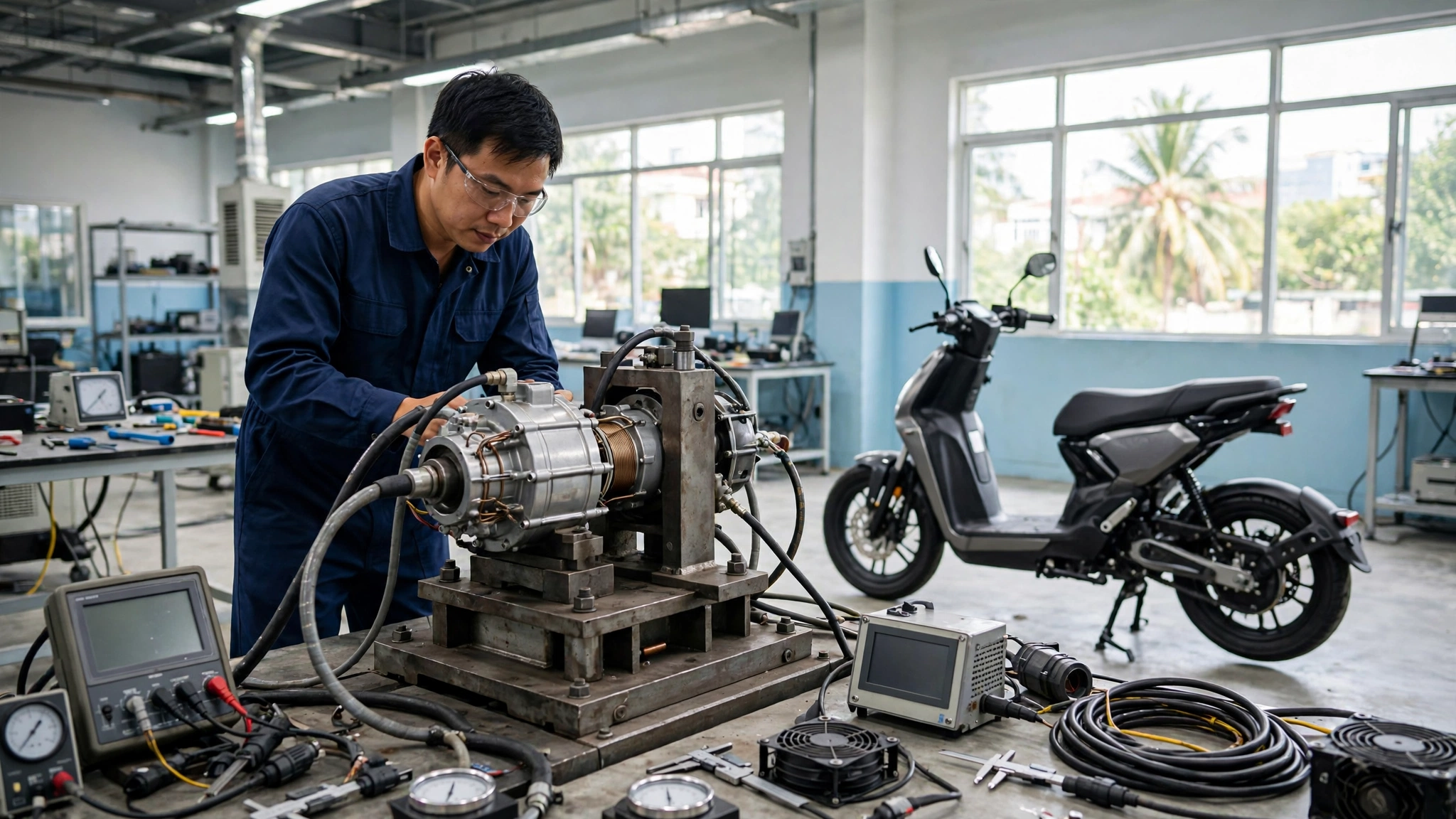
Vietnam’s updated technical regulations for electric motorcycle motors and batteries took effect on October 9, 2026, changing the compliance framework for manufacturers, assemblers and component importers.
Issued by the Ministry of Construction under Circular 12/2026/TT-BXD and Circular 13/2026/TT-BXD, the two regulations, QCVN 30:2026/BXD and QCVN 31:2026/BXD, set requirements for motor performance, electrical protection, battery capacity and safety testing. They replace the corresponding 2024 regulations from the Ministry of Transport, and they keep a transition for certification files that were already in the system before the effective date.
For suppliers, the key question is how the updated requirements affect testing and certification. For riders, the distinction is simpler: neither regulation introduces a new inspection requirement for motorcycles already in use.
Document facts: QCVN 30:2026/BXD, motors
Issuing body: Ministry of Construction
Document: Circular 12/2026/TT-BXD, promulgating QCVN 30:2026/BXD on motors for electric motorcycles and electric mopeds
Scope: New motors in production, assembly and import, and motors examined at the request of a management authority
Signed: April 9, 2026
Effective: October 9, 2026
Replaces: QCVN 90:2024/BGTVT, issued by the Ministry of Transport
Transition: Certification files received before October 9, 2026 continue under the rules in force when they were received; test reports issued before that date remain valid for certification
Document facts: QCVN 31:2026/BXD, traction batteries
Issuing body: Ministry of Construction
Document: Circular 13/2026/TT-BXD, promulgating QCVN 31:2026/BXD on traction batteries for electric motorcycles and electric mopeds
Scope: New traction batteries, covering sealed and valve-regulated lead-acid batteries, nickel-metal hydride batteries and lithium-ion batteries, in production, assembly and import
Signed: April 9, 2026
Effective: October 9, 2026
Replaces: QCVN 91:2024/BGTVT, issued by the Ministry of Transport
Transition: Certification files received before October 9, 2026 continue under the rules in force when they were received; test reports issued before that date remain valid for certification
Unofficial English summary for reference only. Not a legal translation and not legal advice. The Vietnamese text linked at the end of this page is authoritative.
What the document does
Each circular issues one regulation. QCVN 30:2026/BXD sets the technical requirements for new motors used in electric motorcycles and electric mopeds. QCVN 31:2026/BXD does the same for new traction batteries, covering sealed and valve-regulated lead-acid batteries, nickel-metal hydride batteries and lithium-ion batteries. Both regulations were drafted by the Vietnam Register and appraised by the Ministry of Science and Technology before the Minister of Construction issued them.
The scope is deliberately narrow, and it is the first thing to understand about both documents. Both regulations govern parts in production, assembly and import, and parts examined at the request of a management authority. The people and organizations they bind are domestic production and assembly facilities, importers, and the bodies that manage, inspect, test and certify technical safety and environmental quality. Nothing in either text sets a deadline for owners of motorcycles in use, and neither text creates a re-inspection program for vehicles already sold.
What the 2026 regulations require
For motors, the regulation turns the maker’s own paperwork into a testable promise. A motor’s construction and specifications must match its registration file. Its surface must be free of rust, cracks and peeling paint. The rated voltage, rated power and motor number must stay legible on the finished unit, with the number stamped, engraved or embossed so it cannot be altered or erased. On the test bench, measured peak power, rated power and rated speed may differ from the registered values by no more than 5 percent. Efficiency must reach at least 75 percent at rated torque and at least 70 percent at 50% and 160% of rated torque. A motor must survive overload testing without visible mechanical deformation, the insulation resistance between the winding and motor casing must be at least 100 megohms, and temperature rise is capped at 65 degrees Celsius for the winding and 60 degrees Celsius for the casing. The electronic controller must carry its brand, type code and operating voltage, and must protect the motor against voltage sag and overcurrent.
For batteries, the regulation combines truthful labeling with abuse testing. Terminal polarity and the rated voltage and rated capacity must be marked clearly and durably, and batteries rated above 60 volts must carry the prescribed high voltage warning symbol. Measured voltage may not fall below the rated value or exceed it by more than 15 percent. Measured capacity must reach at least 90 percent of the rated three-hour capacity for lead-acid batteries, and 100 percent for nickel-metal hydride and lithium-ion batteries. The regulation also specifies a series of safety tests. Four of them, overcharging, over-discharging, vibration and, except for lead-acid batteries, short circuit, share one pass condition: the battery must not leak, catch fire, explode or rupture during the test or in the hour that follows it.
Two further tests apply only to batteries other than lead-acid, and their conditions are not identical. In the water immersion test, a fully charged battery is submerged up to its top face for two hours in a salt water solution of 3.5 to 5.0 percent sodium chloride; it passes if it does not catch fire or explode during the test or in the hour after it. The drop test applies only to removable batteries: charged to at least 90 percent of rated capacity, the battery is dropped six times from a height of 1.0 meter, in a different orientation each time, onto flat concrete, and it must not leak, catch fire, explode or rupture.

The changeover is managed rather than abrupt. Motor and battery types whose inspection, testing or certification files were received before October 9, 2026 continue through the process under the rules in force when the files were received, and test reports issued before that date remain valid for certification. On the ground, implementation runs through the certification pipeline at the Vietnam Register and accredited testers, not through any action asked of riders: the rules apply during production, assembly and import approval.
What changed from the 2024 rules
Much of the 2026 text is continuity, and readers should not mistake its headline numbers for new tightening. The motor efficiency floors are unchanged from QCVN 90:2024/BGTVT: at least 75 percent at rated torque and at least 70 percent at 50% and 160% of rated torque. The battery capacity floors are unchanged from QCVN 91:2024/BGTVT: at least 90 percent of the rated three-hour capacity for lead-acid batteries and 100 percent for nickel-metal hydride and lithium-ion batteries. The 100 megohm floor for insulation resistance between the winding and the motor casing also carries over.
Four changes are real. First, the tolerance net for motors is wider: the 2024 rule held only peak power to within 5 percent of the registered value, while the 2026 rule applies the same 5 percent tolerance to peak power, rated power and rated speed. Second, the water immersion test changed character: the 2024 battery rule soaked a fully charged battery in plain water for 24 hours and required no sparking, leakage, fire or explosion, while the 2026 rule uses a salt water solution for two hours and requires only that the battery not catch fire or explode. Third, the drop test narrowed: it covered every non-lead-acid battery in 2024 and covers only removable batteries in 2026. Fourth, the crush test that the 2024 battery rule applied to non-lead-acid cells no longer appears in the 2026 text.
The rulebook also changed hands. Both 2024 regulations were issued by the Ministry of Transport under Circular 48/2024/TT-BGTVT; the 2026 pair comes from the Ministry of Construction, which took over the vehicle technical regulation portfolio in Vietnam’s 2025 ministry reorganization. The drafting body did not change: the Vietnam Register wrote both generations.
Who is affected
Domestic manufacturers and assemblers of electric motorcycles and mopeds bear the primary compliance burden, because motors and batteries they source or build must now be tested and certified against the new regulations. Importers of motors and traction batteries are directly covered. Importers of complete electric motorcycles should assess how the component requirements interact with applicable vehicle approval procedures. Testing and certification organizations face additional testing and verification responsibilities. Dealers and riders are affected only indirectly: the next motorcycle they sell or buy should arrive with components whose power, efficiency and safety claims have been verified against a national test method.
Notes for investors and operators
Component compliance is now a market access question, not a marketing one. Brands selling electric two-wheelers in Vietnam should confirm that supplier test reports cite QCVN 30:2026/BXD and QCVN 31:2026/BXD, and build certification lead time into launch schedules. They should also check that the ratings printed on motors and battery cases match the registered values the tests verified. The efficiency floor and the 5 percent tolerance on rated power are the two provisions most likely to expose potential discrepancies in declared specifications.
Separately, Vietnam has adopted QCVN 32:2026/BCT, covering electric vehicle charging equipment and stations within its defined scope. It takes effect on July 1, 2027. Together, these regulations form part of Vietnam’s evolving technical framework for electric mobility. For foreign suppliers and investors, that framework lowers a familiar risk: product quality is increasingly defined by published national tests rather than by each maker’s own claims.
Updated October 13, 2026: this explainer now distinguishes the requirements carried over from the 2024 regulations, narrows two scope statements and adds the water-immersion and drop tests.
Sources and the official text
Official Gazette (Cong Bao), issue 265, May 7, 2026: full text of Circular 12/2026/TT-BXD with QCVN 30:2026/BXD and Circular 13/2026/TT-BXD with QCVN 31:2026/BXD (Vietnamese).
Thu Vien Phap Luat legal database: Circular 12/2026/TT-BXD and QCVN 30:2026/BXD and Circular 13/2026/TT-BXD and QCVN 31:2026/BXD (Vietnamese).
Vietnam.vn, the official external information portal of Vietnam, “Xe máy điện có quy chuẩn mới từ 9.10, xe đang đi có bị ảnh hưởng?”, October 2, 2026, on the scope of the two regulations and why motorcycles in use are not subject to a new inspection.
Ministry of Construction, Circulars 12/2026/TT-BXD and 13/2026/TT-BXD; Vietnam Register, drafting authority for the 2026 regulations and for the 2024 regulations they replace.
About this explainer: VoltViet prepared this summary in English from the official Vietnamese regulations so that investors and operators can follow what changed. It is a reading aid, not a translation of record and not legal advice. Where any wording here differs from the Vietnamese text, the Vietnamese text governs. For decisions with legal or financial consequences, rely on the official text linked above and take advice from a qualified Vietnamese lawyer.
Related reading
Explainers on QCVN 32:2026/BCT, the public EV charging standard issued with Circular 61/2026/TT-BCT, and on Decree 202/2026/ND-CP, the registration fee exemption for battery electric vehicles.